
🧲 Magnetic Permeability Calculator
Formula Used:
μ = B / H
Where:
μ = Magnetic Permeability (H/m)
B = Magnetic Flux Density (Tesla)
H = Magnetic Field Strength (A/m)
✍️ Author & Academic Authority: Dr. Nitish Kr. Bharadwaj
📘 Qualifications: B.Sc., B.Ed., M.Sc., Ph.D. (Biochemistry), MBA (Financial Management)
🧲 Magnetic Permeability Calculator – Easily Calculate Magnetic Permeability (μ) in Physics
Magnetic permeability is one of the most important physical properties in electromagnetism and material science. It describes how easily a magnetic field can pass through a material. Understanding and calculating magnetic permeability is crucial for students studying physics, electrical engineering, electronics, and electromagnetic theory.
Our Magnetic Permeability Calculator is designed to help students, researchers, and engineers instantly calculate permeability values using standard physics formulas. Instead of solving complex equations manually, this calculator allows you to quickly determine magnetic permeability using known parameters such as magnetic flux density and magnetic field strength.
Magnetic permeability is represented by the Greek symbol μ (mu) and is defined as the ratio of magnetic flux density (B) to magnetic field intensity (H). The basic formula used to calculate magnetic permeability is:
μ = B / H
Where:
μ = Magnetic permeability
B = Magnetic flux density (Tesla)
H = Magnetic field strength (A/m)
The SI unit of magnetic permeability is Henry per meter (H/m).
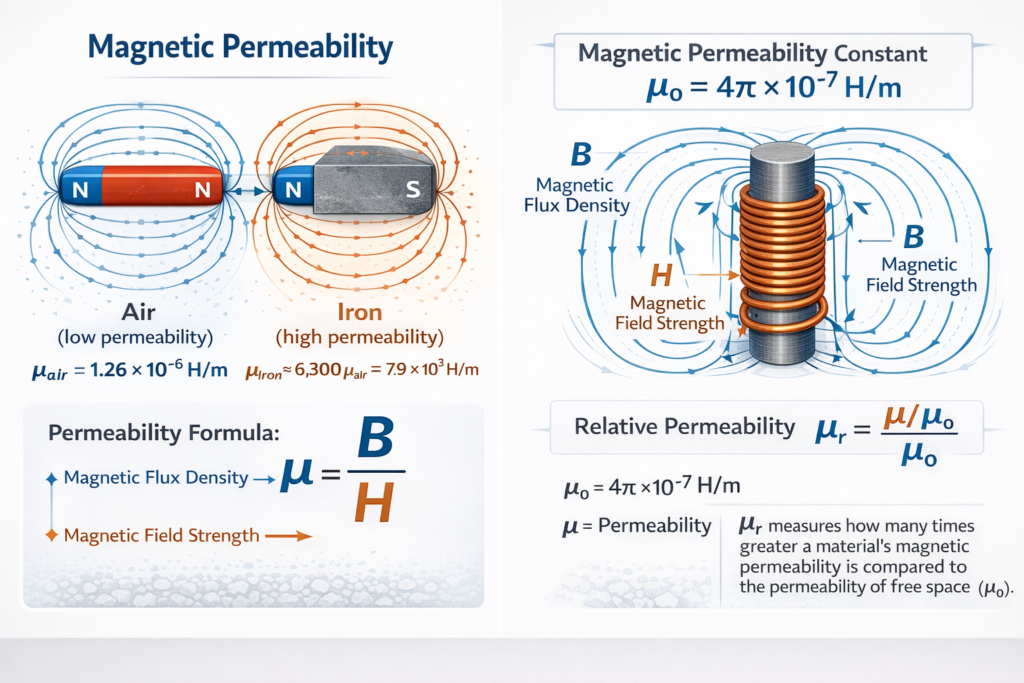
Magnetic permeability plays a fundamental role in determining how magnetic fields behave in different materials. Materials such as iron, nickel, and cobalt have very high magnetic permeability, meaning magnetic fields can pass through them easily. On the other hand, materials such as air or vacuum have very low permeability.
In physics, there are two main types of magnetic permeability: absolute permeability and relative permeability.
Absolute permeability refers to the actual permeability of a material and is measured in Henry per meter. It represents the ability of a material to support the formation of a magnetic field within itself.
Relative permeability, on the other hand, compares the permeability of a material to the permeability of free space. The permeability of free space is a universal physical constant represented as:
μ₀ = 4π × 10-7 H/m
This constant is extremely important in electromagnetic equations such as Maxwell’s equations and magnetic field calculations.
Relative permeability is calculated using the formula:
μr = μ / μ₀
Where:
μr = Relative permeability
μ = Absolute permeability
μ₀ = Permeability of free space
Relative permeability is a dimensionless quantity and indicates how much more magnetic a material is compared to vacuum.
Our online Magnetic Permeability Calculator simplifies these calculations by instantly computing values based on the inputs you provide. This tool is particularly helpful for solving physics problems related to magnetic materials, electromagnetic induction, transformer cores, inductors, and magnetic circuits.
Magnetic permeability is widely used in many areas of physics and engineering. For example, electrical engineers rely on permeability values when designing transformers, electric motors, and inductors. Materials with high permeability allow magnetic fields to concentrate more effectively, improving efficiency in electromagnetic devices.
Another important application of magnetic permeability is in shielding sensitive electronics from external magnetic interference. Special materials with high permeability can redirect magnetic field lines away from delicate circuits.
Students studying electromagnetism often encounter permeability calculations when solving problems involving magnetic flux, inductance, magnetic circuits, and magnetic materials. Instead of repeatedly applying formulas manually, using a calculator reduces errors and saves time.
This calculator is especially useful for solving textbook problems where the values of B and H are given and students need to find μ quickly.
For example, suppose a magnetic flux density of 0.8 Tesla is produced by a magnetic field strength of 400 A/m. The magnetic permeability can be calculated as:
μ = B / H
μ = 0.8 / 400
μ = 0.002 H/m
Using our Magnetic Permeability Calculator, you can obtain this result instantly without performing manual division.
Magnetic permeability is also a key concept in understanding magnetic materials. Materials are commonly classified into three categories based on their permeability:
Diamagnetic materials
Paramagnetic materials
Ferromagnetic materials
Diamagnetic materials have permeability slightly less than free space. Paramagnetic materials have slightly higher permeability than free space. Ferromagnetic materials have extremely high permeability and are strongly attracted to magnetic fields.
Ferromagnetic materials are widely used in transformers, electric motors, generators, magnetic storage devices, and inductors because they allow strong magnetic fields to be generated efficiently.
Another important concept related to permeability is magnetic reluctance, which represents resistance to magnetic flux in a magnetic circuit. Materials with higher permeability have lower magnetic reluctance, making them more efficient for electromagnetic devices.
Understanding permeability also helps explain how inductors and transformers store magnetic energy. The permeability of the core material directly affects the inductance of coils.
Physics students preparing for exams such as JEE, NEET, GATE, and university physics courses frequently encounter problems involving permeability, magnetic fields, and electromagnetic theory. Tools like this calculator help them verify answers and practice numerical problems more efficiently.
Our Magnetic Permeability Calculator is designed with simplicity and accuracy in mind. It eliminates calculation mistakes and helps users obtain instant results with correct units.
This calculator is useful for:
Physics students solving electromagnetic problems
Electrical engineering students studying magnetic circuits
Researchers analyzing magnetic materials
Teachers demonstrating electromagnetism concepts
Engineers designing electromagnetic devices
Because it works instantly online, you can access it from any device including mobile phones, tablets, and desktops.
By using this calculator, you not only save time but also improve your understanding of how magnetic fields interact with different materials.
If you frequently solve physics equations involving magnetic fields, this tool will become an essential part of your study resources.
Try the Magnetic Permeability Calculator now to instantly calculate permeability values and make your electromagnetism calculations faster, easier, and more accurate.
🌍 Applications in Daily Life ⚡
Although magnetic permeability sounds like a complex physics concept, it actually plays a role in many technologies we use every day.
⚡ Electric Motors: Electric motors used in fans, washing machines, and electric vehicles rely on magnetic materials with high permeability to efficiently convert electrical energy into mechanical motion.
🔌 Transformers: Power transformers in electricity grids use ferromagnetic cores with high magnetic permeability to transfer electrical energy efficiently between circuits.
📱 Electronics and Inductors: Inductors inside smartphones, chargers, and electronic devices depend on core materials with specific permeability values to regulate electrical signals.
🛡️ Magnetic Shielding: High-permeability materials are used to shield sensitive medical and scientific equipment from unwanted magnetic interference.
🧲 Magnetic Storage: Hard drives and magnetic memory devices rely on materials whose magnetic properties depend strongly on permeability.
🚗 Electric Vehicles: EV motors and charging infrastructure use magnetic materials with optimized permeability to improve efficiency and reduce energy losses.
⚠️ Disclaimer 📘
The Magnetic Permeability Calculator provided on this website is intended for educational and informational purposes only. While we strive to ensure high accuracy in calculations and formulas, the results generated by this tool should be used as a reference and not as a substitute for professional engineering analysis or academic verification.
Users should always double-check important physics calculations, especially when using them in research, engineering projects, or academic submissions. The formulas used in this calculator follow standard electromagnetism principles commonly taught in physics and electrical engineering.
By using this calculator, you acknowledge that the website owners are not responsible for any decisions made based on the calculated results.
📌 Related Calculator
❓FAQs 🧲
❓ What is magnetic permeability in physics?
Magnetic permeability is a physical property that measures how easily a magnetic field can pass through a material. It is represented by the symbol μ and calculated using the formula μ = B / H.
❓ What is the SI unit of magnetic permeability?
The SI unit of magnetic permeability is Henry per meter (H/m).
❓ What is the permeability of free space?
The permeability of free space is a universal constant equal to: μ₀ = 4π × 10-7 H/m
❓ What is relative permeability?
Relative permeability compares the permeability of a material to the permeability of vacuum and is calculated as: μr = μ / μ₀
❓ Why is magnetic permeability important?
Magnetic permeability determines how magnetic fields behave in materials and is crucial for designing transformers, motors, inductors, and other electromagnetic devices.
❓ Which materials have high magnetic permeability?
Ferromagnetic materials such as iron, cobalt, and nickel have very high magnetic permeability.