
🧲 Magnetic Dipole Moment Calculator
μ = N × I × A
Where:
μ = Magnetic Dipole Moment (A·m2)
N = Number of Turns
I = Current (Ampere)
A = Area of Coil (m2)
✍️ Author & Academic Authority: Dr. Nitish Kr. Bharadwaj
📘 Qualifications: B.Sc., B.Ed., M.Sc., Ph.D. (Biochemistry), MBA (Financial Management)
🧲 Magnetic Dipole Moment Calculator – Calculate Magnetic Moment of Current Loop Instantly ⚡
The Magnetic Dipole Moment Calculator is an advanced physics tool designed to help students, researchers, and educators calculate the magnetic dipole moment of a current carrying loop quickly and accurately. In electromagnetism, the magnetic dipole moment (μ) is a fundamental physical quantity that describes the strength and orientation of a magnetic source such as a current loop, bar magnet, or electron orbit.
Understanding magnetic dipole moment is essential in electromagnetism, electrical engineering, quantum physics, and applied electronics. Instead of solving equations manually, this online magnetic dipole moment calculator automates the process and provides instant, error-free results, making it perfect for physics homework, competitive exams, laboratory experiments, and conceptual learning.
The magnetic dipole moment describes how strongly a system interacts with an external magnetic field. In simple terms, it determines the torque experienced by a magnetic object placed in a magnetic field.
The standard formula used to calculate the magnetic dipole moment of a current loop is: μ = N × I × A
Where:
μ = Magnetic dipole moment
N = Number of turns in the coil
I = Electric current flowing through the coil
A = Area of the loop
The SI unit of magnetic dipole moment is Ampere square meter (A·m²).
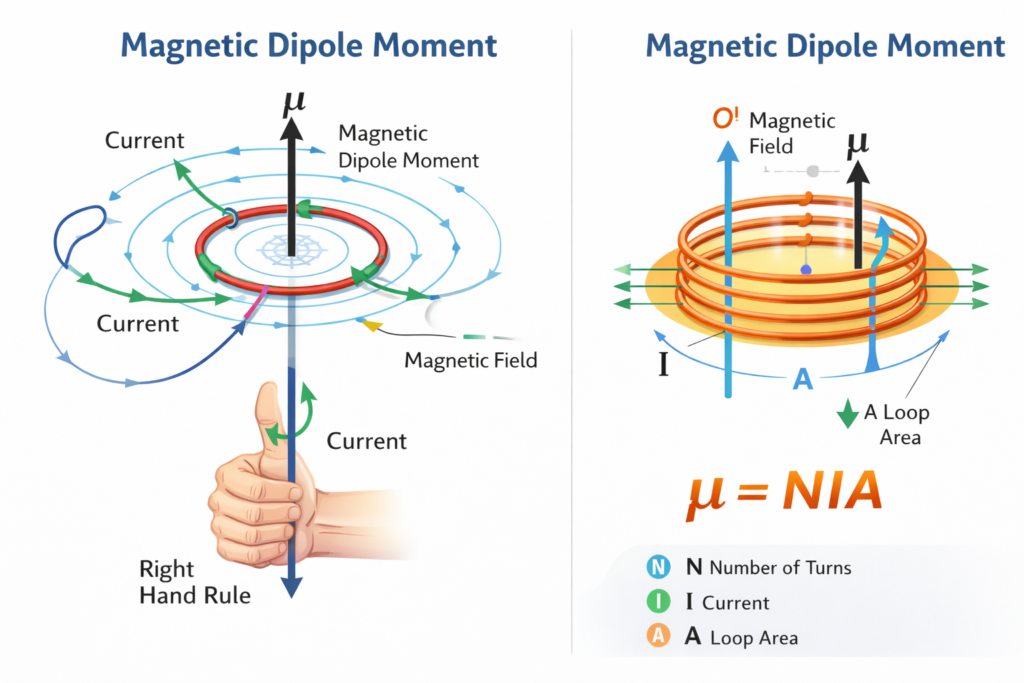
Using this Magnetic Dipole Moment Formula Calculator, users can simply input the values of current, number of turns, and loop area to obtain the magnetic moment instantly. This significantly reduces calculation errors and helps users visualize the physical behavior of electromagnetic systems.
Magnetic dipole moment plays a crucial role in understanding the interaction between electricity and magnetism, which forms the basis of modern electrical technology, motors, generators, transformers, and magnetic storage devices.
When a current flows through a circular loop of wire, it creates a magnetic field similar to that of a tiny bar magnet. This loop behaves like a magnetic dipole, and the magnetic dipole moment quantifies the strength of that dipole.
The direction of magnetic dipole moment is determined using the right-hand rule. If you curl the fingers of your right hand in the direction of current flow, your thumb points in the direction of the magnetic dipole moment vector.
This concept is widely applied in electromagnetic devices, where coils carrying electric current generate magnetic fields to perform mechanical work or transfer energy.
Magnetic dipole moment is also deeply connected with torque in magnetic fields. When a magnetic dipole is placed in a magnetic field, it experiences torque given by: τ = μB sinθ
Where:
τ = Torque
μ = Magnetic dipole moment
B = Magnetic field strength
θ = Angle between dipole and magnetic field
This relationship explains how electric motors and galvanometers operate, converting electrical energy into rotational motion.
In atomic physics, magnetic dipole moment is associated with the orbital motion of electrons and electron spin. Electrons behave like tiny magnets due to their motion around the nucleus and their intrinsic spin.
These microscopic magnetic moments combine to produce the magnetic properties of materials, such as:
• Diamagnetism
• Paramagnetism
• Ferromagnetism
This phenomenon explains why materials like iron, cobalt, and nickel become strongly magnetized.
The magnetic dipole moment equation calculator is especially useful in solving problems involving coil design, electromagnetic field strength, and magnetic torque calculations.
Many electrical devices rely on carefully designed coils with specific magnetic dipole moments to generate the required magnetic fields. Engineers frequently calculate magnetic dipole moment when designing:
• Electric motors
• Electromagnetic actuators
• Magnetic sensors
• Wireless charging coils
• Magnetic resonance systems
For example, in an electric motor, coils carrying current generate magnetic dipole moments that interact with external magnetic fields to produce torque and rotational motion.
The concept is also used in medical imaging technologies such as MRI (Magnetic Resonance Imaging). MRI scanners detect tiny magnetic dipole moments of atomic nuclei inside the human body to create detailed internal images.
Using this free Magnetic Dipole Moment Calculator, users can easily compute magnetic moment values for any coil or current loop by entering known parameters.
This tool helps simplify physics calculations and provides instant results with high accuracy, making it extremely useful for students, teachers, engineers, and physics enthusiasts.
Key advantages of using this calculator include:
⚡ Instant calculation of magnetic dipole moment
📚 Perfect for physics students and competitive exams
🔬 Useful for research and laboratory experiments
📱 Mobile-friendly educational tool
🎯 Accurate and reliable physics computation
By integrating this calculator into your workflow, you can quickly understand the behavior of magnetic systems and solve complex physics problems with ease.
Whether you are preparing for an exam, solving homework problems, or studying electromagnetism concepts, this Magnetic Dipole Moment Calculator provides a simple and efficient solution for calculating magnetic moment using the standard physics formula.
🧲 Applications in Daily Life ⚡
Magnetic dipole moment is not just a theoretical concept in physics. It has many real-world applications in modern technology and everyday devices.
⚙️ Electric Motors: Electric motors use current loops with magnetic dipole moments to generate rotational motion. The interaction between magnetic dipole moment and magnetic fields creates torque that powers appliances like fans, mixers, and washing machines.
🔋 Electric Generators: Generators operate on electromagnetic principles where coils with magnetic dipole moment rotate inside magnetic fields, converting mechanical energy into electrical energy.
📡 Magnetic Sensors: Many modern devices use magnetic dipole moment principles to detect magnetic fields in sensors used in smartphones, navigation systems, and robotics.
🧲 MRI Medical Imaging: Magnetic Resonance Imaging scanners detect magnetic dipole moments of atomic nuclei to create detailed images of organs inside the human body.
💾 Data Storage Devices: Hard drives store data using magnetized regions that behave like magnetic dipoles, allowing information to be written and retrieved magnetically.
🚗 Electric Vehicles: EV motors rely on magnetic fields generated by current loops, where magnetic dipole moment plays a crucial role in motor efficiency and performance.
⚠️ Disclaimer 📘
This Magnetic Dipole Moment Calculator is designed for educational and informational purposes only. While the calculator uses the standard magnetic dipole moment formula (μ = NIA) to provide accurate results, users should verify calculations when performing scientific research, engineering design, or laboratory experiments.
Results generated by this physics calculator depend entirely on the input values provided by the user, and minor rounding differences may occur depending on measurement precision.
For academic coursework, professional engineering work, or scientific publications, it is recommended to cross-check results using textbooks, verified formulas, or professional physics software.
📌 Related Calculator
🧲 FAQs ❓
❓ What is magnetic dipole moment in physics?
Magnetic dipole moment is a physical quantity that measures the strength and orientation of a magnetic source, such as a current loop or bar magnet. It determines how strongly the object interacts with an external magnetic field.
❓ What is the formula for magnetic dipole moment?
The standard magnetic dipole moment formula is: μ = N × I × A. Where N is the number of turns, I is the current, and A is the area of the loop.
❓ What is the SI unit of magnetic dipole moment?
The SI unit of magnetic dipole moment is Ampere square meter (A·m²).
❓ How does a current loop produce magnetic dipole moment?
When electric current flows through a closed loop, it creates a magnetic field. This loop behaves like a tiny magnet with a magnetic dipole moment proportional to current, area, and number of turns.
❓ Why is magnetic dipole moment important?
Magnetic dipole moment is important for understanding electric motors, generators, magnetic materials, electromagnetic devices, and atomic magnetic behavior.