
🧲 Hall Coefficient Calculator
R = 1 / (n × q)
Where:
R = Hall Coefficient (m3/C)
n = Charge Carrier Density (m-3)
q = Charge of Electron (C)
✍️ Author & Academic Authority: Dr. Nitish Kr. Bharadwaj
📘 Qualifications: B.Sc., B.Ed., M.Sc., Ph.D. (Biochemistry), MBA (Financial Management)
🧲 Hall Coefficient Calculator – Instantly Calculate Hall Effect Coefficient in Physics
The Hall Coefficient Calculator is a powerful physics calculator designed to help students, engineers, and researchers quickly compute the Hall coefficient (RH) of a material based on measurable physical parameters. The Hall coefficient is a fundamental concept in solid-state physics, semiconductor physics, and electrical engineering, used to determine the type, density, and behavior of charge carriers in conductive materials.
Understanding the Hall effect is crucial for studying magnetic fields, current flow, and charge carrier properties in materials. When an electric current flows through a conductor or semiconductor placed inside a magnetic field perpendicular to the current, a voltage difference develops across the conductor. This voltage is called the Hall voltage, and the phenomenon itself is known as the Hall Effect. The proportionality constant relating this voltage to the magnetic field and current is called the Hall coefficient.
Using a Hall Coefficient Calculator, users can easily compute this value without performing lengthy manual calculations. This tool is especially helpful for students studying semiconductor physics, electromagnetism, and materials science, as well as professionals working in electronics research and device engineering.
The Hall coefficient provides important insights into the electrical properties of materials. One of its primary uses is determining whether a material is dominated by negative charge carriers (electrons) or positive charge carriers (holes). If the Hall coefficient is negative, electrons are the dominant carriers; if positive, holes dominate. This distinction is extremely important in the development of semiconductor devices like transistors, integrated circuits, and sensors.
The Hall effect was discovered by Edwin Hall in 1879, and it remains one of the most widely used experimental methods for studying electrical conduction in solids. Today, Hall effect measurements are widely used in laboratories and industries to determine parameters such as carrier concentration, mobility, conductivity, and magnetic field strength.
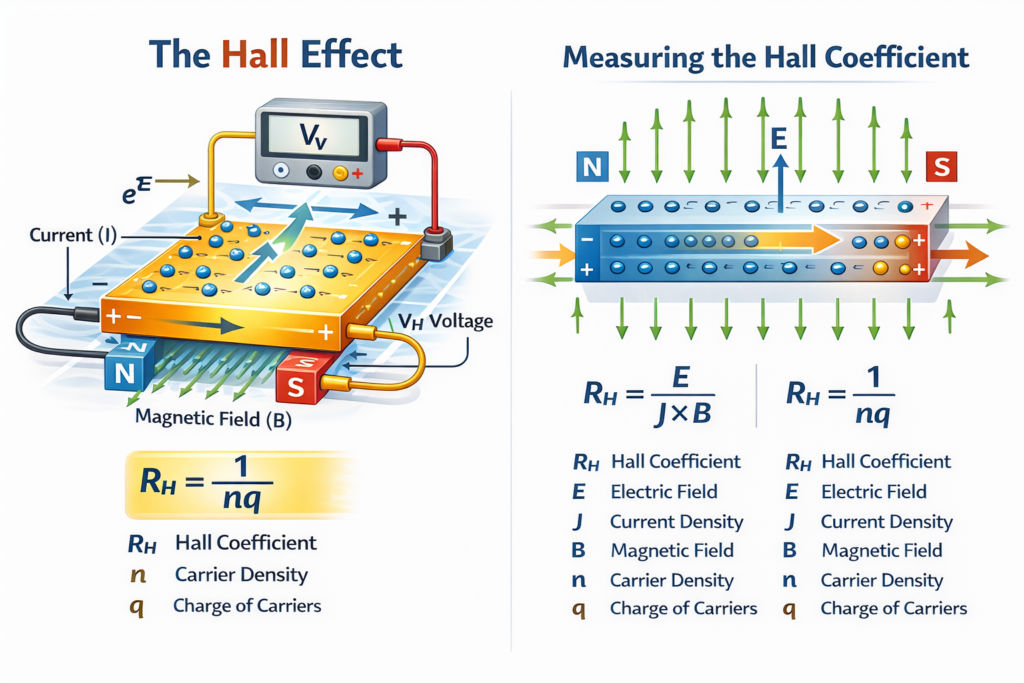
With the help of an online Hall Effect Calculator, users can calculate the Hall coefficient quickly by entering known values like charge carrier density and charge magnitude. Many advanced calculators also allow calculations using alternative forms of the equation, such as:
RH = E / (J × B)
Where:
E = electric field strength
J = current density
B = magnetic field
This flexibility allows students and professionals to solve physics problems efficiently using different sets of known variables.
Another major benefit of a Hall coefficient calculator online is improved accuracy. Manual calculations involving scientific notation such as 10-19 can easily lead to errors. Automated calculators remove this risk and deliver instant, precise results, making them ideal for homework, physics assignments, research calculations, and engineering applications.
In semiconductor physics, measuring the Hall coefficient helps determine carrier mobility and doping levels. Semiconductor manufacturers rely heavily on Hall measurements to analyze materials like silicon, gallium arsenide, and germanium. By calculating the Hall coefficient, engineers can evaluate whether a semiconductor is n-type or p-type, which is essential for designing electronic devices.
The Hall Coefficient Calculator is also widely used in academic environments. Physics students often encounter Hall effect problems in courses related to electromagnetism, solid-state physics, and electronics. Using this calculator allows them to verify solutions quickly and understand the relationship between magnetic fields, electric current, and voltage generation.
Another advantage of this tool is its educational value. Many learners struggle to understand the Hall effect because it involves multiple physical concepts simultaneously. A calculator tool simplifies the computational part so users can focus on understanding the physical meaning of the Hall coefficient and how it reflects microscopic properties of materials.
Furthermore, Hall effect measurements are used in many modern technologies. Devices such as Hall sensors, current sensors, and magnetic field detectors rely on the Hall coefficient principle. These sensors are widely used in automotive systems, smartphones, industrial automation, and robotics.
For example, Hall effect sensors are commonly used in vehicles to detect wheel speed, crankshaft position, and engine timing. Similarly, smartphones use Hall sensors to detect magnetic covers and enable automatic screen on/off functionality. All these technologies rely on accurate knowledge of the Hall effect and Hall coefficient.
Using a Hall coefficient formula calculator simplifies the entire process of solving physics problems related to the Hall effect. Instead of performing complicated calculations manually, users simply input the required variables and receive the result instantly. This makes the tool ideal for students preparing for exams, teachers demonstrating concepts, and engineers performing quick estimations.
In addition to convenience, online calculators improve accessibility to scientific tools. Students from anywhere in the world can use a free Hall coefficient calculator without installing specialized software. This democratizes access to physics learning resources and supports better understanding of advanced concepts.
From a learning perspective, this calculator also helps users explore how changing variables affects the Hall coefficient. By experimenting with different values of carrier concentration or charge, students can gain deeper insight into the behavior of materials under magnetic fields.
Overall, the Hall Coefficient Calculator is an essential tool for anyone studying or working with electromagnetism, semiconductor physics, and material science. It provides quick, accurate results while reinforcing the understanding of one of the most important concepts in modern physics.
Whether you are solving homework problems, conducting laboratory experiments, or analyzing semiconductor materials, this calculator allows you to compute Hall coefficients instantly and reliably.
🌍 Applications in Daily Life ⚡
Although the Hall effect originates from physics laboratories, it has many real-world applications in everyday technology.
🚗 Automotive Sensors: Modern vehicles use Hall effect sensors to detect wheel rotation, crankshaft position, and engine speed. These sensors rely on the Hall coefficient principle to measure magnetic field changes accurately.
📱 Smartphones and Smart Devices: Many smartphones use Hall sensors to detect magnetic flip covers. When the cover closes, the phone screen automatically turns off.
⚙️ Industrial Automation: Factories use Hall sensors for contactless position detection, current sensing, and motor control systems.
🔌 Current Measurement Devices: Hall effect technology allows engineers to measure electric current without physically touching the conductor, improving safety and efficiency.
🧭 Magnetic Field Detection: Scientific instruments and navigation tools use Hall sensors to measure magnetic field strength precisely.
🤖 Robotics and Motion Detection: Robots rely on Hall sensors to detect motor speed and movement for accurate automation.
⚠️ Disclaimer
This Hall Coefficient Calculator is designed primarily for educational and academic use. The results generated by this tool are based on the standard Hall coefficient formula RH = 1/(n × q) and assume ideal conditions.
🔬 Real-world materials may exhibit additional complexities such as temperature dependence, multiple charge carriers, and material imperfections. Therefore, results should be used as approximate values for learning, homework, and conceptual understanding.
📚 For professional laboratory measurements or research experiments, users should verify results using precise experimental methods and calibrated scientific instruments.
📌 Related Calculator
❓FAQs
❓ What is the Hall coefficient in physics?
The Hall coefficient is a physical constant that describes the relationship between the Hall voltage, magnetic field, and current density in a conductor or semiconductor.
❓ What is the formula for calculating the Hall coefficient?
The most common formula is: RH = 1 / (n × q). where n is carrier concentration and q is the charge of the carrier.
❓ Why is the Hall coefficient important in semiconductors?
It helps determine whether the semiconductor is n-type or p-type and provides information about charge carrier density and mobility.
❓ Can the Hall coefficient be negative?
Yes. A negative Hall coefficient indicates electrons are the dominant charge carriers, while a positive value indicates holes.
❓ What devices use the Hall effect principle?
Devices such as Hall sensors, current sensors, magnetic field detectors, and automotive speed sensors rely on the Hall effect.
❓ Who discovered the Hall effect?
The Hall effect was discovered by Edwin Hall in 1879 while studying magnetic effects in conductors.