
⚡ Coulomb’s Law Calculator
🎯 Best Physics Calculator for Students
✍️ Author & Academic Authority: Dr. Nitish Kr. Bharadwaj
📘 Qualifications: B.Sc., B.Ed., M.Sc., Ph.D. (Biochemistry), MBA (Financial Management)
⚡ Coulomb’s Law Calculator – Complete Guide to Electrostatic Force Between Charges
Coulomb’s Law is one of the most fundamental principles in physics that explains how electrically charged particles interact with each other. Whether you are preparing for competitive exams like JEE, NEET, SAT, engineering entrance tests, or simply trying to understand electrostatics for school assignments, mastering Coulomb’s Law is absolutely essential. 🚀
The mathematical expression of Coulomb’s Law is: F = k × |q₁ × q₂| / r²
Where:
- F = Electrostatic Force (in Newtons)
- q₁ and q₂ = Electric charges (in Coulombs)
- r = Distance between charges (in meters)
- k = Coulomb’s constant = 8.9875517923 × 10⁹ N·m²/C²
This equation tells us that the force between two charges is directly proportional to the product of their magnitudes and inversely proportional to the square of the distance between them. 📏
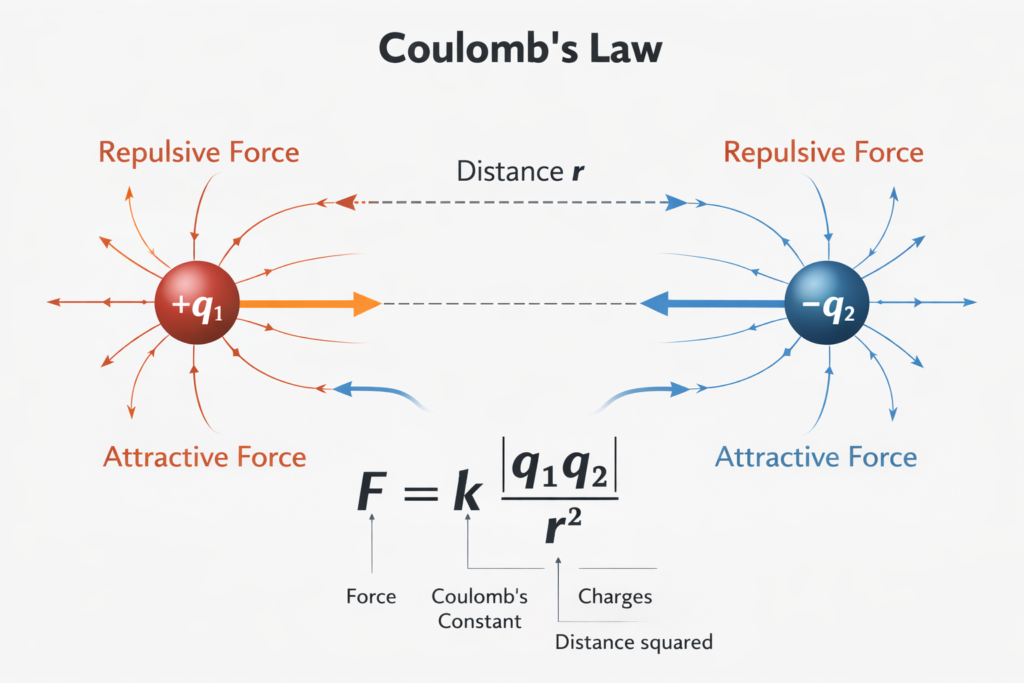
This means:
🔹 If charges increase → Force increases
🔹 If distance increases → Force decreases rapidly
🔹 If charges are opposite → Force is attractive
🔹 If charges are same → Force is repulsive
Our Coulomb’s Law Calculator simplifies complex physics calculations by instantly computing the electrostatic force using exact scientific exponent format like: 1.23 × 10⁻⁵ N
This format is extremely important for students because electrostatic forces often involve very small or very large numbers. Standard decimal format can become confusing, especially in exam settings. 🎯
Understanding Coulomb’s Law is the foundation of:
⚡ Electric field concepts
⚡ Electric potential
⚡ Capacitors
⚡ Atomic structure
⚡ Electromagnetism
⚡ Electrostatic energy
⚡ Force interactions inside atoms
The law was discovered by French physicist Charles-Augustin de Coulomb in 1785 using a torsion balance experiment. His experimental work proved that electric force follows an inverse square relationship, similar to Newton’s Law of Gravitation.
This similarity is not accidental. Both gravitational and electric forces follow inverse square laws. However, electric forces are significantly stronger than gravitational forces at atomic scales.
For example:
Two protons separated by a small distance experience electric repulsion much stronger than their gravitational attraction.
This is why electrostatic forces dominate atomic and molecular interactions. 🔬
Students often struggle with:
❌ Handling powers of 10
❌ Squaring small distances
❌ Converting microcoulombs to coulombs
❌ Maintaining unit consistency
That is why this calculator is designed to output answers in scientific notation with correct exponent formatting (1.00 × 10ⁿ). It prevents rounding mistakes and improves conceptual clarity.
If you are preparing for:
📘 CBSE Class 12 Physics
📘 ICSE Board Exams
📘 JEE Main & Advanced
📘 NEET
📘 Engineering Entrance Exams
📘 University Physics Courses
Then mastering Coulomb’s Law is non-negotiable.
This tool helps you:
✔ Instantly calculate force
✔ Avoid manual exponent mistakes
✔ Understand the formula structure
✔ Visualize mathematical relationships
✔ Improve problem solving speed
In advanced physics, Coulomb’s Law forms the base of:
⚡ Gauss’s Law
⚡ Maxwell’s Equations
⚡ Electrostatic Potential Energy
⚡ Electric Flux
It is also used in real-world applications such as semiconductor design, capacitor manufacturing, electrostatic precipitators, laser printing technology, and electrostatic spray painting.
Understanding electrostatic force also helps explain lightning ⚡, static electricity shocks, dust attraction on screens, and how photocopiers work.
In summary, Coulomb’s Law is not just an academic formula. It is the backbone of classical electromagnetism and modern electrical engineering.
Using this Coulomb’s Law Calculator regularly will significantly improve your numerical solving speed, conceptual clarity, and exam accuracy.
⚛️ APPLICATIONS IN DAILY LIFE
⚡ Static electricity shocks
⚡ Lightning formation
⚡ Laser printers & photocopiers
⚡ Capacitors in mobile phones
⚡ Semiconductor chips
⚡ Electrostatic air purifiers
⚡ Spray painting technology
⚡ Particle accelerators
⚡ Atomic bonding understanding
Coulomb’s Law helps engineers design electrical circuits and helps scientists understand molecular structures. 🧪
⚠️ DISCLAIMER
This Coulomb’s Law Calculator is designed for educational and academic use only. Results are computed based on standard physical constants and mathematical formulas. Always verify calculations during professional engineering design, laboratory research, or safety-critical applications. This tool does not replace certified scientific instrumentation or professional consultation.
❓ FAQs
Q1: What is Coulomb’s Law in physics?
Coulomb’s Law defines the electrostatic force between two electric charges.
Q2: What is the exact value of Coulomb’s constant?
k = 8.987552 × 10⁹ N·m²/C².
Q3: Why is force inversely proportional to r²?
Because electric force follows inverse square law due to spatial distribution in 3D space.
Q4: Is Coulomb’s Law similar to gravitational law?
Yes, both follow inverse square law, but electric force is much stronger.
Q5: Does Coulomb’s Law work for large distances?
It works accurately for point charges and spherically symmetric distributions.