
⚡ Speed of Electron Calculator
Instantly Calculate Electron Velocity | Physics Exam Ready Tool for Students
✍️ Author & Academic Authority: Dr. Nitish Kr. Bharadwaj
📘 Qualifications: B.Sc., B.Ed., M.Sc., Ph.D. (Biochemistry), MBA (Financial Management)
⚡🔬 Speed of Electron Calculator – Complete Physics Guide
The Speed of Electron Calculator is an essential physics tool designed for students, researchers, engineers, and competitive exam aspirants preparing for JEE, NEET, SAT Physics, CBSE Board Exams, and university-level atomic physics. Understanding electron velocity is fundamental in atomic structure, electromagnetism, quantum mechanics, semiconductor physics, and electrical engineering.
An electron is a subatomic particle with a mass of 9.11 × 10⁻³¹ kg and charge of −1.602 × 10⁻¹⁹ C. Because electrons are extremely light, even small amounts of energy cause them to move at very high speeds ⚡. In fact, in hydrogen’s first Bohr orbit, the electron moves at approximately 2.18 × 10⁶ m/s — which is nearly 1% the speed of light 🚀.
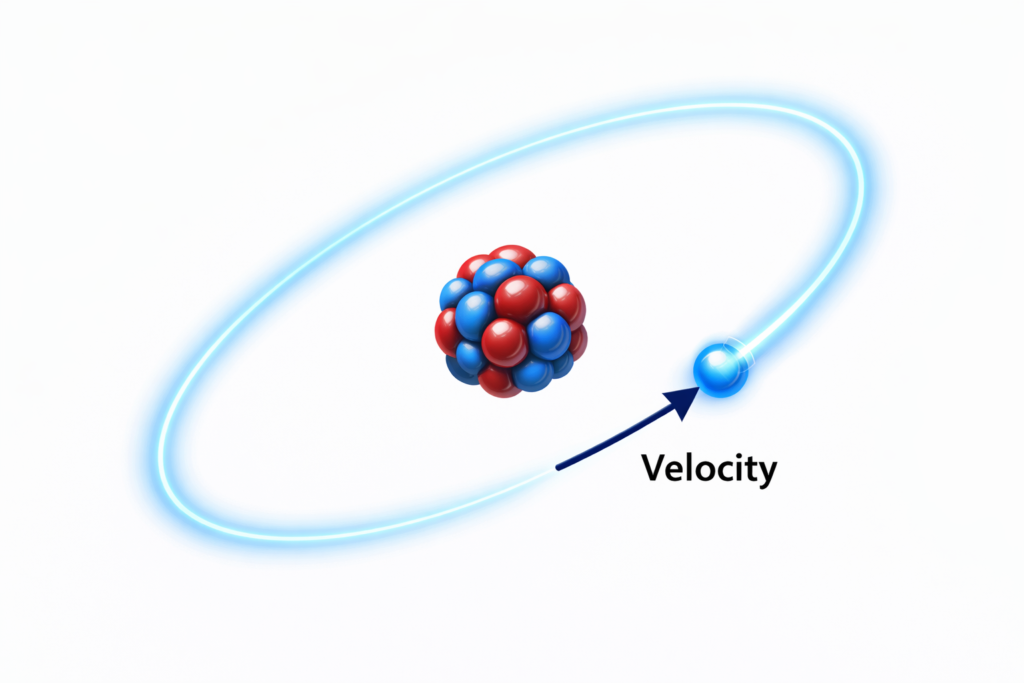
There are three primary ways to calculate the speed of an electron:
🔹 1️⃣ From Kinetic Energy: When the kinetic energy (KE) is known, we use classical mechanics: v = √(2KE / m)
This formula comes from rearranging KE = ½mv². This method is frequently used in atomic collision problems and spectroscopy experiments.
🔹 2️⃣ From Accelerating Voltage: When an electron is accelerated through a potential difference V, it gains energy equal to eV. Therefore: v = √(2eV / m)
This is widely used in cathode ray tubes, electron microscopes, vacuum tubes, and particle accelerators.
🔹 3️⃣ From Bohr Model: For hydrogen-like atoms: v = (2.18 × 10⁶) / n
Where n is the principal quantum number. This formula is derived from balancing centripetal force and Coulomb attraction.
Electron speed calculations are vital in understanding:
• Atomic radius
• Ionization energy
• Spectral lines
• Quantum transitions
• Semiconductor current flow
• Electron beam devices
In modern technology 💻, electron velocity determines transistor switching speed, LED efficiency, solar panel performance, and even CPU clock frequency.
The Speed of Electron Calculator simplifies complex physics equations into instant, scientifically formatted results. Instead of manually converting values into exponent form, students receive exact outputs like: 1.45 × 10⁷ m/s
This scientific notation format is critical for board exams and competitive exams because answers must be expressed precisely.
Moreover, electron velocity becomes relativistic when approaching 10% the speed of light. In such cases, classical formulas require relativistic correction from Einstein’s Special Theory of Relativity.
This tool enhances conceptual clarity, numerical accuracy, and exam preparation speed — making it an indispensable academic physics calculator.
🌍 Applications in Daily Life ⚡
• 📺 Cathode Ray Tubes & Displays
• 🔬 Electron Microscopes
• 💡 LED & Semiconductor Devices
• ⚙️ Electric Motors & Generators
• ☀️ Solar Panels
• 💻 Microprocessors & Computer Chips
• 📡 Communication Systems
• ⚡ Power Transmission Systems
Electron speed directly impacts electricity flow, resistance heating, and circuit efficiency.
⚠️ Disclaimer
This Speed of Electron Calculator provides physics-based results using standard classical equations. 🚨 For relativistic speeds approaching the speed of light, relativistic corrections must be applied. Results are intended for educational, academic, and conceptual purposes only. Always verify critical engineering calculations independently.
❓FAQs
❓ What is the formula for speed of an electron?
v = √(2KE/m) or v = √(2eV/m)
❓ What is electron speed in hydrogen atom?
2.18 × 10⁶ m/s in first orbit.
❓ Does electron move at speed of light?
No 🚫 — electrons with mass cannot reach light speed.
❓ Why is electron speed important in physics?
It determines atomic stability, spectral lines, and electrical current.
❓ Is electron speed constant?
No — it depends on energy level and applied voltage.