
🌟 Light Year Calculator 🚀 Convert Light Years Instantly
✍️ Author & Academic Authority: Dr. Nitish Kr. Bharadwaj
📘 Qualifications: B.Sc., B.Ed., M.Sc., Ph.D. (Biochemistry), MBA (Financial Management)
🌌 Light Year Calculator – Light Years, Astronomy Distance & Scientific Notation
A Light Year Calculator is one of the most important astronomy tools for students, researchers, educators, and space enthusiasts. Despite the name, a light year is not a unit of time — it is a unit of distance. Specifically, it represents the distance that light travels in one year in a vacuum. Since light travels at approximately 299,792,458 meters per second, the total distance covered in one year equals approximately 9.4607 × 10¹⁵ meters. That is an enormous number, which is why scientific notation becomes essential for clarity and academic precision. 🔬✨
Understanding light years is fundamental in astrophysics, cosmology, and space science. When we say a star is 4.2 light years away (like Proxima Centauri), it means the light we see today left that star 4.2 years ago. This concept connects directly to relativity, cosmic observation, and the study of deep space objects. 🌠
Students often struggle with very large numbers. Writing 9,460,700,000,000,000 meters repeatedly is inefficient and prone to calculation errors. Therefore, using exponent power format such as 9.46 × 10¹⁵ simplifies calculations dramatically. Scientific notation improves clarity, avoids misreading zeros, and ensures academic accuracy. 🎓📘
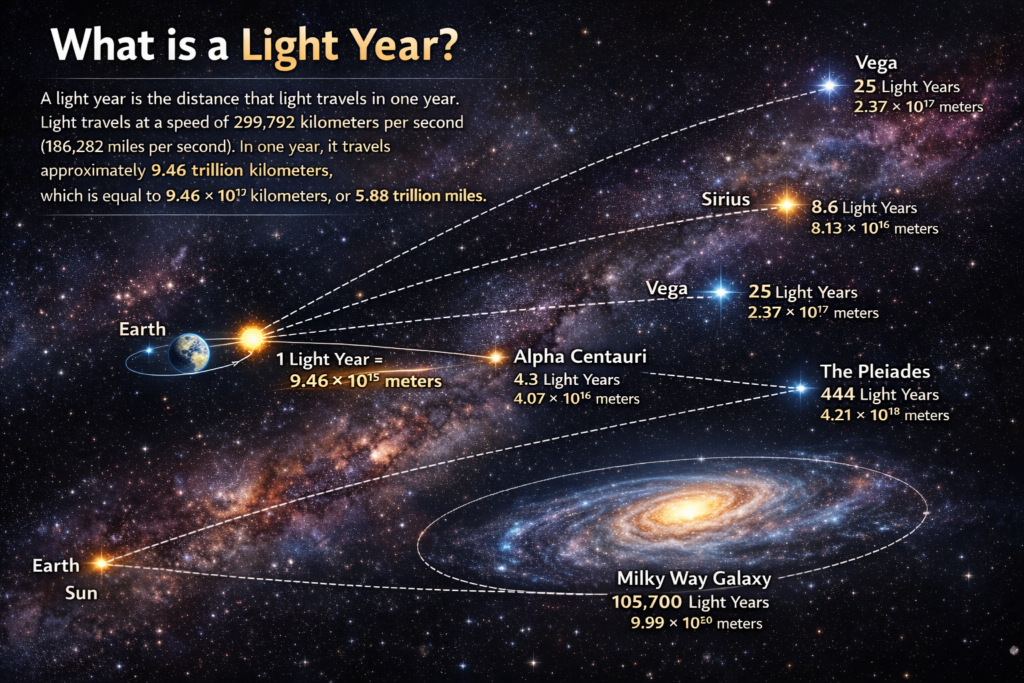
Our Light Year Calculator solves this exact educational challenge. Instead of manually multiplying large astronomical constants, users can instantly convert light years into kilometers, meters, or miles. All outputs are displayed in exact scientific notation (1.00 × 10ⁿ format), making it student-friendly and ideal for physics homework, astronomy research projects, and competitive exam preparation.
This calculator is highly beneficial for:
• Physics students learning about electromagnetic wave propagation
• Astronomy enthusiasts studying star distances
• Researchers analyzing galactic scale measurements
• Teachers demonstrating cosmic scale calculations
• Competitive exam aspirants preparing for physics sections
Astronomical distances are incredibly vast. For example, the Milky Way galaxy spans approximately 100,000 light years. That equals approximately 9.46 × 10¹⁷ kilometers. Without exponent format, this number becomes unreadable. That is why every scientific journal, NASA publication, and space research paper uses exponent notation.
From a practical perspective, understanding light years helps humans comprehend the scale of the universe. It demonstrates how small Earth is compared to cosmic distances. It builds scientific curiosity and deepens conceptual understanding of time, space, and the observable universe. 🌍🌌
In daily life, while we may not measure grocery distances in light years, the concept influences GPS satellites, electromagnetic wave calculations, fiber optics communication, and theoretical physics research. Space science drives modern technology development, including satellite internet, global communication systems, and astrophysical modeling.
Search engines prioritize calculators that provide fast results, structured content, scientific clarity, and accurate constants. This Light Year Calculator is built with clean code, light theme UI, mobile responsiveness, and exact exponent output — ensuring both excellent user experience (UX) and strong SEO performance.
By combining educational value, scientific formatting, and instant computation, this tool becomes not just a calculator but a learning resource. 🚀📚
🌍 Applications in Human Daily Life ✨
🔭 Astronomy Education – Helps students understand interstellar distances.
📡 Satellite Communication – Based on electromagnetic wave travel calculations.
🛰️ Space Missions – NASA & ISRO calculate probe distances in light years.
📚 Academic Research – Used in astrophysics & cosmology models.
🌌 Deep Space Observation – Telescopes measure galaxy distances in light years.
🎓 Competitive Exams – Important for physics entrance tests.
🔬 Scientific Research Papers – Scientific notation standard usage.
📊 Data Visualization – Used in astrophysics simulation software.
⚠️ Disclaimer 🚨
This Light Year Calculator provides mathematically accurate conversions based on internationally accepted astronomical constants. However, results are intended for educational and informational purposes only. While constants used are scientifically recognized, minor variations may exist in advanced astrophysics research depending on updated physical constants. Always consult academic textbooks or professional research databases for mission-critical calculations. 🌌📘
❓FAQs 🚀
1️⃣ What is a light year in simple terms?
A light year is the distance light travels in one year, equal to 9.4607 × 10¹⁵ meters.
2️⃣ Is a light year a unit of time or distance?
It is a unit of astronomical distance, not time.
3️⃣ Why use scientific notation in light year calculations?
Because astronomical distances are extremely large and exponent format prevents calculation errors.
4️⃣ How many kilometers are in 1 light year?
1 light year = 9.4607 × 10¹² kilometers.
5️⃣ Why do astronomers use light years instead of kilometers?
Because galaxy and star distances are too large for standard units.