
🌟 Luminosity Calculator 🌟 Calculate Stellar Brightness Instantly 🧠
Formula Used:
Where:
L = Luminosity (Watts)
R = Radius of Star (meters)
σ = 5.670374419 × 10⁻⁸ W·m⁻²·K⁻⁴
T = Surface Temperature (Kelvin)
✍️ Author & Academic Authority: Dr. Nitish Kr. Bharadwaj
📘 Qualifications: B.Sc., B.Ed., M.Sc., Ph.D. (Biochemistry), MBA (Financial Management)
🌟 Luminosity Calculator – Complete Guide to Stellar Brightness, Stefan–Boltzmann Law & Astrophysics Calculations 🚀
Luminosity is one of the most important concepts in astrophysics and stellar physics 🌌. When scientists talk about how bright a star truly is, they refer to its luminosity, not just how bright it appears from Earth. The Luminosity Calculator helps students, researchers, astronomy enthusiasts, and competitive exam aspirants calculate stellar luminosity using the powerful Stefan–Boltzmann Law equation:
L = 4πR²σT⁴
Where L represents total energy output per second in Watts 🔆.
Unlike apparent brightness, luminosity is an intrinsic property of a star 🌟. It depends only on two physical parameters: radius and surface temperature. That’s why understanding stellar luminosity is crucial in astronomy, space science, astrophysics research, cosmology, and even NASA-level star classification systems 🚀.
The Stefan–Boltzmann constant (σ = 5.670374419 × 10⁻⁸ W·m⁻²·K⁻⁴) connects temperature and radiated energy. Since temperature is raised to the fourth power (T⁴), even a small increase in temperature dramatically increases luminosity 🔥. This explains why blue stars are significantly more luminous than red stars.
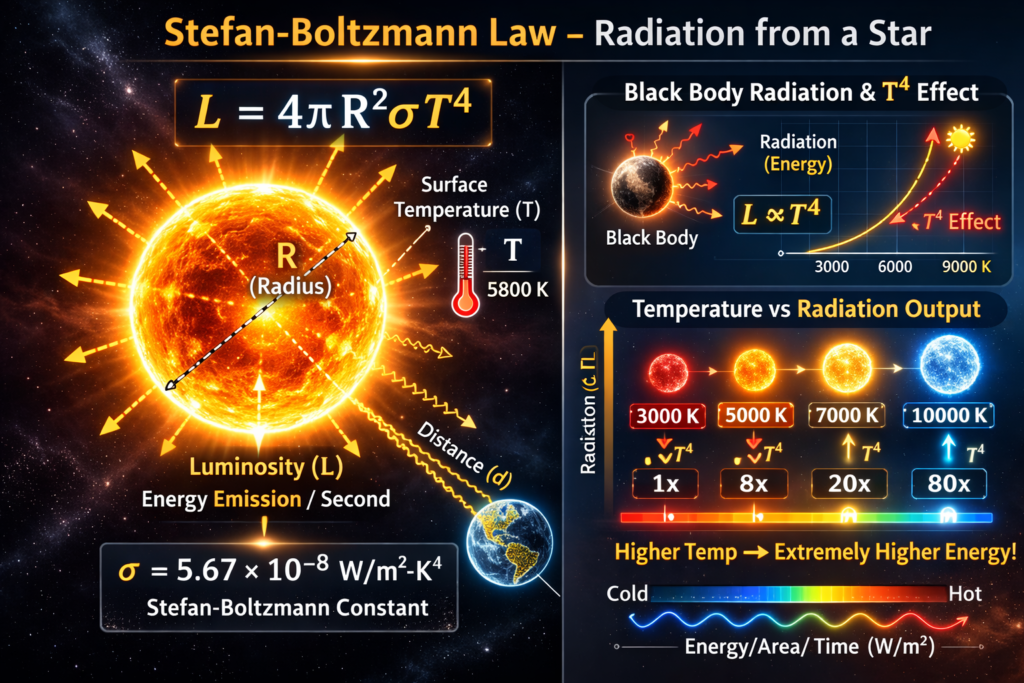
For example, our Sun ☀️ has: Radius ≈ 6.96 × 10⁸ m, Temperature ≈ 5778 K
Using the Luminosity Formula: L = 4π(6.96 × 10⁸)² × (5.67 × 10⁻⁸) × (5778)⁴
The result equals approximately: 3.83 × 10²⁶ Watts
That means the Sun produces 3.83 × 10²⁶ joules of energy every second — an unimaginable energy output ⚡.
This Luminosity Calculator is specially designed for:
✔ Physics students
✔ JEE / NEET aspirants
✔ Astronomy learners
✔ University-level astrophysics studies
✔ Space science projects
It provides output strictly in scientific notation format (1.00 × 10^n), which is academically accepted in physics calculations 📘.
Understanding luminosity also helps explain:
🌌 Hertzsprung–Russell Diagram
🌡 Stellar classification (O, B, A, F, G, K, M stars)
🪐 Life cycle of stars
💥 Supernova explosions
🌑 Black hole formation
When a star expands into a red giant, its radius increases massively. Since luminosity depends on R², even if temperature decreases, the overall luminosity can still increase significantly.
This calculator eliminates manual calculation errors and ensures precision. It is optimized for students who need exact exponent output for assignments and competitive exams.
From a scientific standpoint, luminosity determines:
• Habitable zones around stars
• Planet temperature conditions
• Stellar energy emission rate
• Radiation pressure
Without luminosity calculations, modern astrophysics would not exist.
🌍 Applications in Daily Life
Although luminosity sounds like pure astrophysics, it impacts daily life in many hidden ways:
🌞 Solar energy research
🔋 Renewable energy calculations
🛰 Satellite temperature design
🌡 Climate modeling
🧪 Radiation heat transfer studies
🏭 Industrial furnace design
💡 LED and lighting technology
🚀 Space mission engineering
Solar panel efficiency depends on understanding solar luminosity ☀️. Climate scientists use solar radiation models derived from luminosity equations 🌍.
Even thermal camera technology works on radiation principles derived from Stefan–Boltzmann Law 🔥.
⚠️ DISCLAIMER
This Luminosity Calculator is designed for educational and academic purposes only 📚. Results are based on the Stefan–Boltzmann radiation law and assume ideal black-body conditions. Real astronomical objects may deviate slightly due to atmospheric absorption, stellar composition variations, or observational limitations 🔬. Always consult academic textbooks or professional astrophysics resources for research-level precision. 🚀
❓FAQs
🌟 What is Luminosity in Physics?
Luminosity is the total energy emitted by a star per second, measured in Watts.
🔥 What is the formula for Luminosity?
L = 4πR²σT⁴
☀️ What is the luminosity of the Sun?
Approximately 3.83 × 10²⁶ Watts.
🌌 Why is temperature raised to power 4?
Because radiant energy follows Stefan–Boltzmann radiation law.
📘 Why use scientific notation?
Because stellar energy values are extremely large and easier to express in exponent format.