
🔥 Thermal Stress Calculator
σ = E × α × ΔT
Where:
σ = Thermal Stress (Pa)
E = Young’s Modulus (Pa)
α = Coefficient of Thermal Expansion (1/°C)
ΔT = Change in Temperature (°C)
✍️ Author & Academic Authority: Dr. Nitish Kr. Bharadwaj
📘 Qualifications: B.Sc., B.Ed., M.Sc., Ph.D. (Biochemistry), MBA (Financial Management)
🔥 Thermal Stress Calculator – Best Tool for Engineering & Physics Students
Thermal stress is one of the most important concepts in engineering mechanics, material science, and physics. Whenever a material experiences a temperature change 🌡, it expands or contracts. But if that material is restricted or fixed, internal stress develops inside it. This stress is known as thermal stress.
The formula used in this calculator is:
σ = E × α × ΔT
Where:
σ = Thermal Stress
E = Young’s Modulus
α = Coefficient of Thermal Expansion
ΔT = Temperature Change
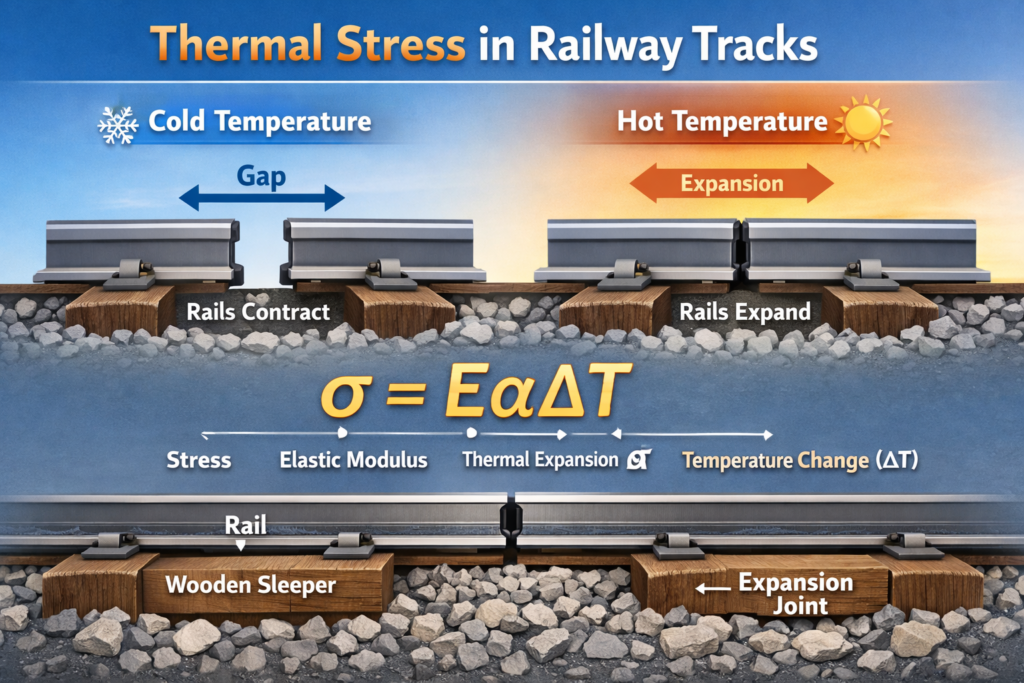
When temperature increases, materials try to expand 🔥. If prevented from expansion (like railway tracks, bridges, or concrete walls), stress builds internally. Similarly, when temperature decreases ❄, contraction creates tensile stress.
Understanding thermal stress is extremely important in:
• Civil Engineering 🏗
• Mechanical Engineering ⚙
• Aerospace Engineering ✈
• Structural Design
• Manufacturing Industry
• Power Plants
If thermal stress is not considered during design, structures may crack, bend, or fail catastrophically.
For example:
Railway tracks are built with expansion gaps 🚆
Bridges use expansion joints 🌉
Pipelines include flexibility loops 🛢
Buildings consider seasonal temperature changes 🏢
Young’s modulus (E) represents stiffness of material. A higher value means more stress will develop for the same temperature change.
The coefficient of thermal expansion (α) tells how much a material expands per degree temperature rise. Aluminum has higher α than steel, so aluminum expands more.
Temperature difference (ΔT) is the driving factor. The larger the temperature change, the larger the thermal stress.
Our Thermal Stress Calculator helps students:
✔ Solve physics numerical problems
✔ Prepare for exams
✔ Understand real-life engineering design
✔ Get exact scientific notation output
We express answers in exponent format (like 1.23 × 10⁸ Pa) to match scientific standards and engineering notation.
This is extremely useful for:
• Competitive exams 🎯
• Board exams 📘
• Engineering semesters
• GATE preparation
• UPSC Engineering Services
• Diploma students
Thermal stress can be:
• Compressive Stress
• Tensile Stress
If expansion is prevented → compressive stress
If contraction is prevented → tensile stress
Ignoring thermal stress may cause:
❌ Structural cracks
❌ Buckling
❌ Joint failure
❌ Leakage in pipelines
❌ Material fatigue
That’s why thermal stress calculation is critical in real-world safety design.
✅ Applications in Daily Life
🌉 Bridges use expansion joints to prevent thermal stress damage.
🚆 Railway tracks include small gaps for thermal expansion.
🏢 Concrete buildings are designed considering seasonal temperature variation.
🚗 Engine components experience thermal stress during heating & cooling cycles.
✈ Aircraft wings expand at high altitude temperature changes.
🛢 Oil pipelines face thermal stress due to temperature difference in fluids.
⚡ Power plants deal with boiler thermal stress.
🔩 Mechanical shafts experience thermal stress under high-speed rotation.
Thermal stress engineering design prevents accidents and ensures safety.
⚠️Disclaimer
This Thermal Stress Calculator is for educational and academic purposes only. While formulas used are scientifically accurate, results should not replace professional structural engineering analysis. Always consult a licensed engineer for real-world construction or industrial applications. Use responsibly for learning and exam preparation only.
✅ FAQs
❓ What is thermal stress in physics?
Thermal stress is internal stress generated when a material undergoes temperature change but expansion or contraction is restricted.
❓ What is the formula for thermal stress?
σ = E × α × ΔT
❓ What are the units of thermal stress?
Pascals (Pa) or N/m².
❓ Why is thermal stress important in civil engineering?
Because bridges, buildings, and roads experience temperature variation daily.
❓ What happens if thermal stress is ignored?
Cracking, structural failure, buckling, or collapse.
❓ Is thermal stress tensile or compressive?
It can be both depending on expansion or contraction restriction.