
🧬 DNA Concentration Calculator
Concentration = A260 × Factor × Dilution Factor
Where:
dsDNA = 50 µg/mL
ssDNA = 33 µg/mL
RNA = 40 µg/mL
Table of Contents
✍️ Author & Academic Authority: Dr. Nitish Kr. Bharadwaj
📘 Qualifications: B.Sc., B.Ed., M.Sc., Ph.D. (Biochemistry), MBA (Financial Management)
🧬 DNA Concentration Calculator - Introduction
🧪 – Accurate DNA Quantification in Seconds📊
DNA concentration plays a critical role in modern biology, molecular research, clinical diagnostics, and biotechnology workflows. Whether you are working in a research lab, performing PCR amplification, sequencing DNA, or conducting genetic analysis, knowing the exact DNA concentration is essential for achieving reliable and reproducible results. This DNA Concentration Calculator is a powerful and user-friendly online tool designed to help students, researchers, and professionals instantly calculate DNA concentration using standard absorbance values such as A260.
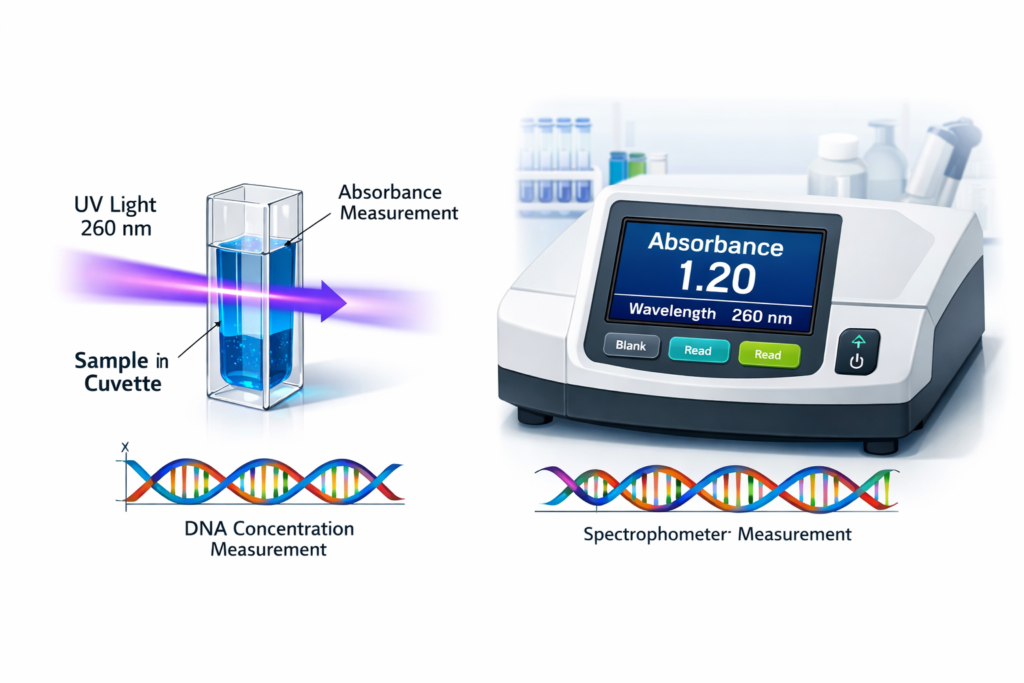
DNA quantification is most commonly performed using spectrophotometry, where absorbance at 260 nm (A260) is used to determine nucleic acid concentration. The standard conversion factor widely used is:
👉 1 A260 = 50 µg/mL for double-stranded DNA (dsDNA)
Using this formula, the DNA concentration can be calculated quickly and accurately:
DNA Concentration (µg/mL) = A260 × Dilution Factor × 50
This calculator eliminates manual calculation errors and provides instant results, making it an essential tool for laboratories, students, and educators. It also helps ensure that downstream applications such as PCR, cloning, sequencing, and electrophoresis are performed with optimal DNA input concentrations.
One of the major challenges faced by researchers is maintaining DNA purity along with concentration. Impurities such as proteins, phenol, or RNA can significantly affect experimental outcomes. Therefore, alongside DNA concentration, ratios such as A260/A280 are often used to assess purity. A ratio of ~1.8 is generally considered pure for DNA. While this calculator primarily focuses on concentration, it complements purity assessment workflows and helps users make informed decisions before proceeding with experiments.
In educational settings, this tool is highly beneficial for biology students learning about nucleic acid quantification. It simplifies complex calculations and allows learners to focus on understanding core concepts rather than spending time on repetitive arithmetic. For competitive exams and lab practicals, having a reliable DNA concentration calculator can significantly improve accuracy and speed.
From an SEO and usability standpoint, this tool is optimized for fast performance, mobile responsiveness, and ease of use. Users can input absorbance values, dilution factors, and instantly receive results without any technical complexity. This ensures higher engagement, lower bounce rates, and improved discoverability on platforms like Google Search and Google Discover.
Additionally, the calculator supports real-world applications such as DNA extraction quality checks, forensic analysis, medical diagnostics, and biotechnology product development. By providing precise DNA concentration values, it helps maintain consistency across experiments and enhances scientific reliability.
In conclusion, this DNA Concentration Calculator is not just a calculation tool—it is a productivity enhancer for anyone working with DNA. It combines scientific accuracy, user-friendly design, and SEO optimization to deliver maximum value. Whether you are a student, researcher, or professional, this tool ensures you get precise DNA concentration results instantly and efficiently. 🚀🧬
🌍 Applications in Daily Life
🔬 Medical Diagnostics & Genetic Testing: DNA concentration calculation is essential in diagnostic labs for detecting genetic disorders, infections, and hereditary diseases. Accurate DNA quantification ensures reliable test results.
🧬 PCR & DNA Amplification: In polymerase chain reaction (PCR), correct DNA concentration is critical. Too much or too little DNA can lead to failed amplification. This DNA concentration calculator ensures optimal input.
🧪 Biotechnology & Research Labs: Scientists use DNA quantification calculators daily for cloning, sequencing, and gene editing experiments, ensuring precision and reproducibility.
👩🎓 Education & Lab Practical's: Biology students use DNA calculators to understand nucleic acid quantification and perform lab experiments accurately.
🕵️ Forensic Science: DNA analysis in crime investigations relies on precise DNA concentration measurement to ensure valid forensic results.
💊 Pharmaceutical Development: Drug discovery and genetic research depend on accurate DNA quantification for developing therapies and vaccines.
⚠️ Disclaimer 📢
This DNA Concentration Calculator is designed for educational and informational purposes only. While the tool provides accurate calculations based on standard scientific formulas, users should verify results using laboratory instruments and professional protocols before applying them in critical experiments or clinical settings. 🧪
The calculator does not replace professional laboratory analysis, spectrophotometric measurements, or expert scientific judgment. Results may vary depending on sample quality, impurities, and measurement conditions. Always consult a qualified professional or researcher when working with sensitive biological data. 🔬
📌 Related Calculator
❓ FAQs
❓ What is a DNA concentration calculator? 🧬
A DNA concentration calculator is an online tool used to determine DNA quantity based on absorbance values (A260) and dilution factors, commonly used in molecular biology.
❓ How do you calculate DNA concentration from A260? 📊
DNA concentration is calculated using the formula: DNA (µg/mL) = A260 × Dilution Factor × 50
❓ What is the ideal A260/A280 ratio for pure DNA? 🔬
An ideal ratio is around 1.8, indicating high purity DNA with minimal protein contamination.
❓ Why is DNA concentration important in PCR? 🧪
Accurate DNA concentration ensures efficient amplification. Incorrect amounts can lead to failed or inconsistent PCR results.
❓ What units are used for DNA concentration? 📏
Common units include ng/µL and µg/mL, depending on laboratory requirements.