
🌱 Plant Drought Stress Index Calculator
- 🌿 0–20%: Low drought-stress deficit
- 💧 >20–40%: Moderate drought-stress deficit
- ⚠️ >40–60%: High drought-stress deficit
- 🚨 >60%: Severe drought-stress deficit
Table of Contents
✍️ Author & Academic Authority: Dr. Nitish Kr. Bharadwaj
📘 Qualifications: B.Sc., B.Ed., M.Sc., Ph.D. (Biochemistry), MBA (Financial Management)
🌱 Plant Drought Stress Index Calculator
Calculate Drought Stress (DSI %) Online
🌿 The Plant Drought Stress Index Calculator is a free online agriculture and botany tool designed to estimate the degree of water stress experienced by a plant or soil–plant system during drought conditions. 💧🌱 It is particularly useful for students, researchers, botanists, agronomists, crop scientists, plant physiologists, greenhouse researchers, and agriculture learners who need a quick way to calculate Drought Stress Index (DSI) from gravimetric pot-weight measurements.
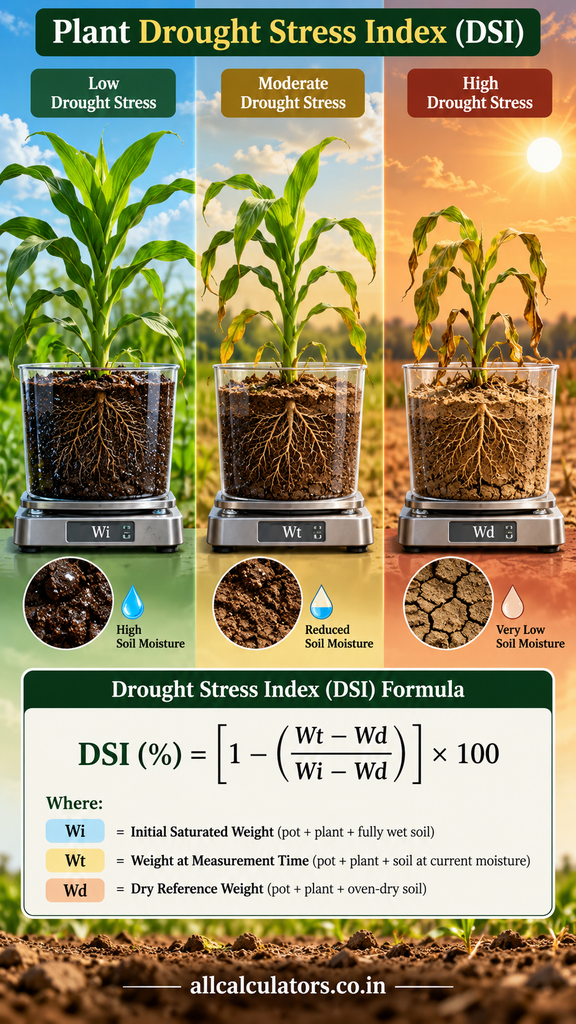
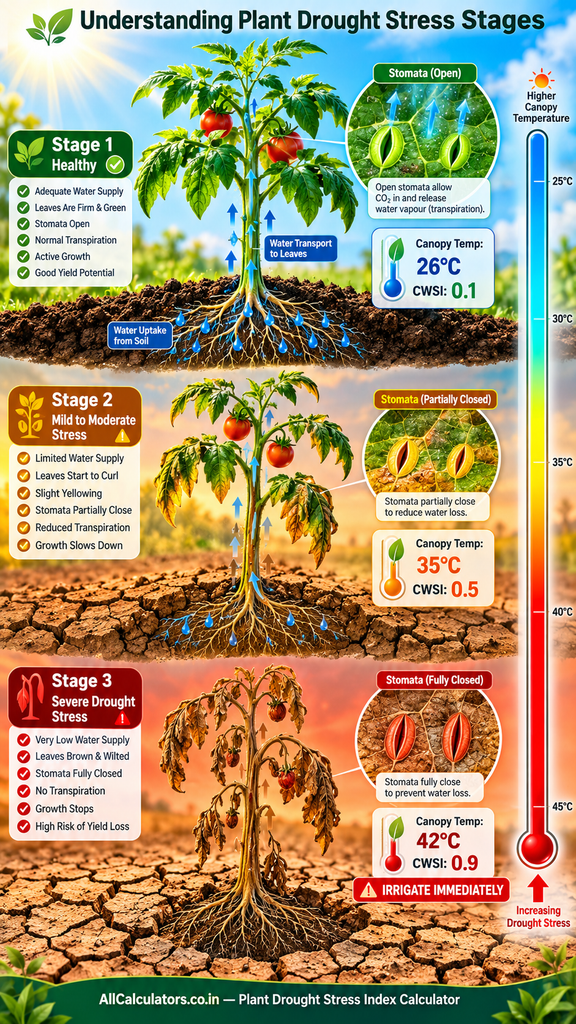
🌾 Drought stress occurs when the water available to a plant becomes insufficient to meet its physiological requirements. As soil water declines, plants can experience reduced cell turgor, stomatal closure, lower transpiration, impaired photosynthesis, slower growth, leaf rolling, wilting, premature senescence, and ultimately reduced biomass or yield. Understanding and quantifying plant water stress is therefore an important part of plant physiology, agricultural research, drought-tolerance screening, and precision water management.
💧 What is Plant Drought Stress Index?
The Drought Stress Index (DSI) is a numerical way of expressing the degree of drought or water deficit imposed on a plant system. In gravimetric drought experiments, the index can be calculated from the change in pot weight relative to the initial saturated condition and the dry reference weight.
For this calculator, the recommended formulation is: DSI (%) = [1 − (Wt − Wd) / (Wi − Wd)] × 100
Where:
🌊 Wi = Initial saturated pot/system weight
⚖️ Wt = Pot/system weight at the selected measurement time
🏜️ Wd = Dry reference weight
📊 DSI = Drought Stress Index expressed as a percentage
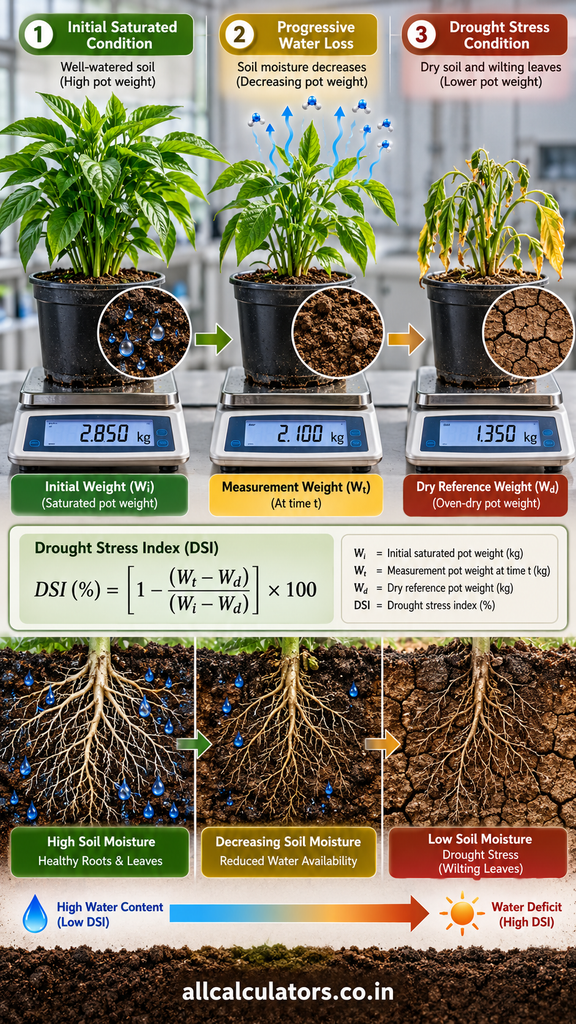
The concept is closely associated with gravimetric approaches to controlling and quantifying soil water status in pot experiments. Earl's 2003 Crop Science study demonstrated the usefulness of gravimetric measurement for imposing and quantifying different levels of drought stress, and subsequent plant studies have applied the DSI formulation to track progressive water depletion.
🧮 How Does the Drought Stress Index Calculator Work?
The calculator uses the relationship between the water-containing mass of the experimental system and its dry reference mass. The difference between the saturated weight and dry weight represents the reference amount of water available in the system. As water is lost, the measured pot weight moves closer to the dry reference condition.
For example, suppose:
⚖️ Initial saturated weight (Wi) = 2,000 g
⚖️ Weight at measurement time (Wt) = 1,600 g
🏜️ Dry reference weight (Wd) = 1,000 g
Then:
DSI = [1 − (1,600 − 1,000) / (2,000 − 1,000)] × 100
DSI = [1 − 600/1,000] × 100
DSI = 40%
This means approximately 40% of the initial water-related weight difference has been depleted under the assumptions of the gravimetric model.
🌱 A lower DSI generally represents a condition closer to the initial well-watered state, whereas a higher DSI represents greater water depletion and therefore greater imposed drought intensity. However, DSI should not automatically be interpreted as a universal physiological severity score for every plant species. Plant responses depend on genotype, soil properties, rooting depth, atmospheric demand, growth stage, acclimation, and experimental conditions.
🔬 Why is Drought Stress Measurement Important in Plant Science?
Drought is one of the major environmental stresses affecting agricultural productivity. Plants respond to water limitation through interconnected physiological and biochemical mechanisms. Stomata may close to reduce water loss, transpiration can decline, leaf temperature can increase, and photosynthetic carbon assimilation may become restricted. Prolonged water deficit can alter membrane stability, antioxidant activity, osmotic adjustment, root growth, and biomass accumulation. 🌡️🌿
A quantitative plant drought stress calculator helps convert raw experimental measurements into a standardized percentage that can be tracked over time.
Researchers can calculate DSI repeatedly during a drought experiment to create a progression such as:
💧 Low water depletion → Low DSI
🌱 Moderate water depletion → Moderate DSI
☀️ Severe water depletion → High DSI
This makes the index useful when comparing treatments, drought durations, cultivars, irrigation regimes, or stress-recovery experiments.
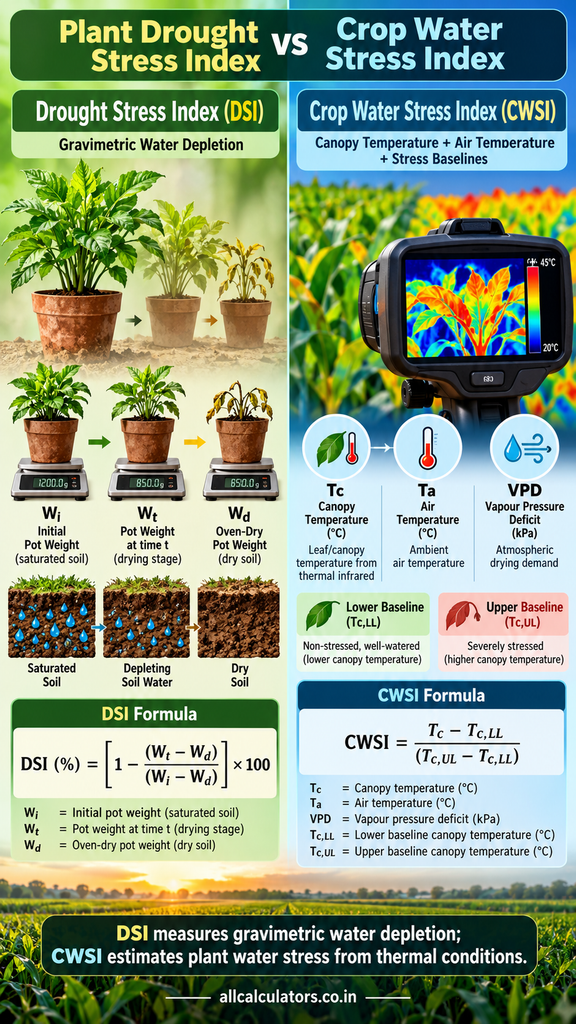
🌾 Drought Stress Index vs Crop Water Stress Index (CWSI)
It is important not to confuse Drought Stress Index (DSI) with Crop Water Stress Index (CWSI).
🌱 DSI in this calculator is based on gravimetric water depletion and pot/system weight.
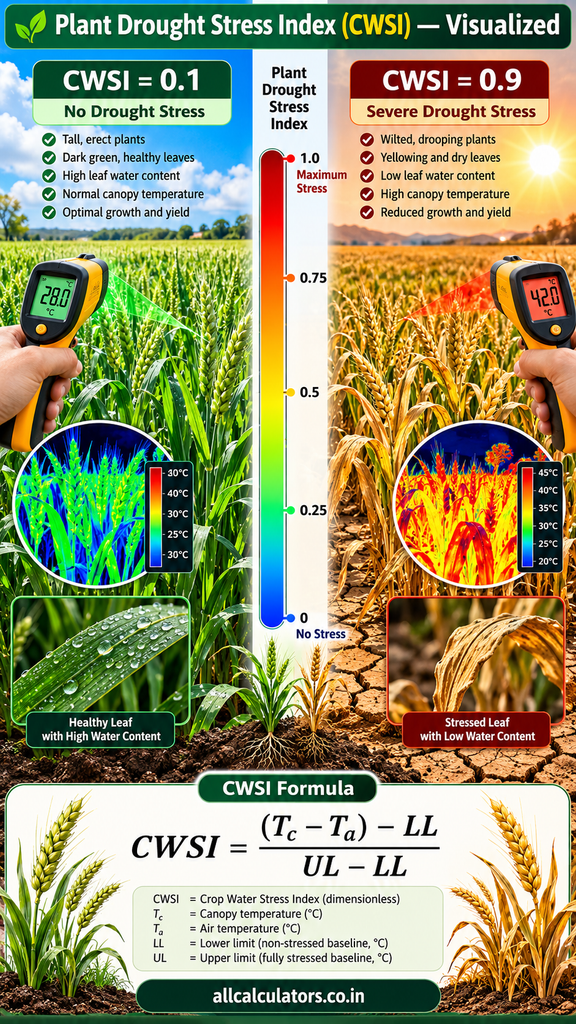
🌡️ CWSI is a thermal plant-water-status indicator commonly calculated from canopy temperature, air temperature, and lower/upper stress baselines. CWSI values are commonly interpreted on a scale where values near 0 represent non-water-stressed conditions and values near 1 indicate severe water stress, although the exact calculation depends on the baseline method.
This distinction matters for students and researchers because a drought stress index calculator and a crop water stress index calculator may require completely different input data.
🎓 Who Can Use This Plant Drought Stress Calculator?
👨🎓 Biology & Botany Students — Understand drought stress, plant water relations, and experimental plant physiology.
🌾 Agriculture Students — Practice drought stress calculations and interpret water-deficit experiments.
🔬 Plant Researchers — Quickly calculate DSI values from gravimetric measurements during controlled drought experiments.
👨🌾 Agronomists & Crop Scientists — Use drought intensity measurements alongside physiological and agronomic observations.
🌱 Plant Breeders — Compare drought-treatment responses among genotypes when DSI is combined with appropriate phenotypic traits.
🏫 Teachers & Educators — Demonstrate quantitative plant-water-stress concepts using real experimental data.
📊 Agricultural Data Analysts — Convert repeated pot-weight observations into an interpretable percentage for experimental datasets.
📈 How to Interpret Drought Stress Index Results?
The DSI should be interpreted as a relative measure of imposed water depletion, not as a universal diagnosis of plant damage.
🟢 Low DSI — Little water depletion relative to the reference condition.
🟡 Moderate DSI — Noticeable water depletion; plants may begin exhibiting physiological responses depending on species and environmental conditions.
🟠 High DSI — Substantial water depletion; drought-related physiological responses are increasingly likely.
🔴 Very High DSI — Severe water depletion approaching the dry reference condition.
These categories are useful for educational interpretation, but researchers should establish species-, soil-, genotype-, and experiment-specific thresholds before using DSI as a biological severity classification.
🧪 Why Gravimetric Measurement is Useful?
Gravimetric monitoring is attractive in controlled experiments because pot weight can provide a practical proxy for changes in the amount of water contained within the soil–plant system. Earl's work demonstrated that gravimetric approaches can be used to impose defined relative soil-water conditions and quantify drought stress in greenhouse experiments.
Modern experiments may combine this approach with soil volumetric water content, soil matric potential, leaf water potential, relative water content, stomatal conductance, canopy temperature, chlorophyll measurements, photosynthesis, biomass, and yield data.
This multi-parameter approach is particularly valuable because no single drought index completely describes plant water status under every environmental condition. Thermal methods such as CWSI, for example, depend on canopy temperature, atmospheric demand, and appropriate stress baselines.
🚀 Why Use an Online Plant Drought Stress Index Calculator?
Manual calculations are easy to perform incorrectly when multiple experimental measurements are involved. A dedicated online calculator reduces repetitive arithmetic and provides a quick way to check calculations.
📱 Mobile-friendly access makes the tool useful in classrooms, laboratories, greenhouse experiments, agricultural fieldwork, and study sessions.
⚡ Enter your values, calculate the DSI, and immediately understand the resulting percentage.
📚 For students, the calculator also connects the mathematical calculation with the biological meaning of drought stress.
🌍 For agriculture learners, it provides a bridge between plant physiology, soil-water relationships, irrigation management, and drought-tolerance research.
🌍 Applications in Human Daily Life
🌾 1. Agriculture & Crop Management — Farmers and agronomists can use drought-stress concepts to understand how declining soil water availability affects crops and why timely irrigation is important.
💧 2. Irrigation Planning — Understanding plant water stress helps support better irrigation decisions, especially in water-limited regions where avoiding unnecessary water loss is essential.
🌱 3. Home Gardening & Plant Care — Gardeners can learn why plants wilt during prolonged water shortage and why both underwatering and poorly managed irrigation can affect plant health.
🌽 4. Drought-Tolerant Crop Development — Plant breeders and researchers use controlled drought experiments to compare crop genotypes and identify plants with better performance under water-limited conditions.
🔬 5. Agricultural Research — DSI measurements can be combined with leaf water content, photosynthesis, stomatal conductance, chlorophyll, biomass, and yield measurements to study plant responses to drought.
🎓 6. Education & Academic Projects — Biology, botany, agriculture, environmental science, and plant physiology students can use drought stress calculations for laboratory reports, assignments, practical examinations, and research projects.
🌍 7. Climate-Change Adaptation — Quantifying plant water stress supports research into how crops and vegetation may respond to changing rainfall patterns, increasing temperatures, and more frequent drought episodes.
🛰️ 8. Precision Agriculture & Remote Sensing — Ground measurements can complement satellite and thermal observations used for agricultural drought monitoring. FAO's Agricultural Stress Index System, for example, combines Earth-observation indicators to identify agricultural areas potentially affected by dry spells or drought.
🌿 9. Plant Physiology Experiments — Controlled drought treatments help researchers investigate physiological adaptation, water-use strategies, photosynthesis, transpiration, and recovery after rehydration.
💦 10. Water Conservation Awareness — Understanding how plants respond to water shortage encourages more efficient irrigation and responsible use of freshwater resources.
⚠️ Disclaimer
🌱 Scientific & Educational Disclaimer: The Plant Drought Stress Index Calculator on AllCalculators.co.in is intended for educational, informational, research-learning, and general reference purposes only. 📚🔬 The Drought Stress Index is not a universal diagnostic scale for every plant species, soil type, crop, or environmental condition.
⚠️ The calculated result depends entirely on the quality and appropriateness of the input measurements, including initial weight, measurement-time weight, and dry reference weight. Experimental factors such as evaporation, drainage, pot characteristics, plant biomass, soil composition, root development, temperature, humidity, and measurement technique can influence results.
🌾 The calculator should not be used by itself to make critical irrigation, commercial crop-management, breeding, or scientific decisions. For professional agricultural decisions, combine DSI with appropriate field measurements and consult a qualified agronomist, crop scientist, botanist, or agricultural extension professional. 👨🔬🌾
📌 Also remember that Drought Stress Index (DSI), Crop Water Stress Index (CWSI), Drought Tolerance Index (DTI), Stress Tolerance Index (STI), and Drought Susceptibility Index (DSI) can refer to different methodologies in plant science. Always verify the formula and interpretation required by your particular experiment or research protocol.
❓ FAQs – Plant Drought Stress Index Calculator
🌱 1. What is a Plant Drought Stress Index?
Plant Drought Stress Index (DSI) is a numerical measure used to express the degree of water depletion or drought stress imposed on a plant system. In the gravimetric method used by this calculator, it is expressed as a percentage based on initial, current, and dry reference weights.
🧮 2. How do you calculate Drought Stress Index in plants?
For the gravimetric formulation used here: DSI (%) = [1 − (Wt − Wd) / (Wi − Wd)] × 100. where Wi is the initial saturated weight, Weight is the weight at the measurement time, and Wd is the dry reference weight.
💧 3. What does a high Drought Stress Index mean?
A high DSI generally means that a larger proportion of the water-related weight difference has been depleted. Therefore, it represents greater imposed water deficit in the experimental system.
🌿 4. What does a low Drought Stress Index mean?
A low DSI generally indicates that the system remains relatively close to its initial water-rich reference condition and has experienced less water depletion.
⚖️ 5. What measurements are required for this Drought Stress Index Calculator?
The gravimetric calculation requires three primary measurements: initial saturated weight (Wi), weight at the selected measurement time (Wt), and dry reference weight (Wd).
🌡️ 6. Is Drought Stress Index the same as Crop Water Stress Index?
No. DSI and CWSI are different concepts. CWSI commonly uses canopy temperature, air temperature, and stress baselines, whereas the DSI formulation used here is based on gravimetric water depletion.
🌾 7. Can this calculator be used for crops?
Yes. It can be used for educational or experimental calculations involving crops, seedlings, greenhouse plants, and other plant systems when the required gravimetric measurements are available.
🔬 8. Is Drought Stress Index useful in plant research?
Yes. DSI can help researchers quantify imposed water depletion and compare drought treatments over time. It is most informative when interpreted alongside physiological, morphological, soil-water, and environmental measurements.
📊 9. Can DSI be used to compare drought-tolerant plant varieties?
It can be used as one experimental variable, but DSI alone does not establish drought tolerance. Genotype performance should also be assessed using traits such as biomass, yield, leaf water status, photosynthesis, stomatal conductance, recovery, and other relevant physiological indicators.
📚 10. Is this Plant Drought Stress Calculator useful for students?
Absolutely. Biology, botany, agriculture, environmental science, and plant physiology students can use it to understand the drought stress index formula, practice calculations, and connect mathematical results with plant water-stress concepts.
The Plant Drought Stress Index Calculator is a free online agriculture and botany tool designed to estimate the degree of water stress experienced by a plant or soil–plant system during drought conditions. https://t.co/vQLh5LKGDK
— AllCalculators (@allcalcs4u) October 4, 2026