
🌿 Chlorophyll Content Calculator 🌱 Botany & Agriculture
Table of Contents
✍️ Author & Academic Authority: Dr. Nitish Kr. Bharadwaj
📘 Qualifications: B.Sc., B.Ed., M.Sc., Ph.D. (Biochemistry), MBA (Financial Management)
🌿 Chlorophyll Content Calculator
Measure the Green Power of Plants!
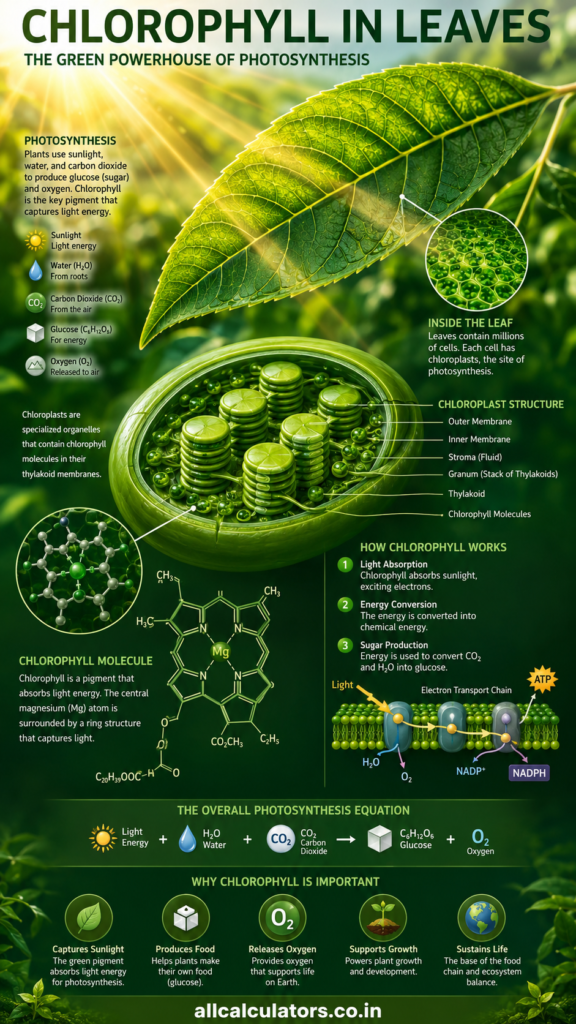
Have you ever wondered why plants are green 🟢 and why some leaves look pale, yellow, or dull? The answer lies in one of nature’s most powerful molecules — Chlorophyll! Chlorophyll is the primary photosynthetic pigment found inside the chloroplasts of plant cells, and it is directly responsible for capturing sunlight ☀️ and converting it into the chemical energy that fuels all life on Earth. Understanding and measuring chlorophyll content is a foundational skill in botany, agriculture, plant physiology, ecology, and food science — and our free online Chlorophyll Content Calculator makes this complex scientific process simple, fast, and accurate for everyone! 🎓
🔬 What is Chlorophyll Content?
Chlorophyll content refers to the total concentration of photosynthetic pigments present in a plant’s leaf or tissue sample. Scientifically, there are two primary types of chlorophyll: Chlorophyll a (Chl a) and Chlorophyll b (Chl b). Chlorophyll a is the main photosynthetic pigment that directly participates in photosynthesis, absorbing light primarily at wavelengths of 663 nm (red region) and 430 nm (blue-violet region). Chlorophyll b, on the other hand, is an accessory pigment that absorbs light at 645 nm and transfers the absorbed energy to Chlorophyll a. Plants also contain Carotenoids 🟡🟠 — yellow and orange pigments that assist in light harvesting and protect the plant from photo-oxidative damage. Measuring all these pigments together gives researchers a complete picture of a plant’s photosynthetic efficiency and overall health.
🧪 The Science Behind Chlorophyll Calculation — Arnon’s Method
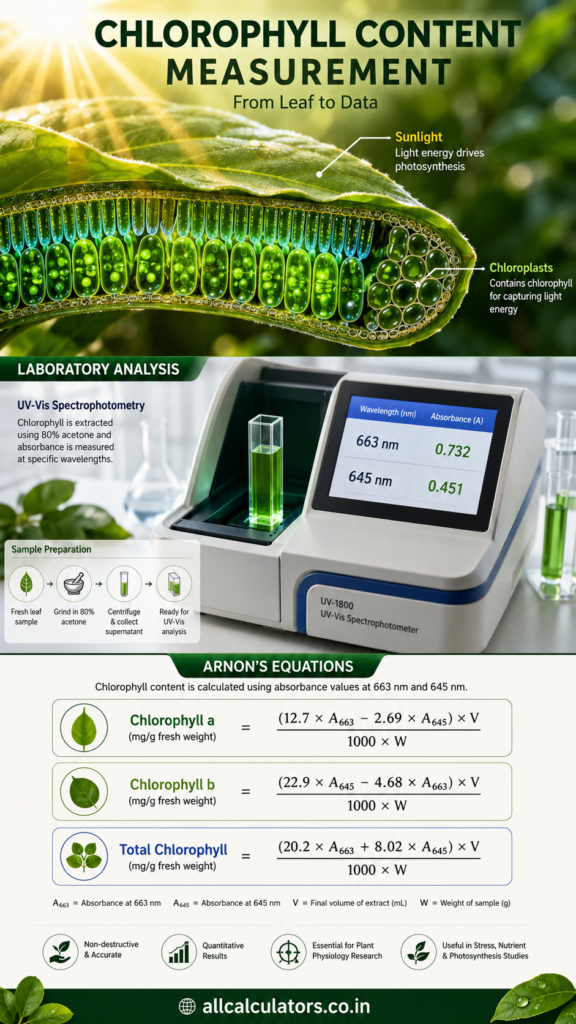
The most widely accepted and scientifically validated method for calculating chlorophyll content is Arnon’s Method (1949), which remains the gold standard in plant physiology laboratories around the world 🌍. In this method, leaf tissue is ground and extracted using 80% acetone as a solvent. The resulting extract is then analyzed using a UV-Vis Spectrophotometer, and absorbance values are recorded at 663 nm (for Chl a) and 645 nm (for Chl b). These absorbance values are then plugged into Arnon’s equations to calculate the exact concentration of each pigment:
📐 Arnon’s Formulas:
- Chlorophyll a (mg/L) = 12.7 × A663 − 2.69 × A645
- Chlorophyll b (mg/L) = 22.9 × A645 − 4.68 × A663
- Total Chlorophyll (mg/L) = 20.2 × A645 + 8.02 × A663
- Carotenoids (mg/L) are also estimated using the Davis (1976) method based on absorbance at 480 nm and 510 nm.
The calculated concentration (in mg/L) is then adjusted based on the volume of solvent used (mL) and the fresh weight of the leaf sample (grams) to express the final result in mg/g fresh weight (FW) or µg/cm² — the two most common units used in botanical research.
🌾 What is SPAD Value & How Does It Relate to Chlorophyll?
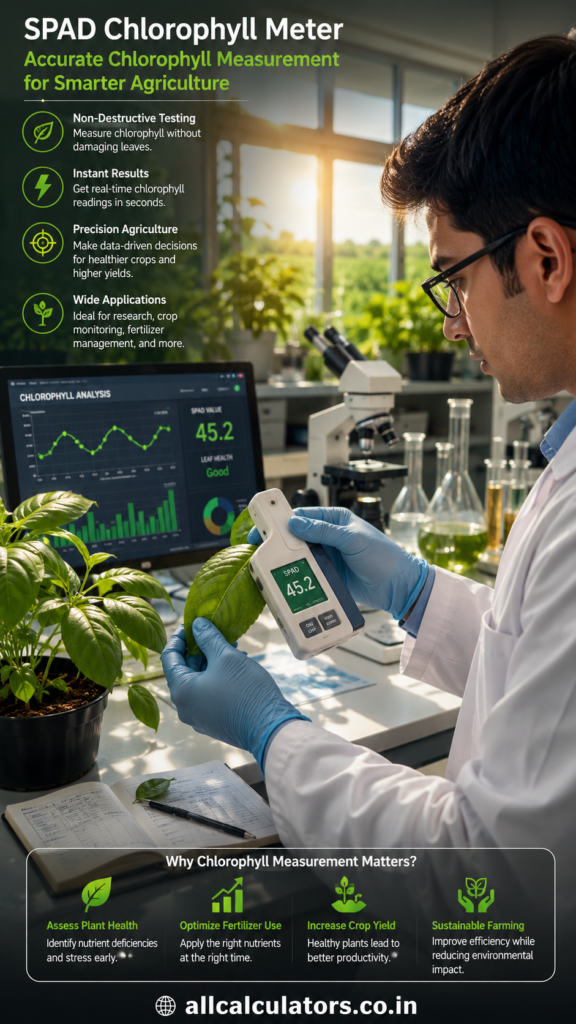
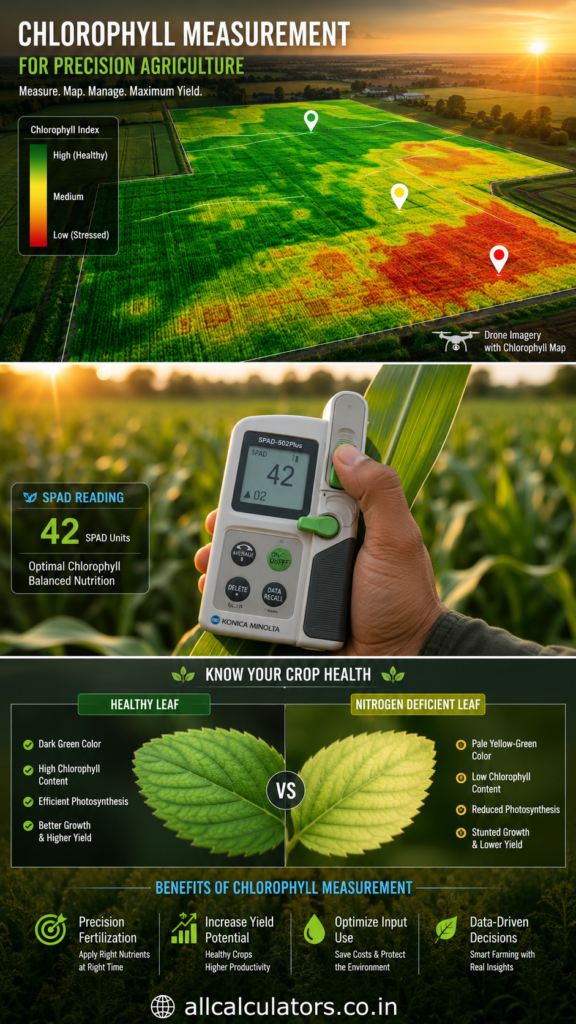
Modern agriculture also uses a portable device called a SPAD Meter (Soil Plant Analysis Development), originally developed by Minolta. The SPAD meter measures the light transmittance through a leaf at two wavelengths — 650 nm (absorbed by chlorophyll) and 940 nm (not absorbed) — and provides a relative SPAD index value. This SPAD value has a well-established correlation with actual leaf chlorophyll concentration and is widely used in precision agriculture, nitrogen management, fertilizer scheduling, and crop monitoring 🌽🌾🍅. Our calculator also includes a SPAD-to-chlorophyll converter so that farmers and agronomists can translate field meter readings into approximate chlorophyll concentrations without any laboratory setup!
📊 Why is Measuring Chlorophyll Content So Important?
Chlorophyll content is one of the most informative indicators of a plant’s physiological state. A healthy, well-nourished plant will exhibit high chlorophyll concentrations, vibrant green leaves, and strong photosynthetic activity. Conversely, a decline in chlorophyll content is one of the earliest and most reliable signs of nutrient deficiency (especially nitrogen), drought stress, pathogen attack, heavy metal toxicity, senescence (leaf aging), and environmental pollution 🏭. Research scientists, plant breeders, agronomists, ecologists, and horticulturists regularly monitor chlorophyll content to evaluate crop quality, optimize fertilizer application, assess environmental stress, screen drought-tolerant varieties, and study the impact of climate change on vegetation 🌡️🌱.
🎓 Who Can Use This Calculator?
Our free online Chlorophyll Content Calculator is designed for a wide range of users including:
- 🎒 Students studying biology, botany, agriculture, and environmental science
- 🔬 Researchers conducting plant physiology and biochemistry experiments
- 🌾 Farmers & Agronomists monitoring crop health and nutrient status
- 🏫 Teachers demonstrating plant science concepts in classrooms
- 🌿 Home Gardeners curious about their plant health
- 🛰️ Remote Sensing Analysts validating field chlorophyll index data
Simply enter your spectrophotometric absorbance values (A663 and A645), the solvent volume used, and the fresh weight of your leaf sample — and our calculator instantly computes Chlorophyll a, Chlorophyll b, Total Chlorophyll, and Carotenoid concentrations with full step-by-step working! No need for complex spreadsheets, textbooks, or manual calculation errors! ✅
Whether you’re a first-year biology student, a PhD researcher, or an experienced farmer using a SPAD meter in the field 🌻, our Chlorophyll Content Calculator at AllCalculators.co.in is your fastest, most reliable, and completely free tool for all chlorophyll-related calculations! Bookmark it today and share it with your classmates and colleagues! 📌🙌
🌍 Applications in Human Daily Life
🌿 Real-Life Applications of Chlorophyll Content Measurement
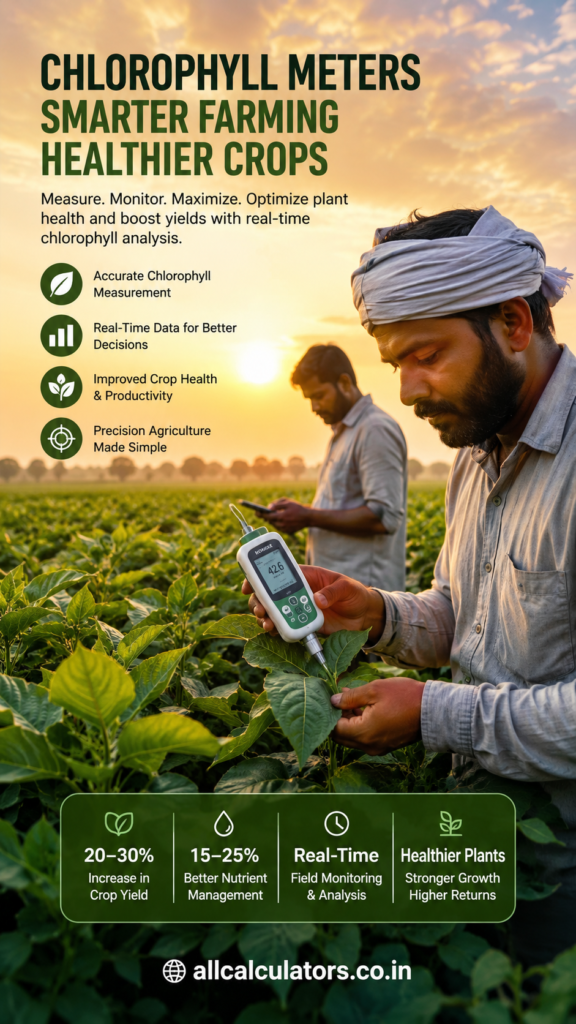
🌾 1. Smart Agriculture & Crop Management — Farmers use chlorophyll readings to decide when and how much nitrogen fertilizer to apply, directly improving crop yield and reducing wasteful chemical use.
🍃 2. Plant Health Diagnosis — Home gardeners and plant lovers can detect nutrient deficiencies and diseases in houseplants early by monitoring leaf color changes linked to chlorophyll loss.
🥦 3. Food Quality Testing — The chlorophyll content of vegetables like spinach, broccoli, and green tea directly reflects their nutritional freshness and quality during storage and shelf-life evaluation.
🌡️ 4. Environmental Pollution Monitoring — Scientists measure chlorophyll decline in roadside trees and forest plants to assess the impact of air pollution, heavy metals, and industrial toxins on local ecosystems.
🌊 5. Aquatic Ecosystem Health — Chlorophyll-a concentration in water bodies is the primary indicator of algal bloom intensity, water quality, and eutrophication — important for drinking water safety.
🛰️ 6. Satellite & Remote Sensing — Chlorophyll vegetation indices (CI, NDVI, NDRE) derived from satellite imagery are used by governments and agri-tech companies to monitor large-scale crop health and food security.
🌱 7. Organic Farming & Sustainable Practices — Organic farmers rely on chlorophyll monitoring to manage soil fertility naturally without synthetic chemicals, promoting eco-friendly agriculture.
☀️ 8. Climate Change Research — Long-term chlorophyll content trends in vegetation help climate scientists track global warming effects on plant photosynthesis and carbon sequestration capacity.
⚠️ Disclaimer
Please Read Before Using This Calculator 📋
🌿 The Chlorophyll Content Calculator on AllCalculators.co.in is designed purely for educational, academic, and informational purposes. The calculations provided are based on widely accepted scientific formulas including Arnon’s Method (1949) and standard spectrophotometric equations. However, actual laboratory results may vary depending on the quality of spectrophotometric equipment 🔬, solvent purity, sample preparation technique, leaf age, plant species variation, and environmental conditions. 🌡️ This tool should NOT be used as a substitute for certified laboratory analysis in professional agricultural advisory, scientific publication, or regulatory compliance contexts. For critical research or commercial crop management decisions 🌾, always verify results with certified lab methods and consult qualified botanists or agronomists. 👨🔬 All data entered into this calculator is processed locally and is not stored or shared by AllCalculators.co.in. Use this tool responsibly and happy calculating! ✅🙌
📌 Related Calculator
❓ FAQs – Chlorophyll Content Calculator 🌿
1. 🌱 What is chlorophyll content?
Chlorophyll content refers to the amount of chlorophyll pigment present in plant leaves, which is responsible for photosynthesis and green coloration.
2. 📚 Why is chlorophyll important in plants?
Chlorophyll absorbs sunlight and converts it into energy through photosynthesis, enabling plants to grow and produce oxygen.
3. 🚜 How does a Chlorophyll Content Calculator work?
The calculator uses chlorophyll-related formulas and measurement values such as SPAD readings, absorbance, or leaf data to estimate chlorophyll concentration.
4. 🌾 Why do farmers measure chlorophyll content?
Farmers measure chlorophyll levels to monitor crop health, detect nutrient deficiencies, optimize fertilizer use, and improve crop productivity.
5. 🔬 What is a SPAD chlorophyll meter?
A SPAD meter is a handheld device used to estimate leaf chlorophyll concentration non-destructively by measuring light transmission through leaves.
6. 🌿 Can chlorophyll indicate plant health?
Yes. Higher chlorophyll levels usually indicate healthy plants, while low chlorophyll levels may signal nutrient deficiency or plant stress.
7. 📖 Who can use this chlorophyll calculator?
Students, teachers, botanists, researchers, gardeners, and farmers can all use this calculator for biology and agriculture purposes.
8. 🌍 Is chlorophyll analysis important in precision agriculture?
Absolutely. Chlorophyll analysis helps optimize fertilizer application, reduce waste, and improve sustainable farming practices.
Have you ever wondered why plants are green and why some leaves look pale, yellow, or dull? The answer lies in one of nature’s most powerful molecules — Chlorophyll! https://t.co/cUPQxMZOwQ pic.twitter.com/04cvlEkwPz
— AllCalculators (@allcalcs4u) May 7, 2026