
Seed Germination Rate Calculator
Mean Germination Time (MGT) = Σ (Tᵢ × Nᵢ) Total Germinated
Table of Contents
✍️ Author & Academic Authority: Dr. Nitish Kr. Bharadwaj
📘 Qualifications: B.Sc., B.Ed., M.Sc., Ph.D. (Biochemistry), MBA (Financial Management)
🌱 Seed Germination Rate Calculator
Calculate Germination Percentage Instantly & Plan Smarter Planting!
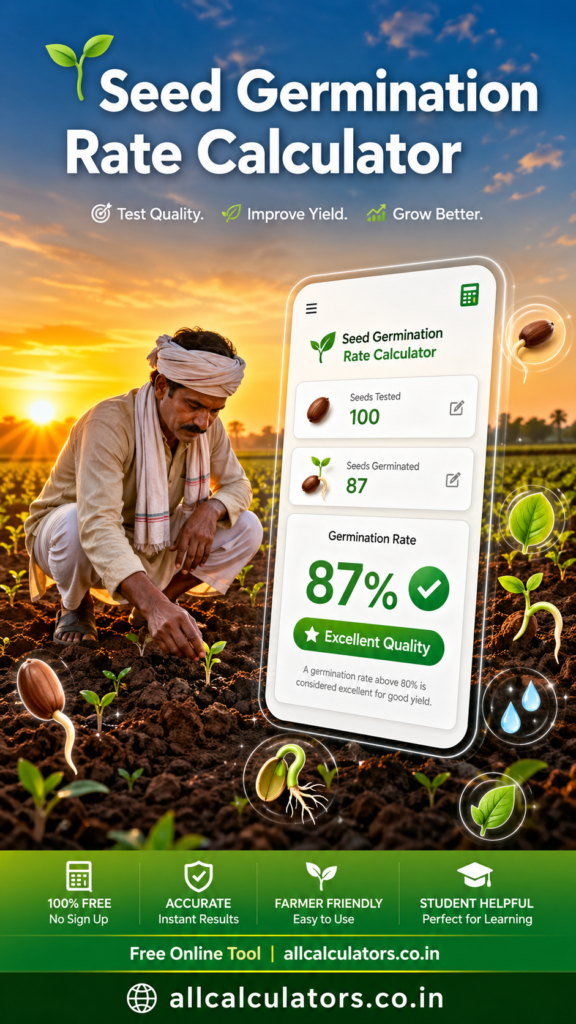
🌿 Whether you’re a biology student trying to ace your botany exam, a passionate home gardener nurturing your backyard plot, or a professional farmer managing vast agricultural fields — one scientific metric stands at the very root of every successful crop story: the Seed Germination Rate. 🌾 Understanding and calculating your seed germination rate accurately can be the single most powerful step you take toward healthier plants, higher crop yields, and smarter resource management. Welcome to our free Seed Germination Rate Calculator — your ultimate online tool to calculate germination percentage in seconds! 🎯
🔬 What is Seed Germination Rate?
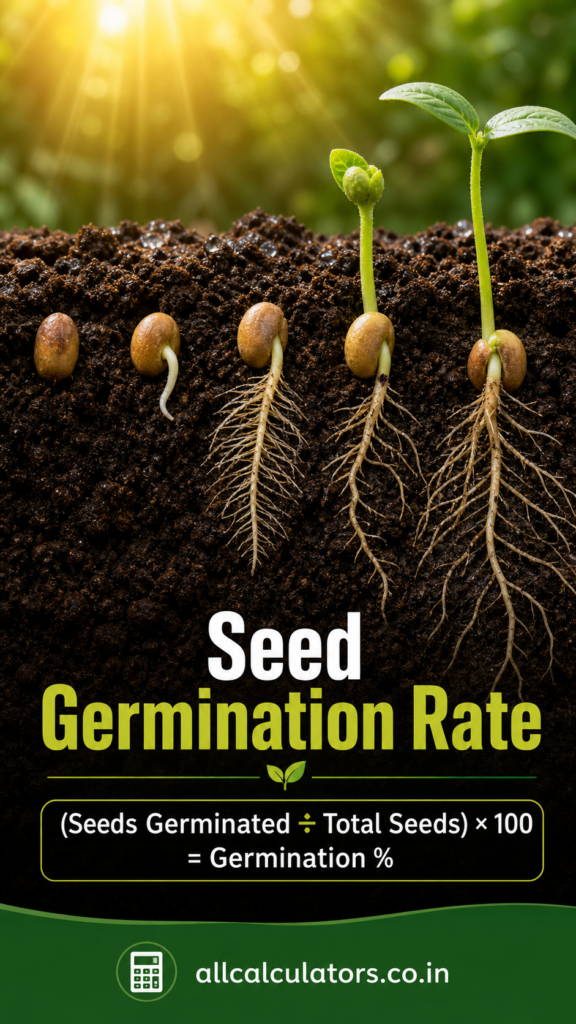
The seed germination rate (also called germination percentage) is a fundamental concept in botany and agriculture that measures the proportion of seeds in a given batch that successfully sprout and develop into seedlings under specific conditions. 🌡️💧 In simple terms, it tells you: “Out of the seeds I planted, how many actually grew?”
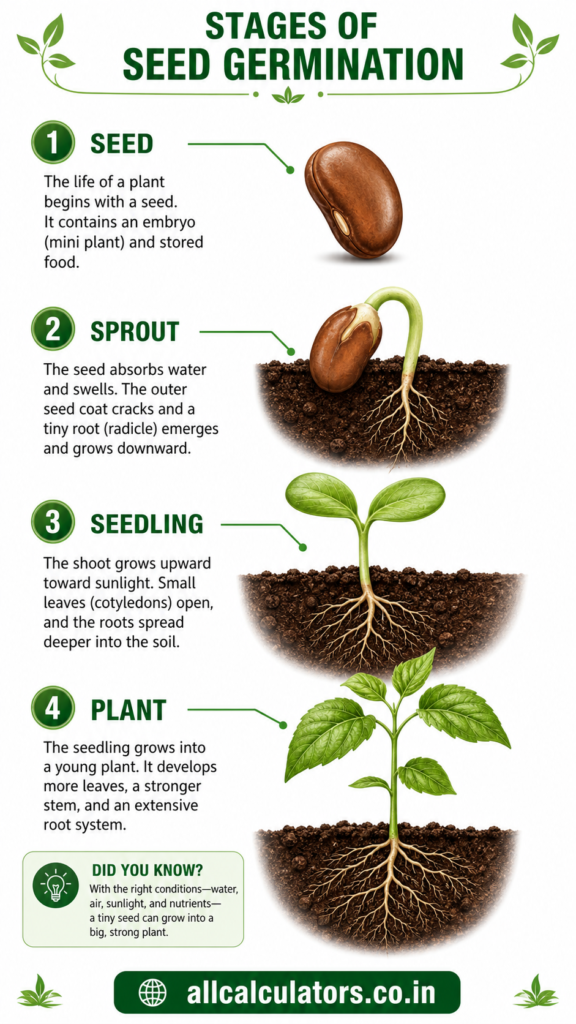
Germination is defined as the sequence of physiological events beginning with water imbibition by a dormant seed and culminating in the emergence of the embryonic root (radicle) and shoot. 🌱 This biological process is highly sensitive to environmental conditions including temperature 🌡️, moisture 💧, light 💡, and soil oxygen levels. The germination rate captures the end result of all these factors as a clean, easy-to-use percentage.
📐 Seed Germination Rate Formula
The universally accepted formula to calculate germination rate is remarkably straightforward:
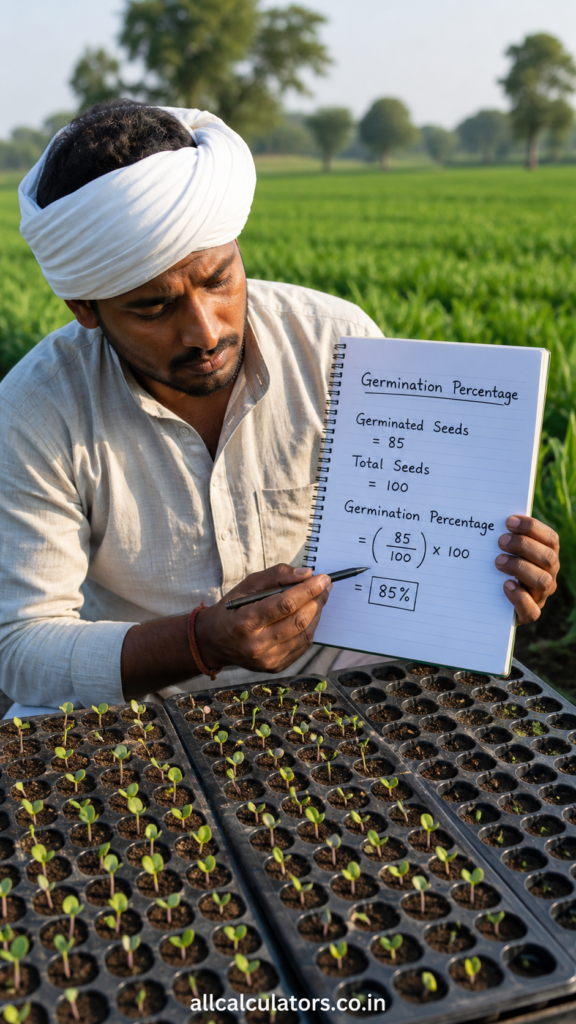
🧮 Germination Rate (%) = (Number of Seeds Germinated ÷ Total Number of Seeds Tested) × 100
For example 👇: If you test 100 seeds and 85 seeds sprout successfully, your germination rate is: (85 ÷ 100) × 100 = 85% ✅
This formula is standardized by global seed testing bodies including the International Seed Testing Association (ISTA) 🌐 and the Association of Official Seed Analysts (AOSA), ensuring your results are comparable and scientifically credible. A germination rate above 85% is generally considered excellent 🏆, between 70–85% is acceptable 👍, and below 70% signals poor seed quality that requires higher sowing rates or seed replacement 🚨.
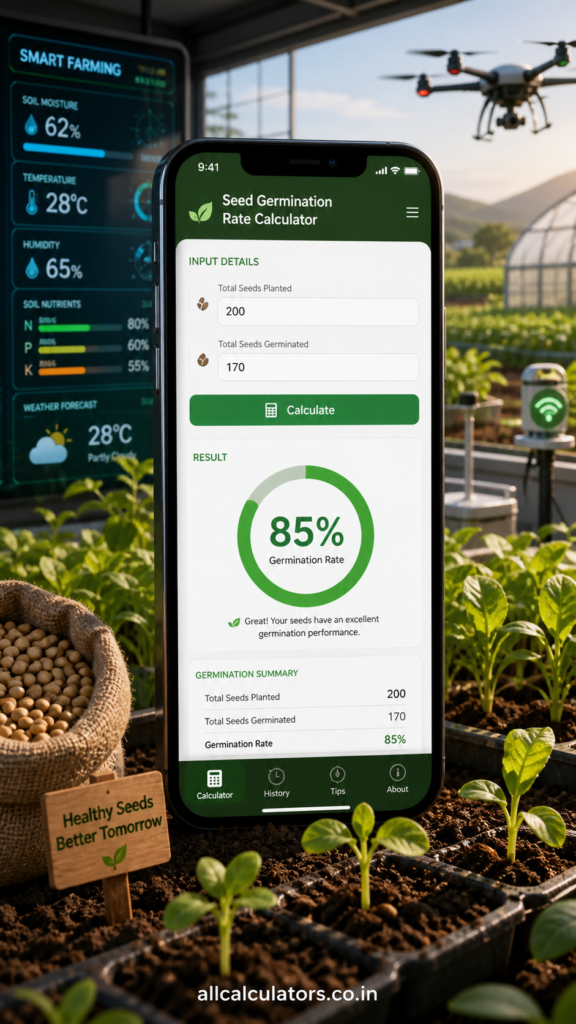
🌾 Why Calculating Germination Rate Matters in Agriculture & Botany
The importance of accurately computing your seed germination percentage cannot be overstated. Here’s why it’s a critical metric in both academic botany and real-world farming 🚜:
🔹 Seed Quality Assessment — The germination rate is the #1 indicator of seed viability. It tells farmers and researchers instantly whether a seed lot is worth planting or should be replaced.
🔹 Optimize Seeding Rate — Did you know that a seed lot with 85% germination requires approximately 18% more seeds per acre compared to a lot with 98% germination to achieve the same plant stand? 📊 Without calculating germination rate, you’re essentially guessing — and guessing costs money! 💸
🔹 Crop Yield Planning — Accurate germination data feeds directly into plant population estimates, which in turn determines expected crop yields per hectare. 🌾 This is essential for agronomy decisions, harvest projections, and farm economics.
🔹 Biology Education & Lab Work 📚 — Students conducting germination experiments in petri dishes 🧫 or seed boxes regularly need to calculate and report germination rates. Our calculator eliminates manual calculation errors and saves precious lab time.
🔹 Seed Storage & Viability Studies — Seeds lose viability over time due to improper storage conditions like excessive heat, humidity, and light exposure. Tracking germination rates across storage periods helps identify optimal storage strategies and predict the seed’s shelf life. ❄️📦
🔹 Sustainable Agriculture 🌍 — By knowing exactly how many seeds will sprout, farmers avoid overseeding — reducing seed waste, cutting costs, and supporting eco-friendly farming practices.
🧪 How to Conduct a Germination Test (Standard Method)
Before you use our germination rate calculator online, you’ll need actual test data. Here’s the most widely used method to test seed germination at home, in the lab, or on the field:
1️⃣ Select Seeds — Count out a standard sample of seeds (commonly 50 or 100 seeds for statistical reliability). 2️⃣ Soak Seeds — Soak seeds in clean water for 30–60 minutes to initiate imbibition. 💧 3️⃣ Set Up — Place seeds on moist filter paper in a petri dish 🧫, or use a damp paper towel in a zip bag. 4️⃣ Incubate — Keep in a warm, dark environment at optimal temperature (usually 20–25°C for most crop species 🌡️). 5️⃣ Monitor Daily — Record the number of seeds germinating each day for 7 to 14 days depending on species. 6️⃣ Calculate — Enter your total seeds tested and germinated seeds into our calculator — and get your germination percentage instantly! 🎯
📊 Standard Germination Rate Benchmarks by Crop Type
| 🌾 Crop | ✅ Minimum Acceptable Germination |
|---|---|
| Wheat & Rice | 85% |
| Maize (Corn) | 90% |
| Tomato & Pepper | 75% |
| Beans & Pulses | 80% |
| Carrot & Onion | 65% |
| Sunflower | 85% |
(These benchmarks are based on ISTA and FAO standard recommendations for commercial seed lots.)
🌐 Factors That Affect Seed Germination Rate
Multiple biological and environmental variables influence whether a seed germinates successfully 🌿:
- 🌡️ Temperature — Each species has an optimal temperature range. Too cold or too hot drastically reduces germination.
- 💧 Water/Moisture — Seeds need adequate moisture to initiate enzymatic activity and cell expansion.
- 🌬️ Oxygen — Aerobic respiration powers germination energy. Waterlogged soils suppress it.
- ☀️ Light — While most seeds germinate in dark soil, some species (like lettuce) need light cues.
- 🕰️ Seed Age & Storage — Older seeds stored in poor conditions consistently show lower germination rates.
- 🧬 Seed Dormancy — Some seeds have built-in dormancy mechanisms requiring specific triggers like cold stratification or scarification.
🎯 Use our Seed Germination Rate Calculator above to instantly compute your germination percentage, evaluate your seed lot quality, and make data-driven planting decisions — whether you’re a student, a gardener, or a commercial farmer! 🌱✨
🌍 Applications In Human Daily Life
🌿 The Seed Germination Rate Calculator isn’t just a classroom tool — it directly impacts real lives every day! Here’s how:
🏡 Home Gardening — Home gardeners use germination calculators to test leftover or saved seeds before the growing season, saving money and avoiding patchy garden beds. 🌻
🚜 Farming & Crop Production — Farmers across India 🇮🇳 and globally compute germination percentage before sowing to optimize seed quantity per acre and protect their investment. Every percentage point counts at scale!
🎓 School & College Biology Labs — Students in Class 10, 11, 12, and BSc Agriculture regularly need to calculate germination rates as part of botany practicals. 📚 This calculator makes lab reports accurate and instant.
🌾 Precision Agriculture & Smart Farming — AgriTech professionals integrate germination rate data into IoT-based soil monitoring systems and precision seeding machines for maximum crop efficiency. 📡
🏪 Seed Industry & Quality Control — Seed companies and government agriculture labs use germination testing to certify seed lots before commercial sale, ensuring legal compliance with minimum viability standards. ✅
🌿 Organic Farming — Organic farmers depend on high-germination heirloom seeds. Calculating germination rate helps them maintain healthy seed banks and plan biodynamic planting calendars. 🌙
🌱 Reforestation & Conservation Projects — Ecologists and forest departments test native tree seeds using germination calculators to plan large-scale replanting efforts. 🌳🌍
⚠️ Disclaimer 📋
This Seed Germination Rate Calculator provides estimated results based on the values entered by the user. While the tool is designed for accuracy, actual germination rates may vary due to environmental factors such as soil conditions, temperature, moisture, and seed quality. 🌱 This calculator is intended for educational and informational purposes only and should not replace professional agricultural advice. Always consult agronomy experts for critical farming decisions. 🚜
📌 Related Calculator
❓ FAQs
🌱 1. What is seed germination rate?
Seed germination rate is the percentage of seeds that successfully sprout out of the total seeds planted.
📊 2. How do you calculate germination percentage?
You divide the number of germinated seeds by total seeds and multiply by 100.
🌾 3. Why is germination rate important in agriculture?
It helps determine seed quality and predict crop yield.
🌿 4. What is a good germination rate?
A germination rate above 80% is generally considered good for most crops.
💧 5. What factors affect seed germination?
Temperature, moisture, oxygen, and seed quality all impact germination.
🌍 6. Can this calculator be used for all types of seeds?
Yes, it works for crops, vegetables, flowers, and experimental seeds.
Whether you’re a biology student trying to ace your botany exam, a passionate home gardener nurturing your backyard plot, or a professional farmer managing vast agricultural fields-https://t.co/H1MmOjiigr pic.twitter.com/dw0T8zufBk
— AllCalculators (@allcalcs4u) May 4, 2026