
Herd Immunity Threshold Calculator
📐 Formula Used
HIT = (1 – 1/R0) × 100
Where R0 = Basic Reproduction Number
🎯 Herd Immunity Threshold Result
R0 Value
–
1/R0
–
Formula Step
–
📊 Interpretation
Table of Contents
✍️ Author & Academic Authority: Dr. Nitish Kr. Bharadwaj
📘 Qualifications: B.Sc., B.Ed., M.Sc., Ph.D. (Biochemistry), MBA (Financial Management)
🧬 Herd Immunity Threshold Calculator
Understand When a Population Becomes Protected from Disease Outbreaks 💉🌍
Have you ever wondered why doctors and scientists say things like “we need 95% of the population vaccinated” for measles, but only around 60–70% for COVID-19? 🤔 The answer lies in a powerful concept called the Herd Immunity Threshold (HIT) — and our free Herd Immunity Threshold Calculator at AllCalculators.co.in makes it effortless to calculate this critical number in just seconds! Whether you’re a biology student, a public health researcher, a curious learner, or a science educator, this tool is designed precisely for you. 🎓🔬
🔬 What is Herd Immunity Threshold?
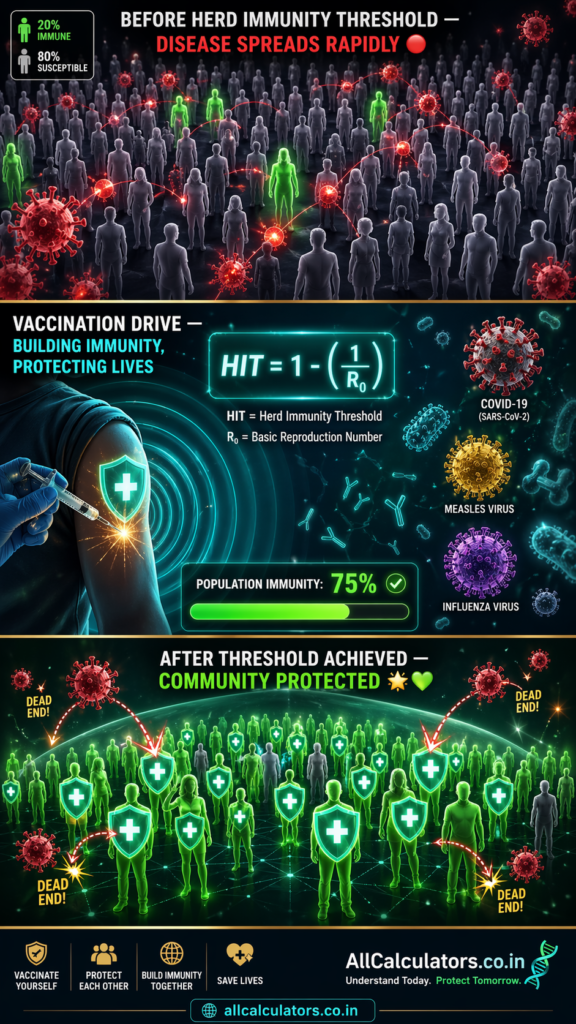
Herd immunity — also known as population immunity or community immunity — is the indirect protection that unvaccinated or vulnerable individuals receive when a sufficiently large proportion of a population has become immune to an infectious disease. 🛡️ This immunity can be acquired through natural infection (recovering from the disease) or through vaccination. When enough people are immune, the pathogen essentially hits a “dead end” — it can no longer find enough susceptible hosts to sustain its spread, and the outbreak dies out naturally. 🚫🦠
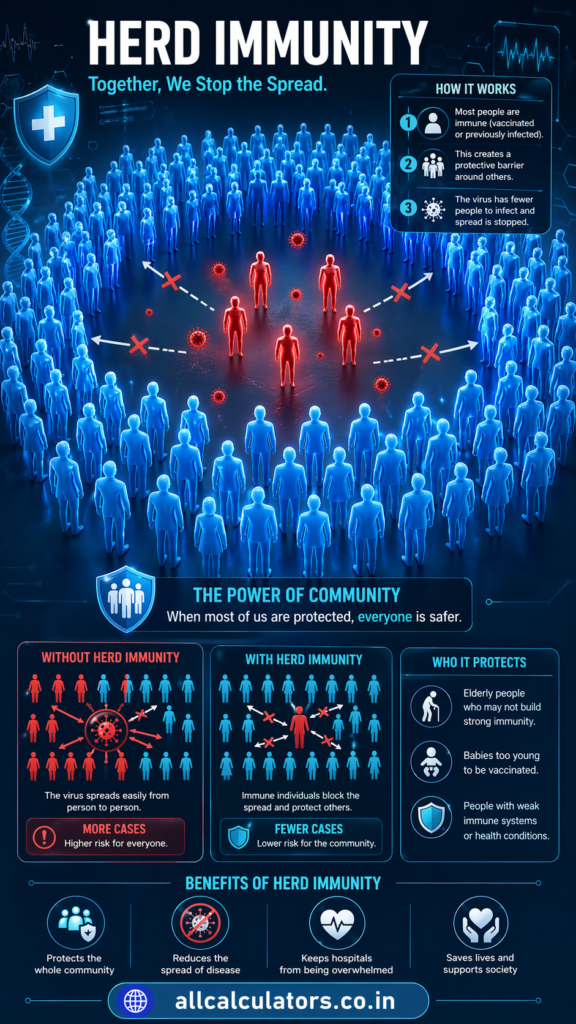
This concept is the entire scientific foundation behind mass vaccination campaigns. Diseases like smallpox have been completely eradicated from the planet, and polio has been eliminated from most countries, thanks to achieving and maintaining herd immunity through systematic vaccination programmes. 🌐💊
At its core, herd immunity occurs when a sufficient proportion of individuals in a population are immune—either through vaccination 💉 or prior infection—thereby reducing the likelihood of disease transmission. This creates an indirect protection shield 🛡️ for individuals who are not immune. The herd immunity threshold (HIT) is calculated using the formula:
👉 HIT = 1 − (1 / R₀)
Where R₀ (basic reproduction number) represents the average number of people that one infected individual can infect in a fully susceptible population. For instance, if R₀ = 3, the herd immunity threshold would be approximately 66.7%, meaning two-thirds of the population must be immune to halt disease transmission 📉.
🧮 The Herd Immunity Threshold Formula — How is It Calculated?
The mathematical formula for calculating the Herd Immunity Threshold is elegantly simple yet incredibly powerful:
HIT = 1 − (1 / R₀)
Here, R₀ (R-naught) is the Basic Reproduction Number — the average number of new infections that a single infected person causes in a completely susceptible population (i.e., one with no prior immunity or vaccination). It is the single most important measure of a pathogen’s contagiousness. 📊
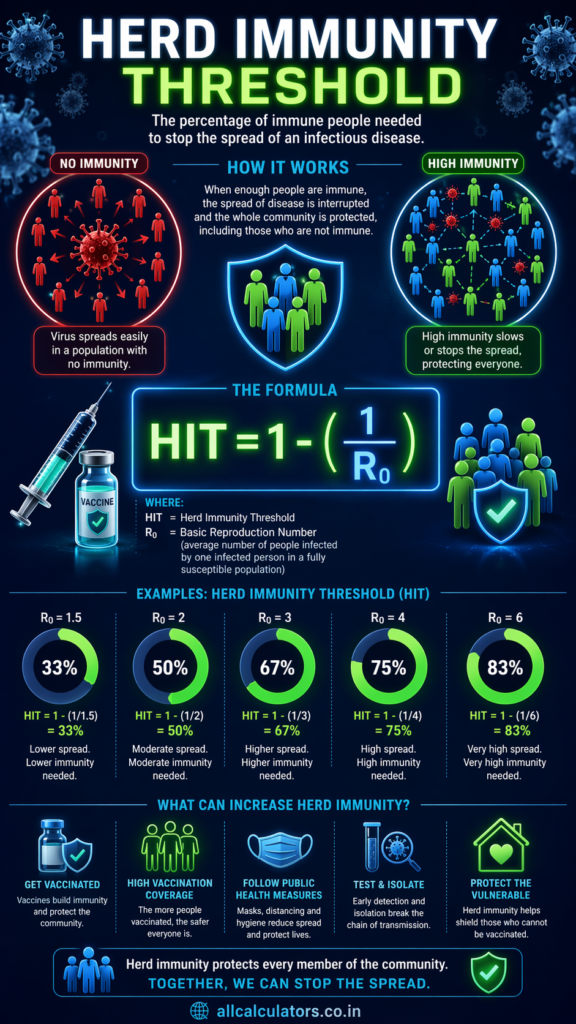
👉 Example Calculations: 🔹 Measles (R₀ ≈ 15): HIT = 1 − (1/15) = ~93% — meaning nearly the entire population must be immune! 🔹 Polio (R₀ ≈ 5–7): HIT ≈ 80–86% 🔹 COVID-19 original strain (R₀ ≈ 2.5–3): HIT ≈ 60–67% 🔹 Seasonal Flu (R₀ ≈ 1.3): HIT ≈ ~23% 🔹 Smallpox (R₀ ≈ 5–7): HIT ≈ 80–85%
The higher the R₀, the more contagious the disease — and the higher the percentage of population that needs immunity to break the transmission chain. 📈🧫
This herd immunity calculator simplifies complex epidemiological calculations into an intuitive interface, allowing students, researchers, and health professionals to quickly determine immunity thresholds. It plays a crucial role in understanding vaccination strategies, outbreak modeling, and infection control policies.
During pandemics like COVID-19, the concept of herd immunity became widely discussed 🌍. Governments and health organizations relied on herd immunity models to decide vaccination targets and public health interventions. However, achieving herd immunity naturally (through widespread infection) can lead to significant morbidity and mortality ⚠️, which is why vaccination programs remain the safest and most effective method.
💉 The Role of Vaccine Efficacy in HIT
In the real world, no vaccine is 100% effective, which means the required vaccination coverage is always slightly higher than the raw HIT. The adjusted formula accounting for vaccine efficacy (E) is:
Required Vaccination Coverage (Vc) = HIT ÷ Vaccine Efficacy (E)
For example, if HIT = 67% and vaccine efficacy = 90%, then the required vaccination coverage = 67% ÷ 0.90 = ~74.4%. 💡 Our calculator seamlessly integrates this real-world factor so you get accurate, practical results — not just theoretical estimates.
The basic reproduction number (R₀) varies between diseases. For example:
- Measles has a very high R₀ (12–18), requiring over 90–95% immunity 📊
- Seasonal flu has a lower R₀ (~1.3), requiring about 23% immunity
- COVID-19 variants showed fluctuating R₀ values depending on mutation and spread dynamics 🔬
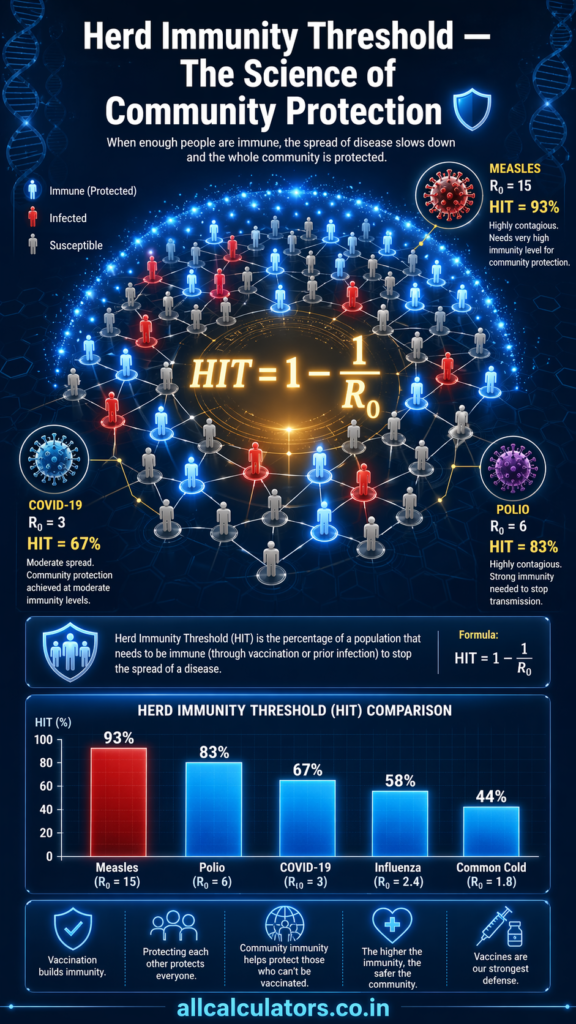
Using this R0 calculator for herd immunity, users can input different values and observe how the required immunity level changes. This makes it an essential educational tool for biology students and a practical resource for epidemiology studies.
Moreover, herd immunity is not a fixed number—it depends on real-world factors such as population density 🏙️, social behavior, mutation rates, and vaccine effectiveness. Therefore, this calculator provides a theoretical baseline, helping users understand the underlying science while acknowledging real-world variability.
From a microbiological perspective, herd immunity demonstrates how collective immunity can interrupt transmission chains 🔗. It highlights the importance of vaccination campaigns and public health awareness. Without sufficient immunity levels, infectious diseases can resurge rapidly, even in partially protected populations.
For educators 📚, this tool enhances learning by transforming abstract formulas into interactive insights. For policymakers 🏛️, it supports data-driven decisions regarding vaccination goals. For students 🧑🎓, it builds a strong conceptual foundation in immunology and disease dynamics.
In conclusion, the Herd Immunity Threshold Calculator is not just a mathematical tool—it is a gateway to understanding how societies control infectious diseases 🌐. By leveraging this calculator, users can explore how immunity, vaccination, and transmission dynamics interact to protect populations and prevent outbreaks.
💡 Real-World Applications of Herd Immunity Threshold in Daily Life
🏫 School & Childhood Vaccination Programs — Schools and daycare centres use HIT data to mandate vaccination rates (e.g., measles requires ~95% coverage), protecting unvaccinated kids with medical conditions like immunodeficiency.
👴 Protecting the Elderly & Immunocompromised — Senior citizens and cancer patients who cannot receive certain vaccines are shielded from infections when the surrounding community is sufficiently vaccinated. This is herd immunity working in your neighbourhood every day! 🛡️
🌍 Travel & International Health Advisories — Before international travel, governments consult HIT data to issue vaccination advisories. If a country falls below its HIT for a disease, travellers face elevated risk. ✈️💉
💰 Health Insurance & Healthcare Planning — Insurance companies and hospital systems use epidemiological data (including HIT projections) to forecast outbreak risks, bed capacity, and vaccination programme costs. 📋
🔬 Biology & Medical Students’ Exam Preparation — HIT calculations are standard questions in NEET PG, USMLE, AIIMS, and international medical entrance exams. 📝🎓
📰 Understanding Pandemic News — During COVID-19, the media frequently discussed “reaching herd immunity.” Our calculator helps you personally verify any such claims instantly! 📺🧠
🏛️ Public Health Policy Advocacy — Citizens and activists use HIT data to push for stronger vaccination campaigns and hold governments accountable for immunization targets. 📣
⚠️ Disclaimer
🧬 The Herd Immunity Threshold Calculator on AllCalculators.co.in is designed exclusively for educational, academic, and general informational purposes in the fields of microbiology, immunology, and public health biology. 📚 All results generated are based on the standard mathematical formula HIT = 1 − (1/R₀) and widely accepted epidemiological models. 📐
🚫 This tool is NOT a substitute for professional medical advice, clinical diagnosis, or public health policy decisions. Real-world disease dynamics are influenced by many complex factors — including population heterogeneity, waning immunity, pathogen mutation, vaccine distribution, and social behaviour — that go beyond this simplified model. 🌐
✅ For accurate public health guidance, always consult qualified healthcare professionals, epidemiologists, and authoritative bodies such as WHO, CDC, ICMR, or your national health ministry. 💉🏥
📣 AllCalculators.co.in is not responsible for any decisions made based on calculator outputs. Use this tool to learn, explore, and understand — not to replace expert judgment! 🙏
📌 Related Calculator
❓ FAQs
❓ What is herd immunity threshold? 🛡️
Herd immunity threshold is the minimum percentage of immune individuals required to stop disease spread in a population.
❓ How does R0 affect herd immunity? 📊
Higher R0 values increase the herd immunity threshold, meaning more people must be immune to control the disease.
❓ Can herd immunity stop pandemics like COVID-19? 🦠
Yes, but it requires high vaccination coverage and effective public health strategies.
❓ Is natural infection enough to achieve herd immunity? ⚠️
No, relying on natural infection can be dangerous; vaccination is the safest approach.
❓ Why is herd immunity important in epidemiology? 🧬
It helps prevent outbreaks and protects vulnerable individuals who cannot be vaccinated.