
🌿 Biomass Accumulation Rate Calculator
📐 Formula Used
🧮 Step-by-Step Solution
A positive BAR indicates net biomass gain (growth). A negative BAR indicates net biomass loss (decomposition, harvesting, or die-off).
BAR assumes a linear rate of change over the measured interval. For non-linear growth, use instantaneous rates (dB/dt) with calculus-based models.
Table of Contents
✍️ Author & Academic Authority: Dr. Nitish Kr. Bharadwaj
📘 Qualifications: B.Sc., B.Ed., M.Sc., Ph.D. (Biochemistry), MBA (Financial Management)
🌿 Biomass Accumulation Rate Calculator
Measure Plant & Ecosystem Growth Instantly 🌍🔬
Life on Earth is powered by one extraordinary process — the ability of plants, algae, and microorganisms to convert sunlight, water, and carbon dioxide into organic matter 🌱☀️. This organic matter — collectively known as biomass — is the very currency of ecology, agriculture, climate science, and environmental biology. The rate at which biomass is produced, accumulated, and stored across an ecosystem tells us everything: how productive a forest is, how healthy a grassland remains, how much carbon a wetland captures, and how rapidly a crop will yield 🌾🌳. Our free online 🌿 Biomass Accumulation Rate (BAR) Calculator at AllCalculators.co.in is your precision tool to quantify this process instantly — designed for students, researchers, farmers, ecologists, and environmental professionals alike.
🔬 What is Biomass Accumulation Rate (BAR)?
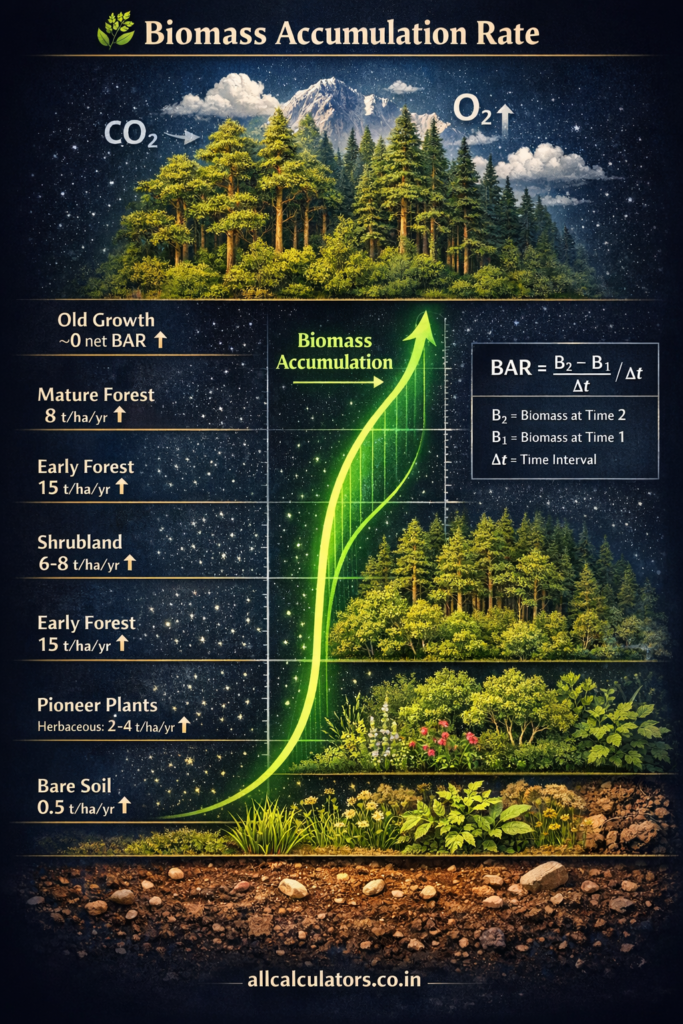
The Biomass Accumulation Rate (BAR) is a fundamental ecological metric that quantifies how rapidly biological organisms — or entire ecosystems — gain organic mass over a defined time period 📅. In its simplest form, the biomass accumulation rate formula is expressed as:
BAR = (B₂ − B₁) ÷ (t₂ − t₁)
Where:
- 🌱 B₁ = Initial biomass (measured in grams/kg/tonnes per unit area) at time t₁
- 🌳 B₂ = Final biomass at time t₂
- ⏱️ (t₂ − t₁) = Time interval over which accumulation is measured (days, months, or years)
- 📊 BAR result = Expressed in g/day, kg/year, tonnes/hectare/year, or g·m⁻²·yr⁻¹
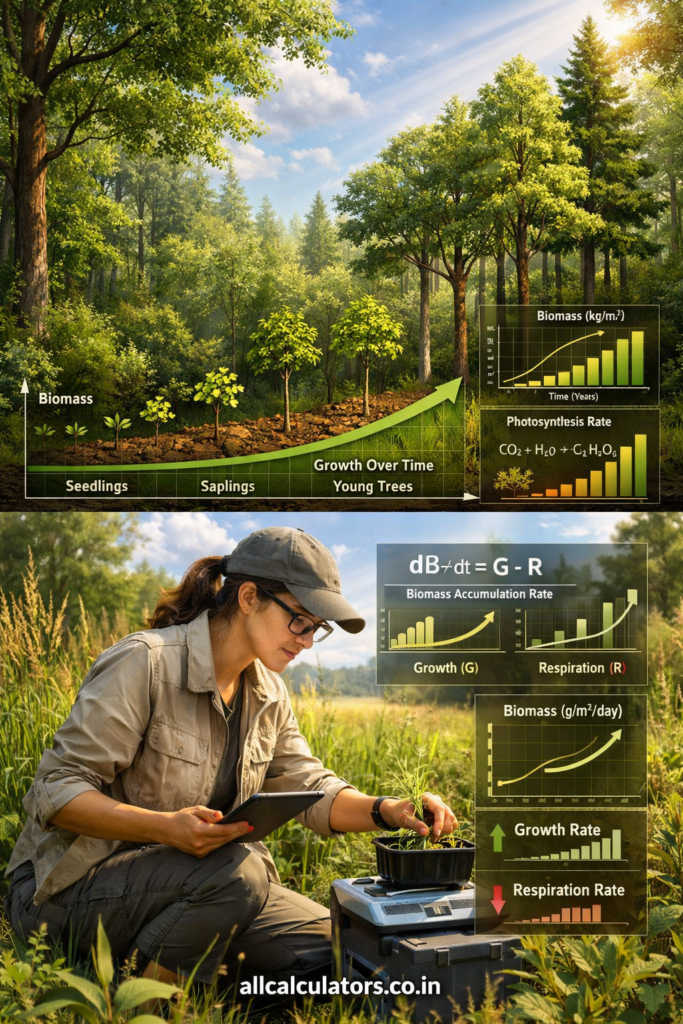
This formula captures the net change in biological mass over time — the difference between gross biomass gains (through photosynthesis, growth, and reproduction) and losses (through respiration, decomposition, mortality, and herbivory). A positive BAR means the ecosystem or organism is growing and storing biomass 🟢; a negative BAR signals biomass loss — a warning sign of ecosystem degradation, disease, drought, or over-harvesting 🔴.
🌍 Biomass in the Context of Ecology & Environmental Biology
Biomass is far more than a number — it is the ecological pulse of a living system 💚. In environmental biology and ecology, biomass accumulation underpins three of the most critical concepts studied today:
🌱 Net Primary Productivity (NPP) — NPP represents the total organic carbon fixed by plants through photosynthesis (Gross Primary Production or GPP) minus the carbon lost through plant respiration (Ra). The formula is: NPP = GPP − Ra. NPP is essentially the driver of biomass accumulation in terrestrial and aquatic ecosystems. Globally, terrestrial NPP is estimated at approximately 56.4 Pg C yr⁻¹ (petagrams of carbon per year) — a staggering testament to the productive power of Earth’s vegetation 🌐.
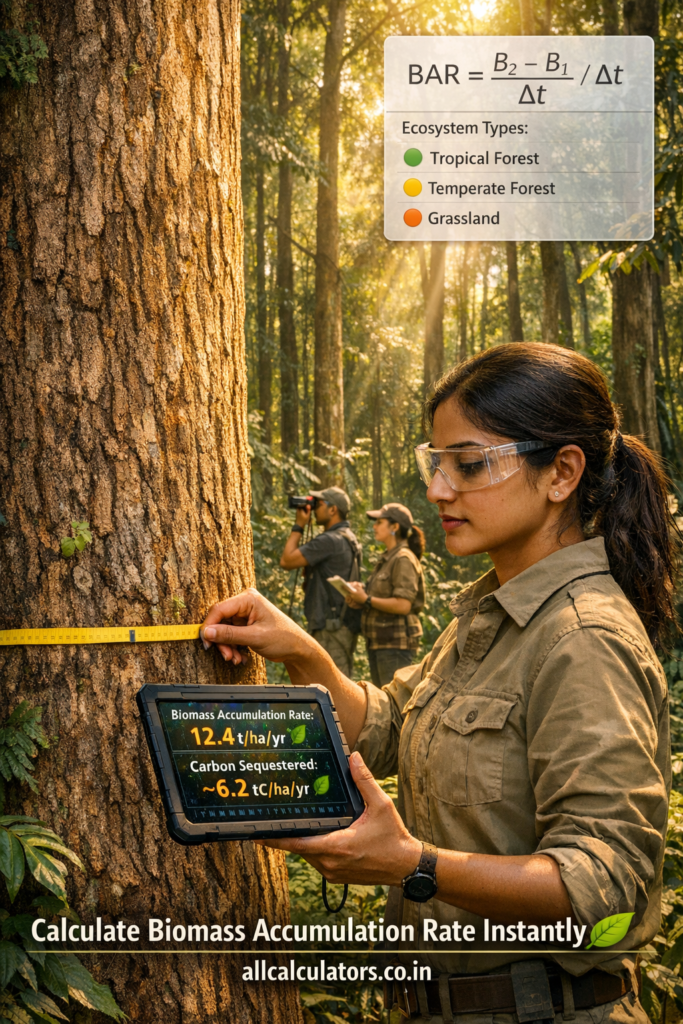
🌲 Carbon Sequestration & Storage — Plants accumulate biomass by fixing atmospheric CO₂ through photosynthesis 🌬️. Approximately 50% of dry plant biomass is carbon — meaning that every kilogram of biomass gained represents roughly 500 grams of carbon removed from the atmosphere and stored in living tissue. This linkage between biomass accumulation and carbon sequestration makes the BAR Calculator not just an ecology tool, but also a climate science tool of immense importance 🌡️.
♻️ Ecosystem Succession & Carbon Cycling — As ecosystems mature through ecological succession — from bare ground → pioneer species → shrubland → secondary forest → climax forest 🏞️ — biomass accumulates rapidly in the early stages and then gradually decelerates as the ecosystem approaches a biomass equilibrium. Old-growth forests, for instance, may show near-zero net BAR because litterfall (biomass loss) nearly equals NPP (biomass gain). Understanding this trajectory is critical for forest conservation, reforestation, and REDD+ (Reducing Emissions from Deforestation and Degradation) projects worldwide 🌿.
📐 Types of Biomass Accumulation Measurements
Scientists and ecologists distinguish between several types of biomass measurements that feed into BAR calculations 📋:
🌿 Above-Ground Biomass (AGB) — Includes stems, branches, leaves, and reproductive structures. Measured using allometric equations based on DBH (Diameter at Breast Height) and height: AGB = a × (ρ × DBH² × H)^b where ρ is wood density, DBH is trunk diameter, and H is tree height (Chave et al. 2005 formula).
🪨 Below-Ground Biomass (BGB) — Root systems, typically estimated as BGB ≈ 20–25% of AGB (IPCC default ratio). Together, AGB + BGB = Total Biomass, which is the basis of the BAR formula.
🌾 Absolute Growth Rate (AGR) — The actual increase in biomass per unit time: AGR = (B₂ − B₁) ÷ (t₂ − t₁). Identical to the BAR formula — making it directly applicable to crop science, agriculture, and plant physiology as well as ecosystem ecology.
🔄 Relative Growth Rate (RGR) — Normalizes BAR against the initial biomass to allow fair comparison between plants or ecosystems of different sizes: RGR = [ln(B₂) − ln(B₁)] ÷ (t₂ − t₁). RGR is expressed in g·g⁻¹·day⁻¹ and is widely used in crop improvement, plant ecology, and climate change research 🌡️.
📊 Net Biomass Change — A more comprehensive calculation that accounts for both gains and losses: ΔBiomass(net) = ΔBiomass(gross increase) − ΔBiomass(gross decrease). This is used in forestry management, where insect infestations, storms, and logging losses must be subtracted from raw growth figures.
🧪 How to Use the Biomass Accumulation Rate Calculator
Using our 🌿 BAR Calculator at AllCalculators.co.in is incredibly straightforward 🎯:
1️⃣ Enter Initial Biomass (B₁) — Input the starting dry weight of your plant, forest stand, aquatic organism, or ecosystem in your chosen unit (grams, kg, or tonnes per area).
2️⃣ Enter Final Biomass (B₂) — Input the ending dry weight measured after the observation period.
3️⃣ Enter Time Interval (Δt) — Specify the time between measurements in days, months, or years.
4️⃣ Select Units — Choose your preferred output units (g/day, kg/year, t/ha/year).
5️⃣ Click Calculate ⚡ — The calculator instantly delivers your Biomass Accumulation Rate (BAR), with clear interpretation of whether your system is gaining, stable, or losing biomass.
🌱 Real-World BAR Values — How Do Ecosystems Compare?
Understanding what a BAR value means requires reference benchmarks 📊. Here are typical biomass accumulation rates for major terrestrial ecosystems:
| 🌍 Ecosystem Type | 📊 Typical BAR (t DM/ha/yr) | 🌡️ Carbon Equivalent |
|---|---|---|
| 🌴 Tropical Rainforest | 10–30 t/ha/yr | 5–15 tC/ha/yr |
| 🌲 Temperate Forest | 5–15 t/ha/yr | 2.5–7.5 tC/ha/yr |
| 🌿 Tropical Grassland | 3–8 t/ha/yr | 1.5–4 tC/ha/yr |
| 🌾 Agricultural Cropland | 4–12 t/ha/yr | 2–6 tC/ha/yr |
| 🌵 Dryland / Savanna | 0.5–3 t/ha/yr | 0.25–1.5 tC/ha/yr |
| 🏞️ Old-Growth Forest | ~0 (equilibrium) | Near-zero net |
| 🌊 Coastal Mangrove | 8–25 t/ha/yr | 4–12 tC/ha/yr |
🌍 Applications in Daily Life
🌾 Agriculture Optimization
Farmers use the biomass accumulation rate calculator to track crop growth, improve yield, and optimize fertilizer usage.
🌳 Forest Management
Helps in estimating tree growth, timber production, and maintaining ecological balance using ecosystem productivity calculations.
🌱 Gardening & Plant Care
Gardeners can monitor plant health and growth using plant biomass growth rate tools.
🌍 Climate Change Studies
Used to measure carbon storage and evaluate how ecosystems reduce CO₂ using biomass growth rate formulas.
📚 Education & Research
Students and researchers use biomass calculation ecology tools for experiments and academic projects.
🏞️ Environmental Conservation
Helps NGOs and scientists analyze ecosystem recovery and biodiversity restoration.
⚠️ Disclaimer 🚨
This Biomass Accumulation Rate Calculator 🌱📊 is designed for educational and informational purposes only. While it provides accurate results based on standard ecological formulas, actual biomass growth may vary depending on environmental conditions, species differences, climate factors, and measurement accuracy 🌍.
Users are advised to consult professional ecologists, agronomists, or environmental experts for critical research, scientific publications, or commercial applications 🌾. This tool should not replace field measurements or laboratory analysis but rather serve as a supportive digital resource.
📌 Related Calculator
❓ FAQs Section🌟
🌱 What is biomass accumulation rate?
Biomass accumulation rate is the rate at which living organisms gain mass over time, commonly used in ecology and environmental biology.
📊 How do you calculate biomass growth rate?
You can calculate it using the formula: Biomass Growth Rate = (Final Biomass − Initial Biomass) ÷ Time.
🌿 Why is biomass important in ecosystems?
Biomass indicates ecosystem productivity and helps measure carbon storage and energy flow.
🌍 What is the difference between biomass and productivity?
Biomass is the total mass of living organisms, while productivity refers to the rate of biomass production.
🌾 Who uses biomass accumulation calculators?
Students, researchers, farmers, environmental scientists, and forestry professionals use these tools.