
📖 About NPP — Typical Values & Ecosystem Reference
Net Primary Productivity (NPP) measures the rate at which plants accumulate organic matter after accounting for their own respiratory energy costs. It is a cornerstone metric in ecology, climate modelling, and food-web studies.
🔬 Practical tip: NPP is always ≤ GPP. If your result is negative, autotrophic respiration exceeds photosynthesis — re-check your inputs.
| Ecosystem | Typical NPP (g C/m²/yr) |
|---|---|
| 🌧️ Tropical Rainforest | 800 – 3 500 |
| 🌾 Temperate Grassland | 150 – 500 |
| 🌊 Open Ocean | 2 – 400 |
| 🌵 Desert / Semi-arid | 1 – 200 |
| 🌲 Boreal Forest (Taiga) | 200 – 600 |
| 🌿 Wetlands / Estuaries | 500 – 2 000 |
| 🧊 Tundra | 10 – 400 |
Table of Contents
✍️ Author & Academic Authority: Dr. Nitish Kr. Bharadwaj
📘 Qualifications: B.Sc., B.Ed., M.Sc., Ph.D. (Biochemistry), MBA (Financial Management)
🌱 Net Primary Productivity Calculator
Instantly Calculate NPP from GPP & Respiration | Ecology & Environmental Science
Have you ever wondered how much energy a forest, a grassland, or even a vast ocean actually produces for the living world? 🌍 The answer lies in one of ecology’s most powerful concepts — Net Primary Productivity (NPP). Whether you are a student preparing for NEET, JEE, or competitive exams, a researcher studying climate change, an environmental scientist tracking ecosystem health, or simply a curious learner passionate about the planet 🌿, our free online Net Primary Productivity Calculator gives you an instant, accurate, and easy-to-understand result in seconds. No complex formulas, no confusion — just enter your values and get your NPP calculated right away! ⚡
🔬 What is Net Primary Productivity (NPP)?
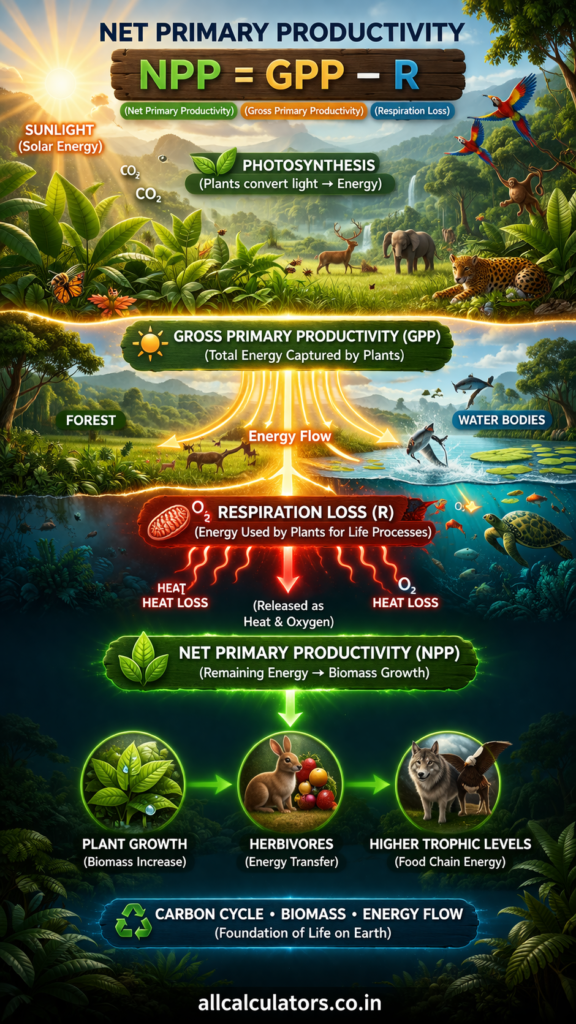
Net Primary Productivity (NPP) refers to the rate at which all the plants and photosynthetic organisms in an ecosystem produce net useful chemical energy — in the form of organic biomass — after accounting for the energy they consume through their own cellular respiration 🌞➡️🍃. It is one of the most critically important metrics in ecology and environmental biology because it tells us exactly how much energy is left over and available for all the other organisms — herbivores, carnivores, decomposers, and ultimately humans — in the food web 🦌🐺🍄.
In the simplest terms: 📐 NPP = GPP − R
Where:
- 🌿 GPP (Gross Primary Productivity) = The total rate of carbon or energy fixed by plants through the process of photosynthesis. This is the absolute maximum energy that the ecosystem can capture from sunlight.
- 🌬️ R (Respiration Loss) = The energy that the plants themselves consume through cellular respiration to carry out their own metabolic processes — growth, reproduction, nutrient uptake, and maintenance of living tissue.
- ✅ NPP = The actual, usable surplus energy that is stored as biomass and passed on to the rest of the food chain.
NPP is typically expressed in units of grams of carbon per square meter per year (gC/m²/yr), though it can also be expressed in kgC/m²/yr or MgC/ha/yr depending on the scale of study. Our calculator supports all major units for your convenience. 🛠️
📊 Understanding GPP vs. NPP — The Core Difference
Many students and researchers get confused between Gross Primary Productivity (GPP) and Net Primary Productivity (NPP). Let’s clear this up once and for all! 💡
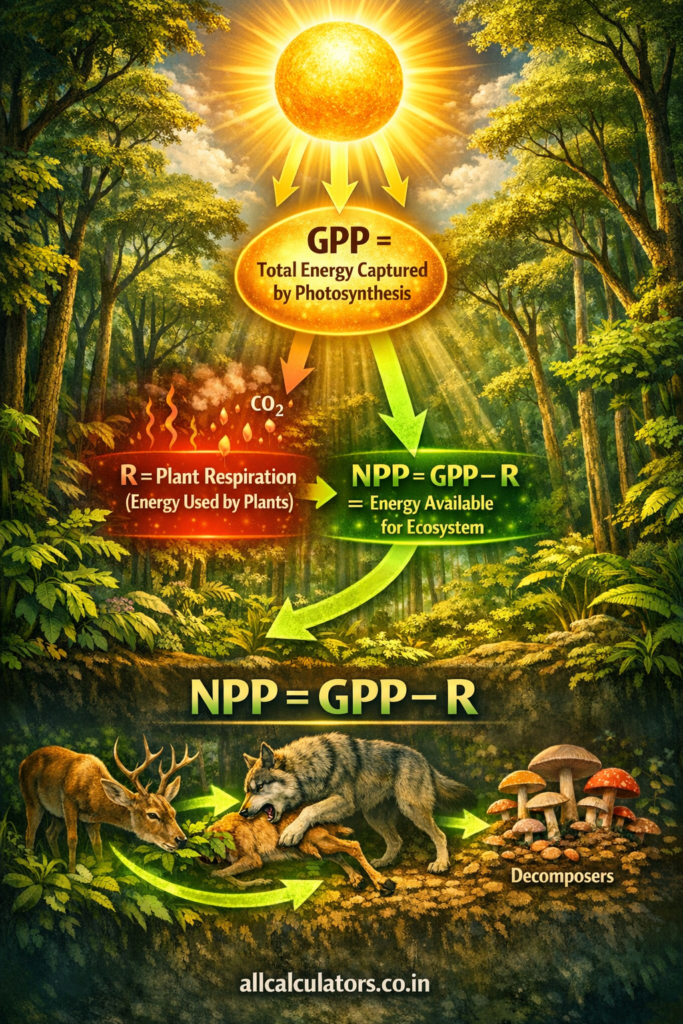
🌟 GPP is the BIG picture — it is everything the ecosystem captures from sunlight through photosynthesis. Think of it as the total income of a factory before any expenses.
🌟 NPP is the NET result — it is what remains after plants “spend” energy on their own survival through respiration. Think of it as the profit after operational costs.
For example: If a tropical rainforest has a GPP of 2,200 gC/m²/yr and the plants use 1,200 gC/m²/yr for their own respiration, then the NPP is 1,000 gC/m²/yr. This 1,000 grams of carbon per square meter per year is what gets channeled into new leaves, wood, roots, and ultimately into all the animals and organisms that depend on plants for food 🦋🐘.
🌏 How Does NPP Vary Across Ecosystems?
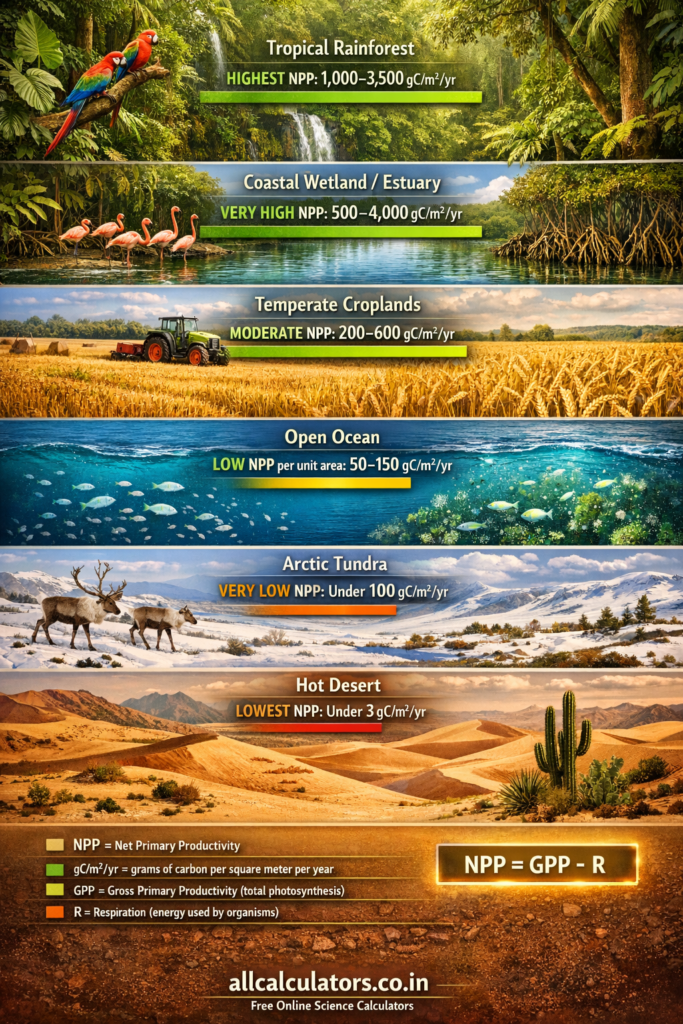
Not all ecosystems are equally productive! 🌱 Understanding this variation is fundamental to environmental science, conservation biology, and climate change research. Here is a quick overview of NPP across major global biomes:
🌴 Tropical Rainforests — Among the highest NPP on Earth, often exceeding 1,000 to 3,500 gC/m²/yr. Warm temperatures, abundant sunlight, and heavy rainfall create ideal photosynthetic conditions.
🌾 Temperate Grasslands & Croplands — Moderate NPP ranging from 200 to 600 gC/m²/yr. These are hugely important for global food production and agriculture.
🌊 Open Oceans — Despite covering over 70% of Earth’s surface, the open ocean has relatively low NPP (around 50 to 150 gC/m²/yr) due to limited nutrients. However, because of their sheer size, they contribute massively to global carbon cycling 🐟.
🌿 Coastal Wetlands & Estuaries — Extremely high NPP (often 500 to 4,000 gC/m²/yr) per unit area, making them ecological powerhouses and critical carbon sinks.
🏜️ Deserts — Very low NPP, sometimes below 3 gC/m²/yr, due to extreme water scarcity and harsh temperature fluctuations.
❄️ Tundra & Polar Regions — Very low NPP (under 100 gC/m²/yr), limited by cold temperatures, short growing seasons, and frozen soils.
🔑 Key Factors that Influence Net Primary Productivity
Several environmental and biological factors control how productive an ecosystem can be. Our NPP Calculator helps you quantify the result, but knowing these factors helps you interpret WHY the numbers are what they are: 🧠
☀️ 1. Sunlight Availability — The primary driver of photosynthesis. More sunlight = more GPP potential. Tropical regions near the equator receive the most consistent solar radiation year-round.
💧 2. Water Availability — Water is a direct raw material for photosynthesis. Drought conditions dramatically reduce NPP, as seen in arid and semi-arid ecosystems.
🌡️ 3. Temperature — Warm temperatures (within optimal range) accelerate enzyme activity in photosynthesis. However, extreme heat increases plant respiration (R), thereby reducing NPP even if GPP increases.
🌱 4. Soil Nutrient Content — Nitrogen (N), Phosphorus (P), and Potassium (K) directly control how efficiently plants can conduct photosynthesis and build biomass. Nutrient-poor soils drastically limit NPP.
🌫️ 5. CO₂ Concentration — Rising atmospheric CO₂ levels can act as a “fertilizer effect,” potentially boosting GPP. However, climate models from 2025 show that this CO₂ fertilization benefit is declining as nutrient limitations and heat stress increase.
🏭 6. Human Activities — Deforestation, urbanization, land use change, and pollution can drastically reduce NPP in affected regions, while afforestation and sustainable farming can increase it.
🌊 7. Seasonal Variation — Temperate ecosystems show strong seasonal swings in NPP, peaking in summer and dropping near zero in winter.
🧮 The NPP Formula — Step-by-Step Calculation
Using our Net Primary Productivity Calculator is as easy as 1-2-3! 🎯 But let’s also understand the manual formula so you can excel in your exams and research:
Formula: NPP = GPP − R
📝 Example 1 (Basic):
- GPP = 1,500 gC/m²/yr
- Respiration (R) = 600 gC/m²/yr
- NPP = 1,500 − 600 = 900 gC/m²/yr ✅
📝 Example 2 (Reverse — Finding GPP from NPP):
- NPP = 2,000 kcal/m²/yr (given wetland data)
- Respiration (R) = 18,000 kcal/m²/yr
- GPP = NPP + R = 2,000 + 18,000 = 20,000 kcal/m²/yr ✅
This reverse calculation is common in NEET biology questions and ecology research — our calculator handles BOTH forward and reverse calculations smoothly! 🏆
🌍 NPP and the Global Carbon Cycle — Why It Matters More Than Ever
In the age of climate change, NPP has taken center stage in global environmental research 🌡️🔥. Here is why:
Plants, through photosynthesis, absorb CO₂ from the atmosphere and convert it into organic carbon stored in their biomass. The NPP represents the NET amount of this carbon that actually stays locked in the ecosystem rather than being immediately returned to the atmosphere through respiration. This makes NPP a direct measure of an ecosystem’s carbon sequestration capacity — its ability to act as a carbon sink and help offset greenhouse gas emissions 🌱💚.
Recent peer-reviewed research published in 2025 in Nature and Communications Earth & Environment reveals alarming findings: Earth system models are underestimating the decline in marine NPP associated with ocean warming. Phytoplankton — the microscopic photosynthetic organisms of the ocean — are responsible for roughly half of all global NPP. As oceans warm, their productivity drops, weakening one of our planet’s most important carbon sinks. 🐠🌊
On land, research tracking India’s terrestrial NPP shows that while overall productivity increased recently due to CO₂ fertilization, the benefit is projected to weaken significantly by mid-century due to heat stress and nutrient limitations. This means that ecosystems we have relied upon as carbon sinks may become less effective — making monitoring and understanding NPP more urgent than ever.
🛰️ Modern Methods of Measuring NPP
Beyond the simple formula (NPP = GPP − R), modern ecology uses advanced technologies to measure and map NPP at large scales: 📡
🛸 Remote Sensing & Satellite Data — NASA’s MODIS satellite platform provides global NPP estimates using vegetation indices like NDVI (Normalized Difference Vegetation Index) and EVI (Enhanced Vegetation Index). These tools allow scientists to track ecosystem productivity across entire continents.
📊 Eddy Covariance Towers — Ground-based instruments that measure the actual flux of CO₂ between the ecosystem and the atmosphere in real time. These provide highly accurate local NPP values.
🔬 Biometric Methods — Direct measurement of plant biomass through harvesting, weighing, and chemical analysis — the “gold standard” for ground-truth data.
💻 Ecological Models — Process-based models like BIOME-BGC and the CASA model simulate NPP using climate inputs, soil data, and satellite-derived vegetation parameters.
🎓 NPP in Academic Curricula — NEET, JEE & Beyond
For Indian students 🇮🇳 preparing for NEET (National Eligibility cum Entrance Test) and other competitive biology exams, Net Primary Productivity is a highly important concept in the Ecology & Environment chapter of Class 11 and Class 12 Biology syllabus. Questions on NPP, GPP, and ecosystem energy flow appear consistently in NEET exams. Our free calculator helps you:
✅ Verify your manual calculations instantly ✅ Practice with different unit conversions (gC/m²/yr, kgC/m²/yr, MgC/ha/yr) ✅ Build strong conceptual understanding through worked examples ✅ Save time during exam revision and assignment solving.
🌍 Applications in Daily Life
🌾 Agriculture Productivity Analysis
Farmers and agronomists use net primary productivity calculations to estimate crop yield and optimize farming efficiency.
🌳 Forest Management & Conservation
Forestry experts rely on NPP data to assess forest growth, biomass accumulation, and carbon storage capacity.
🌦️ Climate Change Monitoring
Scientists use NPP formula tools to evaluate carbon sequestration and predict global warming trends.
🐄 Food Chain Energy Flow
Understanding ecosystem productivity helps determine how much energy is available for animals and humans.
🏙️ Urban Planning & Sustainability
Planners use ecological productivity metrics to design greener, more sustainable cities.
📚 Education & Competitive Exams
Students use NPP calculators to solve biology and environmental science problems quickly and accurately.
⚠️ Disclaimer
⚠️ This Net Primary Productivity Calculator is designed for educational and informational purposes only. While we strive to provide highly accurate results based on standard ecological formulas, users are advised to verify calculations for critical academic, research, or professional applications 📊. Results may vary depending on input accuracy and assumptions used in ecological models. Always consult textbooks, scientific literature, or experts for advanced analysis 🌱.
📌 Related Calculator
❓ FAQs Section
❓ What is Net Primary Productivity (NPP)? 🌿
Net Primary Productivity (NPP) is the amount of energy stored by plants after subtracting respiration losses from Gross Primary Productivity.
❓ What is the formula for NPP calculation? 📊
The formula is: NPP = GPP − Respiration (R).
❓ Why is Net Primary Productivity important? 🌍
It determines ecosystem health, energy flow, carbon storage, and biodiversity support.
❓ What is the difference between GPP and NPP? ⚖️
GPP is total energy captured, while NPP is the energy available after respiration losses.
❓ Where is NPP highest in nature? 🌴
Tropical rainforests and wetlands have the highest Net Primary Productivity.