
🌿 Simpson’s Diversity Index Calculator
📐 Formulae Used
| # | 🌱 Species Name (optional) | 👥 No. of Individuals (ni) | 🗑 |
|---|
💡 Interpretation
📝 Step-by-Step Solution
Table of Contents
✍️ Author & Academic Authority: Dr. Nitish Kr. Bharadwaj
📘 Qualifications: B.Sc., B.Ed., M.Sc., Ph.D. (Biochemistry), MBA (Financial Management)
🌿 Simpson's Diversity Index Calculator
Instantly Measure Biodiversity & Ecological Balance Online
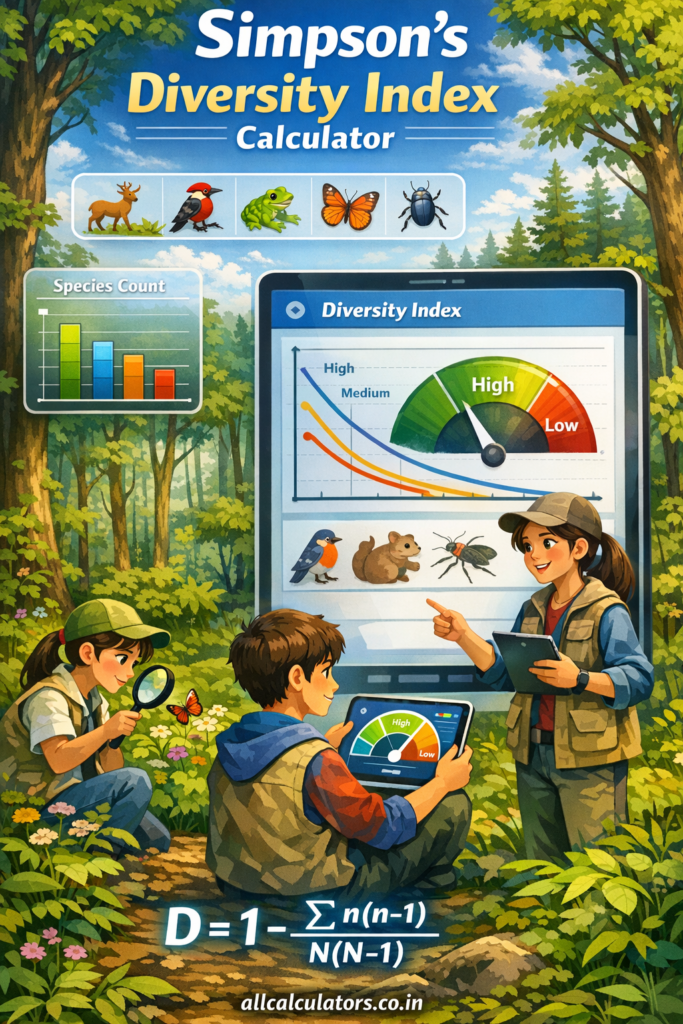
🌍 Understanding the richness and balance of life on Earth has never been more critical — and Simpson's Diversity Index Calculator is your most powerful, free, and instant online tool to do exactly that. Whether you are a biology student working on your ecology fieldwork assignment, an environmental scientist conducting habitat health assessments, a researcher studying population biology, or simply a curious learner who wants to understand how biodiversity is measured, this calculator gives you accurate, ready-to-use results in seconds. No textbook formula grinding. No complex spreadsheets. Just enter your species population data and get your Simpson's Diversity Index value instantly. 🎯
🔬 What is Simpson's Diversity Index?
Simpson's Diversity Index (SDI) is one of the most widely used and respected measures of biodiversity in the entire field of ecology and environmental biology. It was first introduced by the British statistician Edward H. Simpson in 1949 in a landmark paper published in the scientific journal Nature. The index is designed to quantify the diversity of a biological community by taking into account two fundamental components simultaneously: species richness (how many different species are present) and species evenness (how evenly the individuals are distributed among those species). This dual consideration makes Simpson's index far more informative than simply counting the number of species alone. 📊
The core concept behind Simpson's Diversity Index is elegantly probabilistic. The original Simpson's Index (D) calculates the probability that two individuals, randomly selected from a community, will belong to the same species. A high value of D (close to 1) indicates low diversity — meaning the community is dominated by one or very few species. A low value of D (close to 0) suggests high diversity. Because this is counterintuitive for most users, ecologists commonly prefer to work with two transformations: the Simpson's Index of Diversity (1 – D) and the Inverse Simpson's Index (1/D). The Index of Diversity (1 – D) ranges from 0 to 1, where values closer to 1 represent greater biological diversity and a healthier, more balanced ecosystem. 🌱
📐 The Simpson's Diversity Index Formula — Explained Clearly
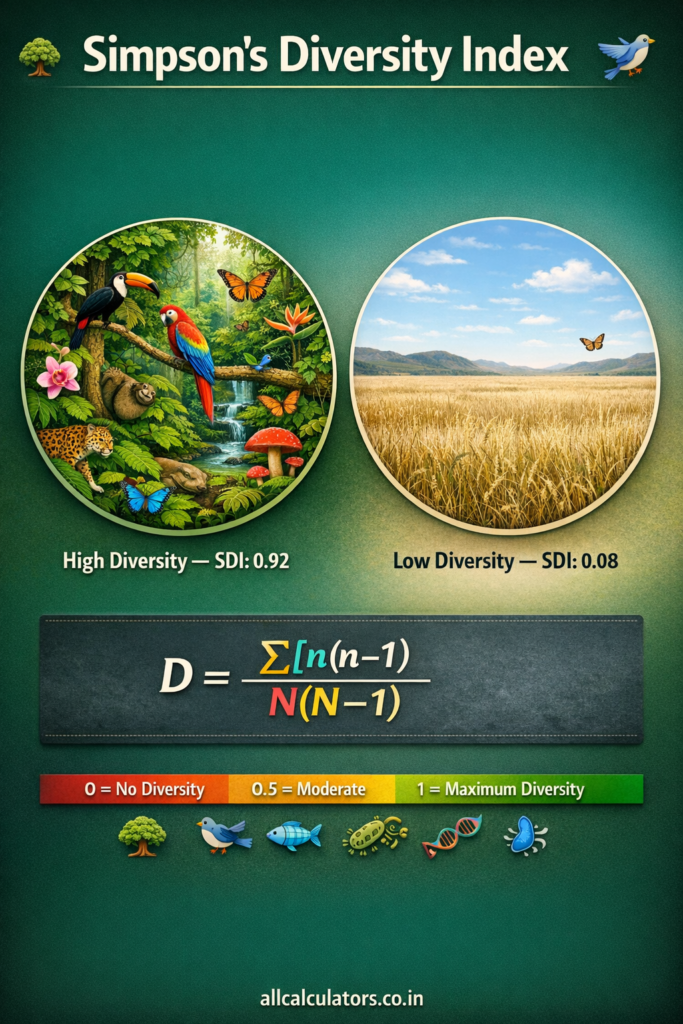
The formula for Simpson's Index (D) is: D = Σ [n(n – 1)] / [N(N – 1)]
Where:
- n = the total number of organisms of a particular species
- N = the total number of organisms of all species combined
- Σ = the sum across all species in the community
Once D is calculated, the Simpson's Index of Diversity is simply: 1 – D
And the Inverse Simpson's Index is: 1/D
Our Simpson's Diversity Index Calculator automates every step of this process. You simply input the population count for each species in your sample, and the tool instantly computes D, the Index of Diversity (1 – D), and the Reciprocal Index (1/D) — giving you a complete biodiversity picture with zero manual effort. ⚡
🌾 Why Does Biodiversity Measurement Matter?
Biodiversity is the cornerstone of a healthy, functional, and resilient ecosystem. Ecosystems with high species diversity are more stable, more productive, and far better equipped to recover from environmental disturbances such as floods, droughts, wildfires, or disease outbreaks. When diversity is low and one species dominates a community, the ecosystem becomes fragile — a single pest, pathogen, or climate event can cause catastrophic collapse. Scientists, ecologists, and conservation planners use Simpson's Diversity Index as a quantitative tool to detect these warning signs early and design effective intervention strategies. 🛡️
For students and researchers, calculating the Simpson's Diversity Index forms a core component of ecological fieldwork. You might be studying the plant diversity of a grassland quadrat, comparing the fish species in two different rivers, analyzing invertebrate communities in soil samples, or assessing the impact of deforestation on bird populations. In every case, the Simpson's Diversity Index provides a single, meaningful, and comparable numerical score that captures the health and balance of the community you are studying. 🐦
🧮 How to Use This Simpson's Diversity Index Calculator?
Using this free online tool is remarkably simple and requires no special training:
Step 1 🖊️ — Enter the name or label of each species in your sample (e.g., Species A, Species B, Oak Tree, Common Sparrow, etc.).
Step 2 🔢 — Enter the number of individuals observed for each species.
Step 3 ➕ — Add more species rows as needed (the calculator supports multiple species).
Step 4 ⚡ — Click the "Calculate" button and instantly receive: • Simpson's Index (D) — the dominance score • Simpson's Index of Diversity (1 – D) — the true diversity score • Inverse Simpson's Index (1/D) — the effective species richness
Step 5 📋 — Interpret your result using the built-in result guide.
🔄 Comparing Communities with Simpson's Index
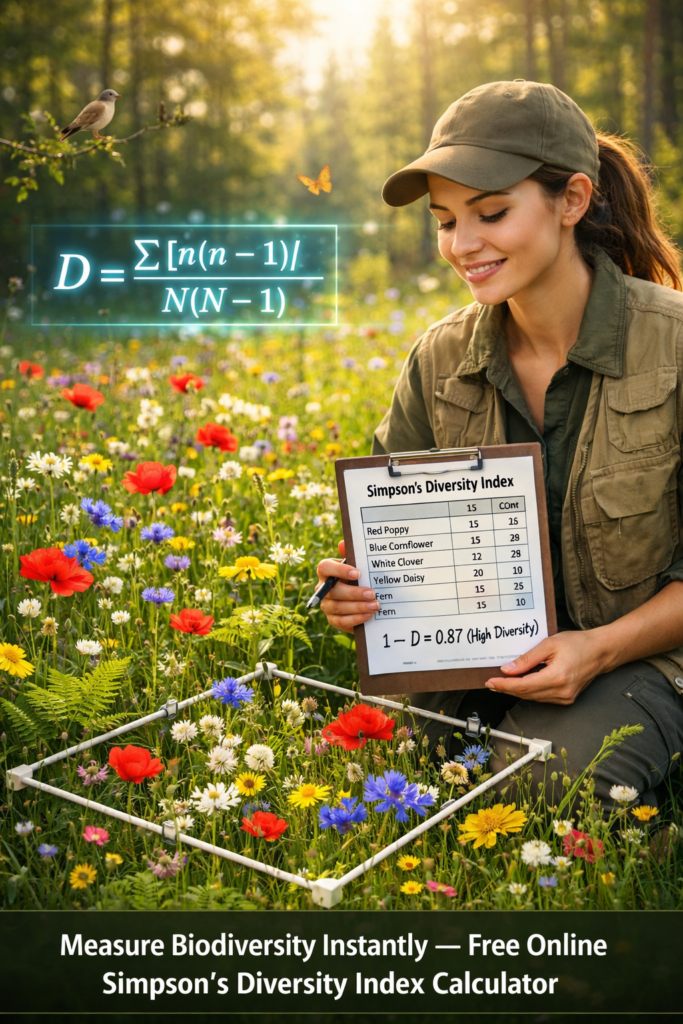
One of the most powerful uses of this calculator is comparing biodiversity between two or more communities, habitats, or time periods. For example, if Forest A gives an SDI of 0.85 and Forest B gives an SDI of 0.42, you can scientifically conclude that Forest A is significantly more biologically diverse. This kind of comparison is invaluable for environmental impact assessments, conservation prioritization, ecological restoration planning, and academic research. 🌳
📜 Historical Background & Scientific Credibility
Edward H. Simpson introduced this measure in his 1949 Nature paper "Measurement of Diversity," a work that has since become one of the most cited papers in the entire ecological sciences. Interestingly, the same mathematical formula was independently rediscovered by economists as the Herfindahl-Hirschman Index (HHI), which is now used globally to measure market concentration and economic competition. This remarkable cross-disciplinary relevance speaks to the mathematical elegance and universal applicability of Simpson's foundational idea. 🏆
Today, Simpson's Diversity Index remains a standard analytical tool in environmental impact studies, biological conservation research, population ecology, microbial ecology, genetic diversity studies, and even social science diversity measurements. Its widespread adoption in peer-reviewed ecological research and educational curricula worldwide establishes it as a time-tested, scientifically validated metric you can trust. ✅
🎓 Who Should Use This Calculator?
✔️ High school and university biology, ecology & environmental science students ✔️ Field ecologists, wildlife biologists, and conservation scientists ✔️ Environmental consultants preparing biodiversity assessments ✔️ Geography teachers and students studying quadrat sampling ✔️ Researchers in population genetics, microbiology & environmental health ✔️ Nature enthusiasts and biodiversity citizen scientists
Whether you're tackling a class project, preparing a fieldwork report, or conducting professional research, our free Simpson's Diversity Index Calculator at AllCalculators.co.in is built to deliver fast, accurate, and reliable results — every single time. 🚀
🌍 Applications in Daily Life
🌿 Environmental Monitoring
Use the Simpson’s Diversity Index calculator to track biodiversity changes in forests, lakes, and ecosystems.
📊 Academic Assignments & Exams
Students frequently search for Simpson diversity index examples and solutions—this tool simplifies calculations instantly.
🏙️ Urban Planning & Sustainability
Helps planners assess biodiversity impact before construction or development projects.
🐾 Wildlife Conservation
Environmentalists use biodiversity index tools to monitor endangered species and ecosystem balance.
🌱 Agriculture & Crop Diversity
Farmers and researchers evaluate crop diversity for sustainable farming practices.
🧪 Scientific Research
Used in ecological and environmental biology studies for accurate species distribution analysis.
⚠️ Disclaimer
⚠️ This Simpson’s Diversity Index Calculator is designed for educational and informational purposes only 📘. While the tool provides highly accurate results based on standard ecological formulas, users should verify calculations when using data for professional research or environmental decision-making 🌍.
📊 Results may vary depending on input accuracy. Always ensure correct species count and data entry for reliable outcomes.
🚫 This tool does not replace expert ecological analysis but serves as a quick and efficient biodiversity calculation aid online.
📌 Related Calculator
❓ FAQs Section
❓ What is Simpson’s Diversity Index?
Simpson’s Diversity Index is a statistical measure used in ecology to calculate biodiversity by considering both species richness and abundance.
❓ How do you calculate Simpson’s Diversity Index?
You use the formula: D = 1 - [Σ n(n-1) / N(N-1)]. This calculator automates the process instantly.
❓ Why is Simpson’s Diversity Index important?
It helps measure ecosystem health, stability, and biodiversity levels in environmental studies.
❓ What does a high Simpson index value mean?
A higher value indicates greater biodiversity and a more balanced ecosystem.
❓ Can students use this biodiversity calculator?
Yes ✅! This tool is perfect for students, researchers, and educators working on ecology and environmental biology problems.