
🌱 Population Growth Rate Calculator
Table of Contents
✍️ Author & Academic Authority: Dr. Nitish Kr. Bharadwaj
📘 Qualifications: B.Sc., B.Ed., M.Sc., Ph.D. (Biochemistry), MBA (Financial Management)
🌍 Population Growth Rate Calculator
Instantly Calculate How Fast a Population Is Growing or Shrinking
Population growth is one of the most fascinating, complex, and critically important phenomena studied across ecology, environmental biology, demography, and public health. Whether you are a biology student trying to solve your textbook problem, a researcher modeling wildlife conservation efforts, an urban planner forecasting city infrastructure demands, or simply a curious mind wanting to understand how the world’s human population reached 8 billion — our Population Growth Rate Calculator gives you the instant, accurate answer you need. 📈
🔬 What is Population Growth Rate?
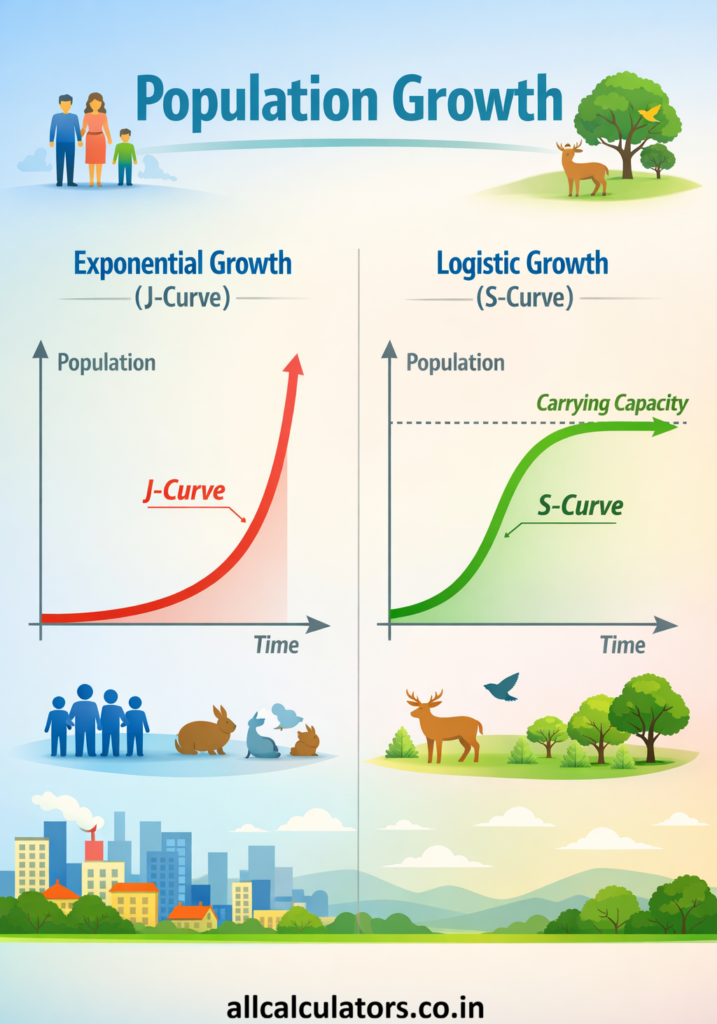
The population growth rate (often symbolized as r) is a measure of how rapidly the size of a given population changes over a defined period of time. In the simplest terms, it tells us: Is the population expanding 🟢, shrinking 🔴, or staying stable 🟡? It is expressed either as an absolute number (additional individuals per year) or, more commonly, as a percentage (%) of the original population.
The most basic formula used to calculate population growth rate is:
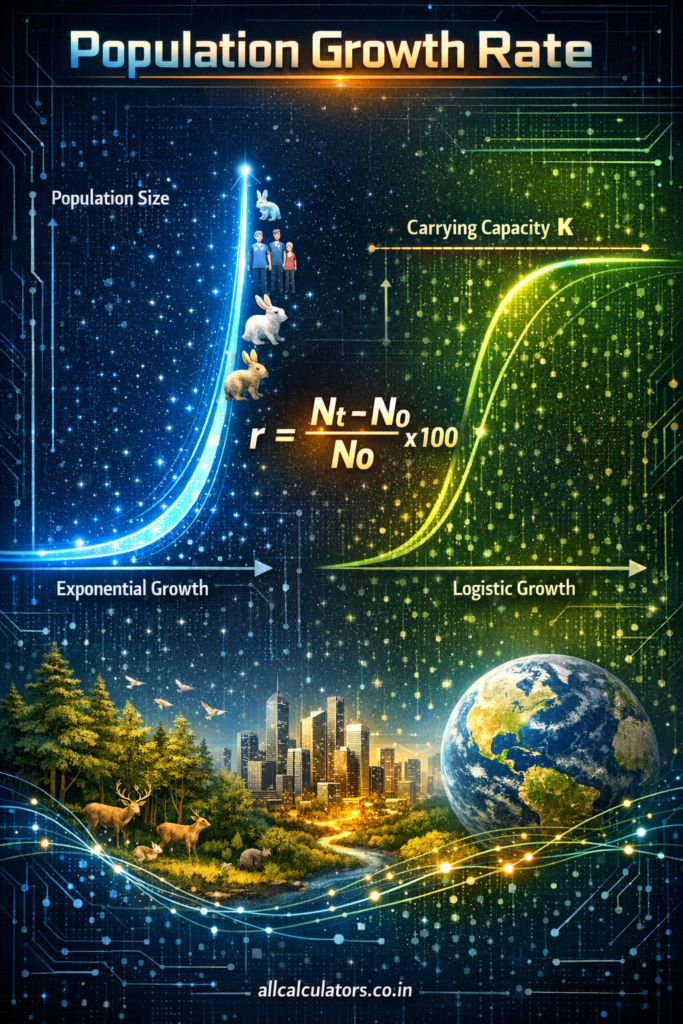
Growth Rate (r) = (Final Population − Initial Population) / Initial Population × 100
For example, if a city had 500,000 people in 2010 and grew to 600,000 by 2020, the population growth rate over that decade is: r = (600,000 − 500,000) / 500,000 × 100 = 20%
This simple yet powerful formula is the foundation of demographic analysis worldwide. 🌐
📐 Types of Population Growth Models
Population ecologists and biologists recognize two primary models of population growth, each with its own formula and real-world significance:
1. 🚀 Exponential Growth Model In exponential (or geometric) growth, a population increases at a constant per-capita rate with no limiting factors. The equation is:
Nt = N₀ × e^(r × t)
Where:
- Nt = Population size at time t
- N₀ = Initial (starting) population
- r = Intrinsic rate of natural increase (per capita growth rate)
- t = Time elapsed
- e = Euler’s number (≈ 2.71828)
Exponential growth produces the famous “J-shaped curve” 📊. While this model applies well to bacterial colonies in a nutrient-rich petri dish or invasive species entering a new habitat, it cannot continue indefinitely in nature due to resource limitations.
2. 🔄 Logistic Growth Model The logistic model is far more realistic for natural populations. It introduces the concept of Carrying Capacity (K) — the maximum population size an environment can sustainably support. The formula is:
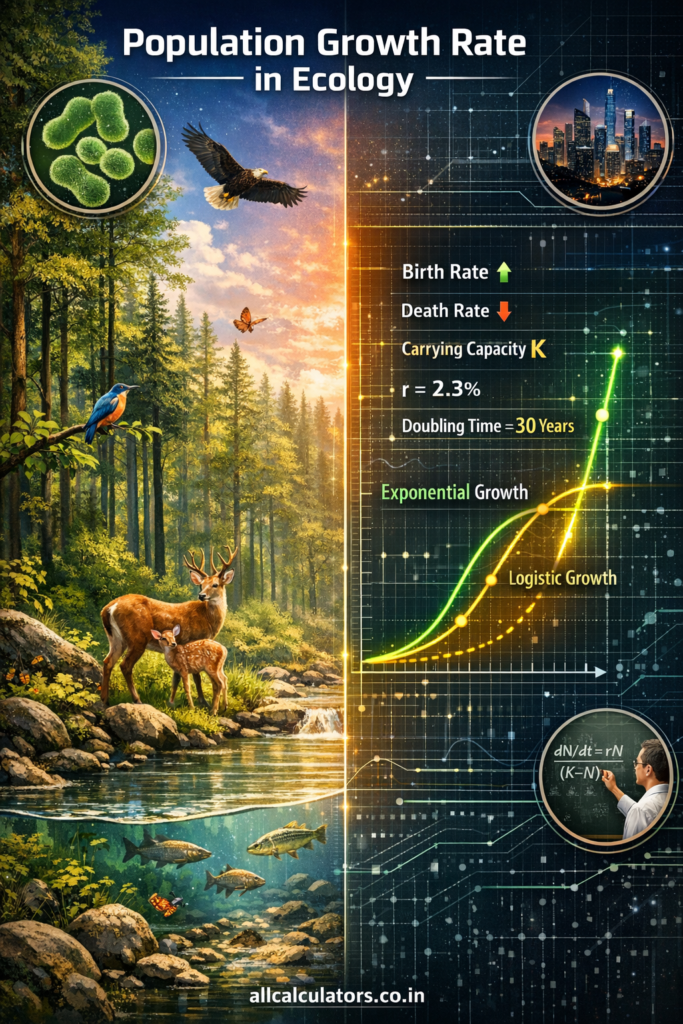
dN/dt = rN × [(K − N) / K]
As population size (N) approaches the carrying capacity (K), the growth rate slows down, producing the classic S-shaped or “sigmoid curve” 📉📈. This model explains why deer populations stabilize in a forest, why fish populations plateau in a lake, and why human population growth in developed nations has decelerated.
📊 Key Components of Population Growth Rate
Understanding your population growth calculation requires knowing these four key demographic variables:
- 👶 Birth Rate (b): The number of live births per 1,000 individuals per year.
- 💀 Death Rate (d): The number of deaths per 1,000 individuals per year.
- 🛬 Immigration Rate (i): Individuals entering a population from outside.
- 🛫 Emigration Rate (e): Individuals leaving a population permanently.
The complete formula for population change including all four factors is:
ΔN = (b − d) + (i − e)
When birth rate exceeds death rate and immigration exceeds emigration, a population grows. When the reverse is true, a population declines. 📉
⏱️ Population Doubling Time
A key concept closely tied to growth rate is doubling time — the number of years it takes for a population to double in size. Using the Rule of 70, doubling time is estimated as:
Doubling Time (T) = 70 / Annual Growth Rate (%)
For instance, a country with a 2% annual growth rate will double its population in roughly 35 years. At 1% growth, it takes about 70 years. This simple rule has enormous implications for urban planning, food security, and environmental sustainability. 🌱
🌿 Intrinsic Rate of Natural Increase (r_max)
In ecology, the intrinsic rate of natural increase (r_max) is the maximum per-capita growth rate achieved under ideal, unlimited conditions. It varies dramatically across species:
- 🦠 Bacteria (E. coli): r_max ≈ 60 per day
- 🐭 Mice: r_max ≈ 0.02–0.04 per day
- 🐘 Elephants: r_max ≈ 0.0007 per day
- 👤 Humans: r_max ≈ 0.0003–0.0004 per day
This explains why pest insects can explode in numbers overnight while elephant populations take decades to recover from poaching threats. 🐘💔
🌍 Human Population Growth — A Global Perspective
The human population crossed 1 billion around 1804, 2 billion by 1927, and has since accelerated dramatically due to advances in medicine, agriculture, and sanitation. As of 2024, the global population stands at approximately 8.1 billion and continues to grow at roughly 0.9% per year. Projections by the United Nations suggest the global population could peak at approximately 10.4 billion by the 2080s before potentially stabilizing.
Understanding and calculating population growth rates is therefore not merely an academic exercise — it directly informs policies on climate change 🌡️, food security 🌾, water conservation 💧, healthcare infrastructure 🏥, and international development. Countries with very high growth rates (above 2.5–3%) face intense pressure on education, employment, and natural resources, while countries with negative growth rates face aging populations and labor force shortages.
🧪 Why Use Our Population Growth Rate Calculator?
Our online Population Growth Rate Calculator at allcalculators.co.in is designed to be:
✅ Fast — Get your answer in seconds, no manual calculations needed ✅ Accurate — Powered by verified ecological and demographic formulas ✅ Educational — Step-by-step formula breakdown shown alongside results ✅ Versatile — Works for human populations, animal species, bacterial cultures, and plant communities ✅ Free — 100% free to use, no registration required ✅ Mobile Friendly — Works perfectly on smartphone, tablet, or desktop 📱💻
Whether you are solving a NEET Biology question 📚, completing a university ecology assignment, preparing for UPSC/IAS exams, or conducting professional demographic research, this tool is built for you. Simply enter your initial population, final population, and time period — and let our calculator do the rest instantly! 🎯
🌍 Applications in Daily Life
🏙️ Urban Planning: Governments use population growth rate calculations to plan cities, transportation, and housing efficiently.
🌾 Agriculture & Food Supply : Farmers and policymakers analyze population increase rates to ensure food production meets demand.
🌍 Environmental Conservation; Ecologists use population growth formulas to monitor endangered species and ecosystem balance.
🧬 Academic & Competitive Exams: Students frequently use population growth calculators in biology, ecology, and environmental science exams.
💼 Business & Market Analysis: Companies analyze population trends to target customers and predict demand.
⚠️ Disclaimer
⚠️ This Population Growth Rate Calculator provides results based on standard ecological formulas and user inputs. While we strive for maximum accuracy, results should be used for educational and informational purposes only. For scientific research, policy-making, or critical decisions, consult verified data sources or professionals. 📊 Always double-check inputs to ensure precise calculations.
📌 Related Calculator
❓ FAQs
❓ What is the formula for population growth rate? 📊
The population growth rate formula is: (Birth Rate – Death Rate) + (Immigration – Emigration).
❓ How do you calculate population growth percentage? 📈
Divide the growth rate by total population and multiply by 100 to get the percentage.
❓ What is exponential population growth? 🚀
It is rapid population increase under unlimited resources, forming a J-shaped curve.
❓ What is logistic population growth? 🌿
It is realistic growth where population stabilizes due to limited resources.
❓ Why is population growth rate important in ecology? 🌍
It helps understand species survival, environmental balance, and resource management.