
Respiratory Quotient (RQ) Calculator
| Parameter | Value | Unit |
|---|
Table of Contents
✍️ Author & Academic Authority: Dr. Nitish Kr. Bharadwaj
📘 Qualifications: B.Sc., B.Ed., M.Sc., Ph.D. (Biochemistry), MBA (Financial Management)
🫁 Respiratory Quotient Calculator
Unlock the Secret Language of Your Metabolism 🔬
Have you ever wondered what fuel your body is actually burning right now? 🤔 Is it the carbohydrates from your last meal, the stubborn fat reserves you’ve been trying to shed, or the protein from your morning shake? The answer lies in one elegant, powerful number — the Respiratory Quotient (RQ). Our free Respiratory Quotient Calculator helps students, fitness enthusiasts, healthcare learners, and curious minds instantly compute this critical metabolic ratio, understand what it means for their health, and unlock deep insights into human physiology. 💪
🧪 What Is the Respiratory Quotient (RQ)?
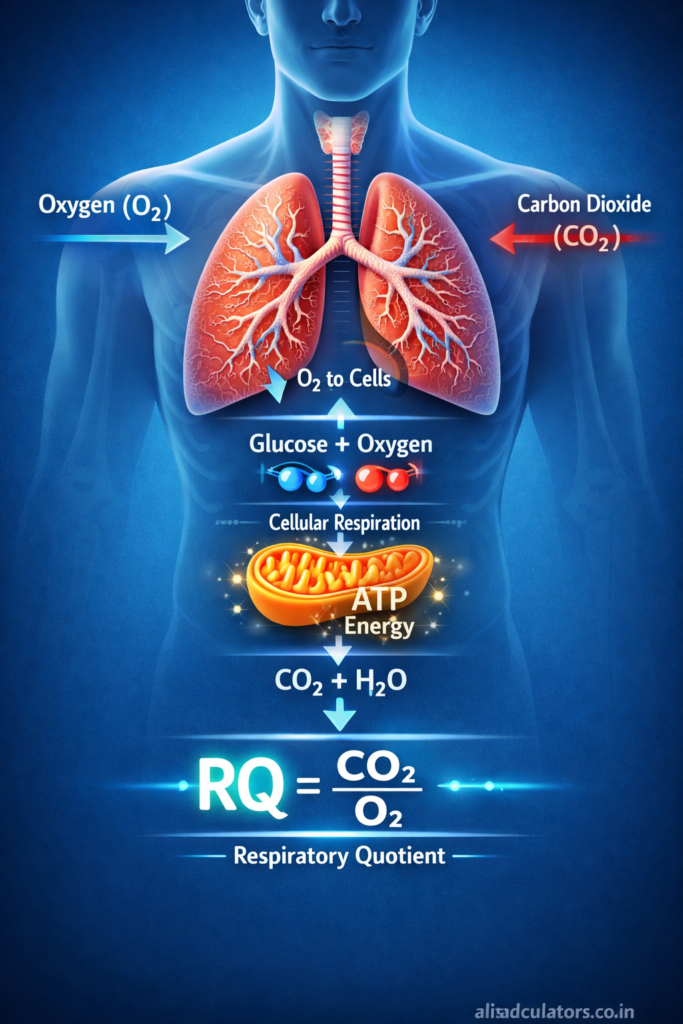
The Respiratory Quotient, also known as the Respiratory Coefficient or RQ, is a dimensionless physiological parameter defined as the ratio of the volume of carbon dioxide (CO₂) produced to the volume of oxygen (O₂) consumed during cellular respiration. In simpler terms, it’s the body’s own metabolic report card — telling you exactly which macronutrient your cells are burning for energy at any given moment. 📊
The RQ Formula is beautifully simple: 🔢 RQ = Volume of CO₂ Produced ÷ Volume of O₂ Consumed
This ratio is dimensionless (has no units) and typically falls between 0.7 and 1.0 for healthy humans under normal dietary conditions. Values outside this range are clinically significant and tell a fascinating story about a person’s metabolic state.
⚗️ RQ Values for Different Macronutrients — The Metabolic Fingerprint
One of the most powerful aspects of the Respiratory Quotient is how it acts as a metabolic fingerprint for each food group. Here’s what the science says:
🍞 Carbohydrates (RQ = 1.0) The complete aerobic oxidation of glucose is a perfect 1:1 exchange. For every molecule of O₂ consumed, exactly one molecule of CO₂ is produced. The equation: C₆H₁₂O₆ + 6O₂ → 6CO₂ + 6H₂O gives us an RQ of 6CO₂/6O₂ = 1.0. When your RQ is at 1.0, your body is running almost entirely on carbohydrates — like a high-revving engine on premium fuel.
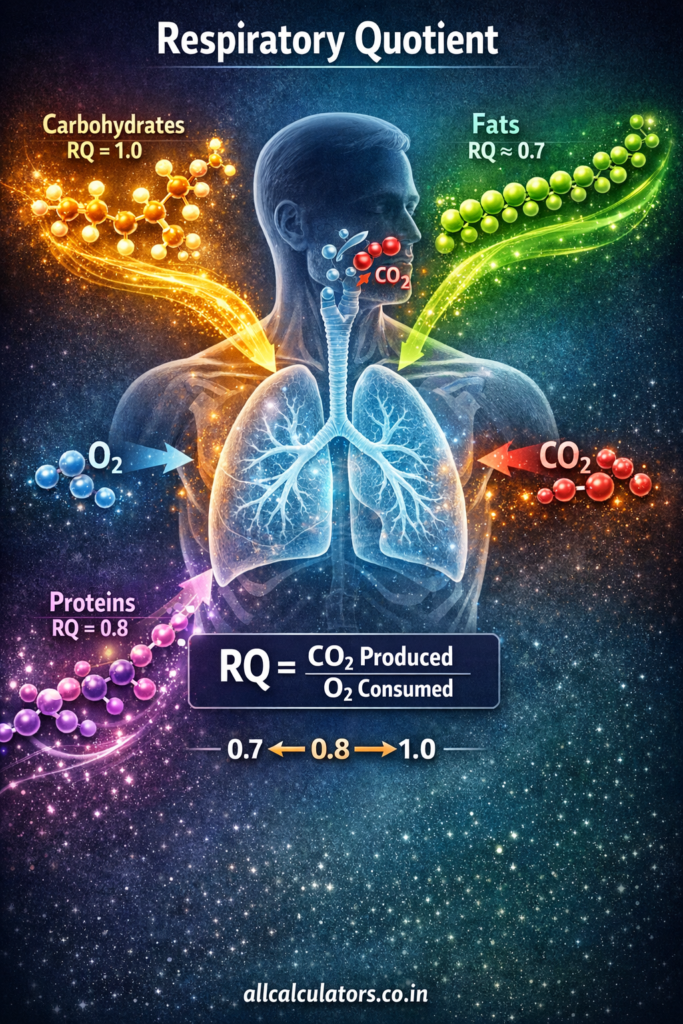
🥑 Fats / Lipids (RQ ≈ 0.7) Fats require significantly more oxygen relative to CO₂ produced because fatty acid molecules are less oxidized. Take palmitic acid: C₁₆H₃₂O₂ + 23O₂ → 16CO₂ + 16H₂O, giving 16/23 ≈ 0.696. An RQ near 0.7 indicates your body is in fat-burning mode 🔥 — ideal for weight loss, ketogenic diets, and endurance training.
🥩 Proteins (RQ ≈ 0.8) Protein metabolism is complex due to the diversity of amino acids. The RQ for albumin (C₇₂H₁₁₂N₁₈O₂₂S + 77O₂ → 63CO₂ + …) yields approximately 63/77 = 0.82. Protein metabolism rarely dominates unless the body is under severe stress or starvation.
🥗 Mixed Diet (RQ ≈ 0.8) For most people eating a balanced, mixed diet of carbohydrates, fats, and proteins, the RQ averages around 0.8 — the standard benchmark for a healthy Western diet. This is the baseline value used in most basal metabolic rate (BMR) calculations.
📈 What Do RQ Values Tell Us?
Understanding your RQ value is like reading your body’s fuel dashboard:
🟢 RQ = 0.7 → Pure fat oxidation. Body is in deep fat-burning or ketosis mode. Common in well-adapted endurance athletes and individuals on ketogenic diets.
🟡 RQ = 0.8 → Mixed substrate use. Healthy, balanced metabolism. This is the “normal” zone for most people at rest.
🟠 RQ = 1.0 → Pure carbohydrate oxidation. Common after a high-carb meal, during moderate exercise, or in hypermetabolic states.
🔴 RQ > 1.0 → A warning signal! This indicates lipogenesis — the body is converting excess carbohydrates into fat for storage. This can occur during overfeeding or excessive carbohydrate intake and has clinical significance in ICU/ventilator patients due to excess CO₂ production.
⚫ RQ < 0.7 → Very rare, may suggest ketone body metabolism, gluconeogenesis, or measurement error. Clinically, it can occur in severe fasting, malnutrition, or certain metabolic disorders.
🏥 Clinical Significance of the Respiratory Quotient
The Respiratory Quotient is far more than a classroom concept — it’s a vital clinical tool used by physicians, dietitians, and critical care specialists worldwide:
🫀 Basal Metabolic Rate (BMR) Estimation: The RQ is an essential component of indirect calorimetry, the gold-standard method for measuring energy expenditure. It refines BMR calculations beyond the simple Harris-Benedict equation by accounting for actual substrate utilization.
🏋️ Sports Science & Exercise Physiology: During low-intensity exercise, the RQ typically ranges from 0.80–0.88, indicating fat is the primary fuel. As exercise intensity increases, the body shifts toward carbohydrates (RQ approaches 1.0). The Respiratory Exchange Ratio (RER) — the exercise-state counterpart of RQ — can even exceed 1.0 during intense anaerobic exercise due to bicarbonate buffering, marking the approach to VO₂ max exhaustion.
🍽️ Nutritional Assessment & ICU Management: Healthcare professionals in ICUs use RQ to monitor patients on enteral or parenteral nutrition. An RQ > 1.0 signals overfeeding with carbohydrates, which causes excess CO₂ and can complicate weaning from mechanical ventilators. Conversely, RQ < 0.7 may indicate severe underfeeding. Adjusting macronutrient ratios based on RQ can literally be life-saving.
🫁 Liver Disease Prognosis: In patients with liver cirrhosis, the non-protein respiratory quotient (npRQ) is a proven prognostic marker. Patients with npRQ < 0.85 show significantly lower survival rates, as a decreased npRQ reflects reduced glycogen storage capacity in the damaged liver.
⚖️ Weight Management & Obesity: Research has consistently shown that higher body weight and fat mass correlate with lower RQ values, as obese individuals tend to oxidize more fat. Tracking RQ changes over time helps clinicians and nutritionists personalize diet and exercise interventions.
🌿 Diabetes & Metabolic Disorders: In type 2 diabetes and insulin resistance, the body’s ability to switch between fuel sources (called metabolic flexibility) is impaired. RQ monitoring helps assess this flexibility. Insulin, which promotes fat storage and suppresses fat oxidation, directly increases RQ values.
🔬 How is RQ Measured in Real Life?
In clinical and research settings, RQ is measured using indirect calorimetry — a technique that analyzes the composition of inhaled and exhaled air using a device called a respirometer or metabolic cart. Modern portable devices like the Breezing Med (FDA-cleared) or the Microlife MedGem allow point-of-care RQ measurement in just 10 minutes, making this once-exclusive technology increasingly accessible.
🎓 Why Use Our Respiratory Quotient Calculator?
Our free online RQ Calculator at AllCalculators.co.in eliminates the manual computation, making it instant, accurate, and accessible to:
✅ Biology & physiology students preparing for NEET, CBSE, and competitive exams ✅ Medical and nursing students studying metabolism ✅ Fitness coaches and sports nutritionists analyzing clients’ fuel utilization ✅ Healthcare students learning indirect calorimetry ✅ Curious individuals wanting to understand their body’s metabolic processes
Simply enter your CO₂ produced and O₂ consumed values, and our calculator delivers an instant RQ result along with interpretation — telling you exactly which macronutrient your body is primarily using for fuel. 🚀
🌍 Applications in Daily Life
💡 Real-Life Applications of Respiratory Quotient Calculator
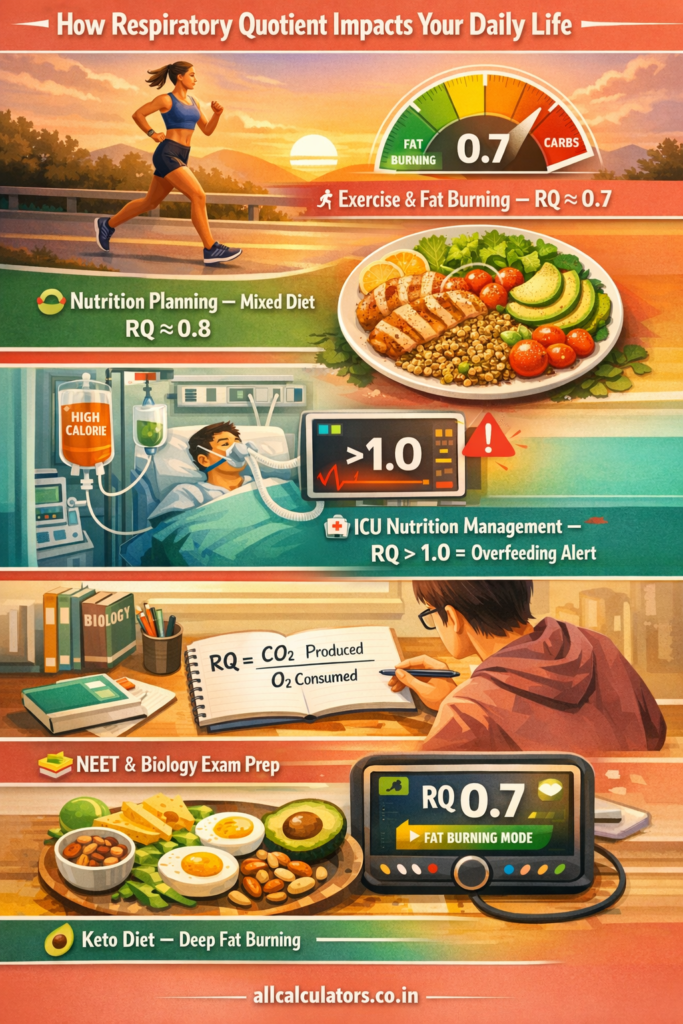
- 🏋️ Fitness & Fat Loss Tracking: Helps determine whether your body is burning fat or carbohydrates using the RQ calculator for metabolism.
- 🥗 Diet Planning & Nutrition Optimization: Dietitians use respiratory quotient values to design personalized meal plans.
- 🏥 Clinical Health Monitoring: Used in hospitals to assess metabolic disorders and respiratory efficiency.
- 🧪 Academic & Research Use: Essential for students studying human physiology, biology, and biochemistry.
- 🏃 Sports Performance Analysis: Athletes use RQ data to optimize endurance and energy utilization.
⚠️ Disclaimer
⚠️ Important Disclaimer
This Respiratory Quotient Calculator is intended for educational and informational purposes only. The results generated are based on standard physiological formulas and should not be considered a substitute for professional medical advice, diagnosis, or treatment. 🏥
Always consult a qualified healthcare provider or nutrition expert before making decisions related to your health, metabolism, or diet based on RQ values or metabolic calculations. ⚡
📌 Related Calculator
🙋 Frequently Asked Questions
❓ What is a normal respiratory quotient value?
👉 A normal respiratory quotient (RQ) ranges from 0.7 to 1.0, depending on whether the body is metabolizing fats, proteins, or carbohydrates.
❓ How do you calculate respiratory quotient?
👉 Use the formula: RQ = CO₂ produced / O₂ consumed. You can also use an online respiratory quotient calculator for instant results.
❓ What does an RQ of 0.7 indicate?
👉 It indicates fat metabolism, meaning the body is primarily burning fats for energy.
❓ Why is respiratory quotient important in metabolism?
👉 It helps determine which macronutrient is being used for energy, making it essential for nutrition planning and metabolic analysis.
❓ Can respiratory quotient be greater than 1?
👉 Yes, an RQ > 1 may occur during lipogenesis or overfeeding, especially when excess carbohydrates are converted into fat.