
🩸 HbA1c to Glucose Calculator
eAG (mg/dL) = 28.7 × HbA1c (%) − 46.7
eAG (mmol/L) = 1.5944 × HbA1c (%) − 2.5944
📊 Estimated Average Glucose (eAG) Results
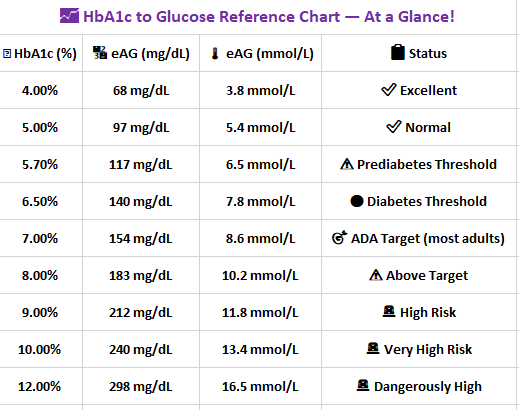
| HbA1c (%) | eAG (mg/dL) | eAG (mmol/L) | Status |
|---|---|---|---|
| < 5.7 | < 117 | < 6.5 | ✅ Normal |
| 5.7 – 6.4 | 117 – 137 | 6.5 – 7.6 | ⚠️ Pre-Diabetic |
| ≥ 6.5 | ≥ 140 | ≥ 7.8 | 🔴 Diabetic |
💡 eAG represents your estimated average blood sugar over the past 2–3 months.
📌 Values use the ADA ADAG formula: eAG (mg/dL) = 28.7 × HbA1c − 46.7
Always consult a qualified healthcare professional for diagnosis or treatment.
© 2025 AllCalculators.co.in
Table of Contents
✍️ Author & Academic Authority: Dr. Nitish Kr. Bharadwaj
📘 Qualifications: B.Sc., B.Ed., M.Sc., Ph.D. (Biochemistry), MBA (Financial Management)
🩸 HbA1c to Glucose Calculator — Introduction
Convert Your A1C to Estimated Average Blood Sugar Instantly!
Managing diabetes and keeping your blood sugar in check is one of the most critical aspects of modern health 🌡️. But let’s be honest — staring at your lab report showing an HbA1c of 7.5% and trying to mentally link that to your daily glucose readings can be incredibly confusing 🤔. That’s exactly why our free online HbA1c to Glucose Calculator exists — to bridge the gap between your lab results and your real-world blood sugar numbers, in seconds! ⚡
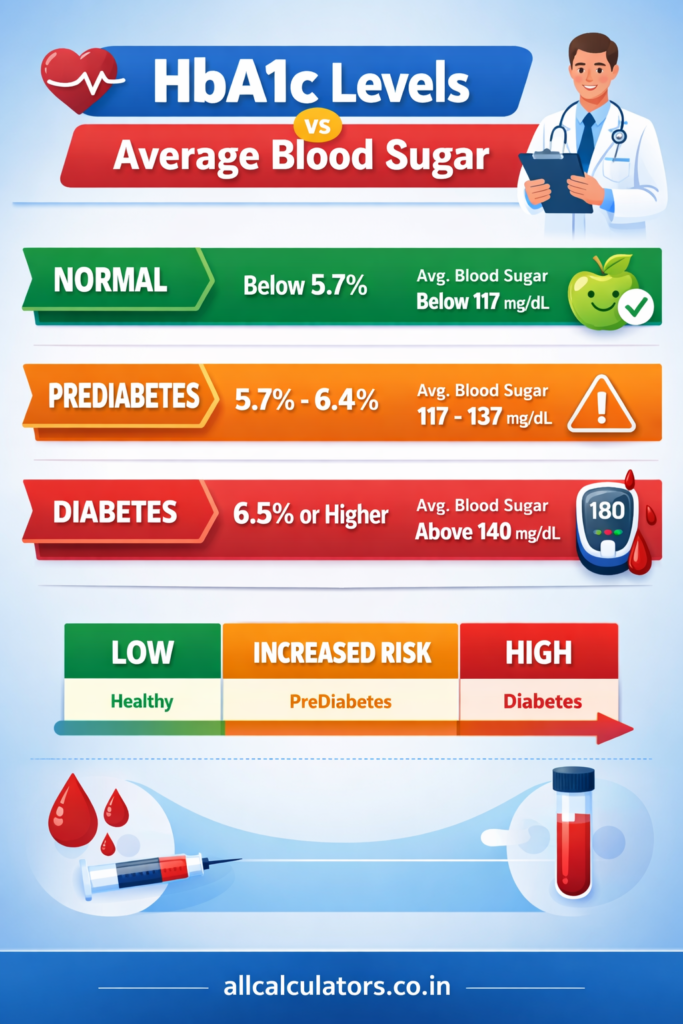
HbA1c reflects your average blood glucose levels over the past 2–3 months, making it far more reliable than a single fasting glucose reading 📊. However, HbA1c is expressed in percentage (%), which can be confusing for many users who are more familiar with blood sugar readings in mg/dL or mmol/L. This is where our A1c to average blood sugar calculator simplifies everything — converting complex clinical data into easy-to-understand glucose values instantly ⚡.
The scientific relationship between HbA1c and average glucose is derived from extensive clinical studies such as the ADAG (A1c-Derived Average Glucose) research. The standard formula used is:
👉 eAG (mg/dL) = (28.7 × HbA1c) – 46.7
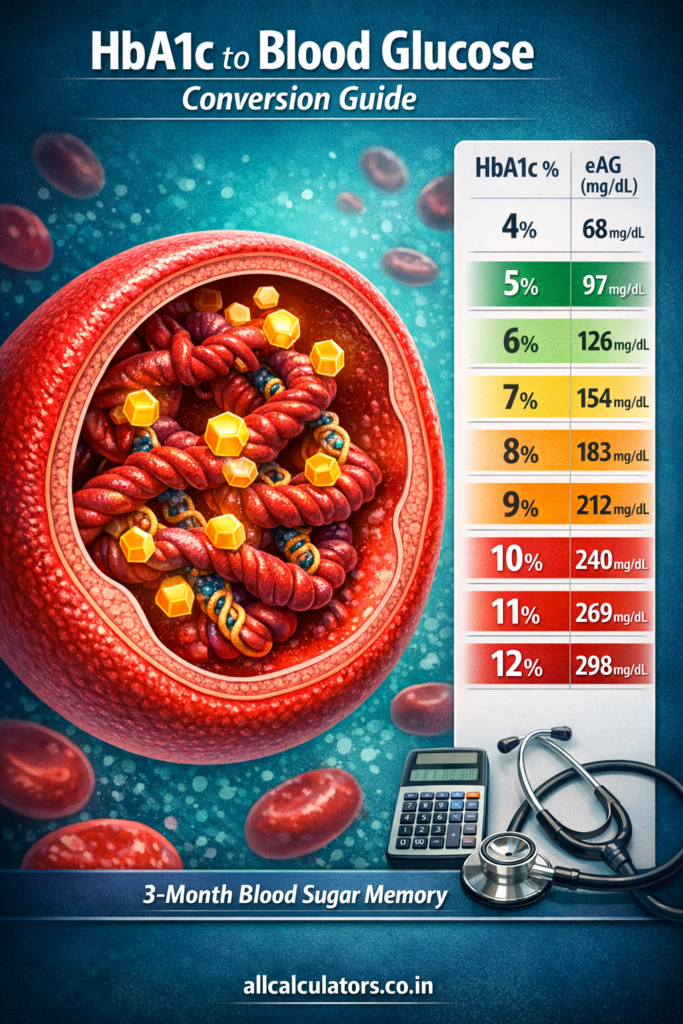
This formula allows users to convert their HbA1c values into estimated average glucose levels with high accuracy. For example, an HbA1c of 7% corresponds approximately to an average glucose level of 154 mg/dL 📈.
🔬 What is HbA1c? Understanding Glycated Hemoglobin
HbA1c, also written as Hemoglobin A1c, Glycated Hemoglobin, or simply A1C, is a special blood protein marker that gives your doctor a panoramic view of your blood glucose control over the past 2 to 3 months 📅. Unlike a routine finger-prick glucose test that shows your blood sugar at a single snapshot in time, the HbA1c test measures how much glucose has permanently attached (glycated) to your hemoglobin — the oxygen-carrying protein inside your red blood cells 🔴.
Here’s the biology behind it 🧬: Every red blood cell in your body has a lifespan of approximately 120 days (about 4 months). During this time, glucose molecules in your bloodstream naturally bond to hemoglobin proteins, creating glycated hemoglobin — HbA1c. The more sugar circulating in your blood over those months, the higher the percentage of HbA1c. This is why HbA1c is such a powerful, trusted diagnostic marker — it can’t be “cheated” with a single day of good eating! 🥗
The HbA1c result is expressed as a percentage (%) in the traditional NGSP/DCCT unit system, or in mmol/mol under the newer IFCC international standard. For most patients, the percentage format is most familiar. A reading below 5.7% is considered normal for non-diabetic adults, 5.7% to 6.4% indicates prediabetes ⚠️, and 6.5% or above is the diagnostic threshold for diabetes mellitus 🩺 according to the American Diabetes Association (ADA).
📊 What is Estimated Average Glucose (eAG)? The Bridge Between HbA1c & Your Glucometer
Estimated Average Glucose (eAG) is the value that translates your HbA1c percentage into the same mg/dL or mmol/L units that you read on your home glucometer or Continuous Glucose Monitor (CGM) 📱. This translation was developed through the landmark ADAG (A1c-Derived Average Glucose) Study — a large multi-center international research project sponsored by the ADA, EASD, and IDF between 2006 and 2008.
The study analyzed over 507 subjects across 10 international centers and produced the now-universally adopted conversion formula:
🧮 eAG (mg/dL) = (28.7 × HbA1c%) − 46.7
🧮 eAG (mmol/L) = (1.59 × HbA1c%) − 2.59
So if your HbA1c is 7%, your estimated average blood glucose is approximately 154 mg/dL (8.6 mmol/L) — a number you can directly relate to your glucose meter readings! 🎯 This single breakthrough made it infinitely easier for patients to understand what their doctor’s report actually means for their day-to-day health.
🎯 Why is Converting HbA1c to Glucose So Important?
The primary reason doctors use HbA1c as the gold standard for diabetes diagnosis and monitoring is its reliability — it reflects your blood glucose trends across weeks and months, not just a single morning reading. However, there’s a critical communication gap: HbA1c is reported in percentages, while your daily blood sugar monitor speaks in mg/dL or mmol/L. 💬
For millions of patients worldwide, especially in India 🇮🇳 where diabetes prevalence is alarmingly high (India ranks second globally with over 77 million diabetics!), this unit mismatch creates real confusion. Our HbA1c to Glucose Converter instantly eliminates this confusion by showing you your eAG in whichever unit you’re comfortable with. 💪
Furthermore, understanding your eAG helps you:
- 🏥 Set realistic daily blood sugar targets in consultation with your doctor
- 📉 Track long-term trends in glycemic control beyond daily fluctuations
- 💊 Evaluate the effectiveness of diabetes medications and lifestyle changes
- 🍽️ Make smarter dietary decisions by connecting your HbA1c to food habits
- 🏃 Understand the impact of exercise and physical activity on blood glucose control
⚠️ Important Limitations to Know
While the HbA1c to eAG conversion is scientifically validated and highly useful, it’s crucial to understand that eAG is an estimation, not a precise measurement 🔍. The conversion may be less reliable in individuals with:
- 🩸 Sickle cell disease or hemoglobin variants — altered red blood cell lifespan affects HbA1c accuracy
- 🫁 Iron deficiency anemia or hemolytic anemia — can falsely raise or lower HbA1c readings
- 🫀 Chronic kidney disease (CKD) — may distort hemoglobin glycation
- 💉 Recent blood transfusions — introduces new red blood cells that skew the 3-month average
- 🤰 Pregnancy — physiological changes affect HbA1c interpretation
Always consult your registered physician or endocrinologist for clinical decisions. This calculator is a powerful educational and self-monitoring tool — not a replacement for professional medical care 👨⚕️👩⚕️.
🧪 How to Use the HbA1c to Glucose Calculator
Using our free calculator is incredibly simple — no login, no downloads, no fees! 🆓
- 📥 Enter your HbA1c value (in % or mmol/mol as shown on your lab report)
- 🔄 Select your preferred output unit — mg/dL or mmol/L
- ⚡ Click Calculate — your estimated average glucose appears instantly!
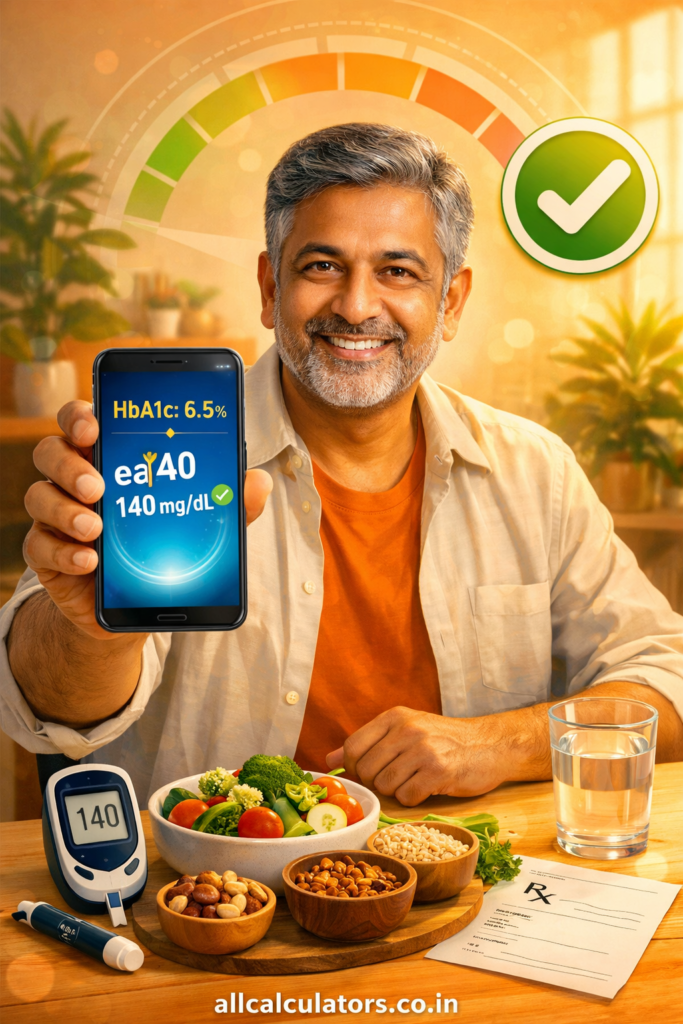
- 📊 Compare your result to the reference chart to understand your range
- 🗒️ Note your result and discuss it with your healthcare provider
Whether you’re a Type 1 diabetic, Type 2 diabetic, someone recently diagnosed with prediabetes, or simply monitoring your metabolic health proactively 💪 — our HbA1c to Glucose Calculator gives you clarity, confidence, and control over your health journey! 🌟
🌍 Applications in Daily Life
✅ Diabetes Monitoring 🩺: Track long-term blood sugar trends using the A1c to average glucose calculator for better disease management.
✅ Health Awareness 📊: Understand your estimated average glucose (eAG) and maintain healthy blood sugar levels.
✅ Doctor Consultations 👨⚕️: Helps patients and doctors communicate using practical glucose values instead of percentages.
✅ Fitness & Diet Planning 🥗: Optimize diet plans by analyzing your blood sugar calculator results.
✅ Early Risk Detection 🚨: Identify risks of diabetes using HbA1c conversion tools online.
⚠️ Disclaimer
⚠️ This HbA1c to Glucose Calculator is designed for informational and educational purposes only 🧠. The results provided are estimates based on standard medical formulas and should not be considered a substitute for professional medical advice, diagnosis, or treatment 🏥.
Always consult a qualified healthcare provider or doctor before making any medical decisions related to diabetes, blood sugar levels, or HbA1c results 👨⚕️. Individual health conditions may vary, and this A1c to glucose conversion tool does not account for all personal medical factors.
📌 Related Calculator
❓ FAQs
❓ What is HbA1c and why is it important? 🩸
HbA1c measures average blood sugar levels over 2–3 months and is crucial for diagnosing and monitoring diabetes.
❓ How do I convert HbA1c to average glucose? 📊
You can use the formula: (28.7 × HbA1c) – 46.7 or use this calculator for instant results.
❓ What is a normal HbA1c level? ✅
A normal HbA1c level is typically below 5.7%, while 6.5% or higher indicates diabetes.
❓ What is estimated average glucose (eAG)? 🔬
eAG represents your average blood sugar level in mg/dL or mmol/L based on HbA1c values.
❓ Is this HbA1c calculator accurate? 🎯
Yes, it uses clinically validated formulas, but results are approximate and should be confirmed by medical professionals.