
🧬 Primer Annealing Temperature Calculator
📌 Annealing Temp (Ta) ≈ Tm − 5°C
Table of Contents
✍️ Author & Academic Authority: Dr. Nitish Kr. Bharadwaj
📘 Qualifications: B.Sc., B.Ed., M.Sc., Ph.D. (Biochemistry), MBA (Financial Management)
🧬 Primer Annealing Temperature Calculator -Introduction
Accurate PCR Tm & Ta Calculation Tool
The Primer Annealing Temperature Calculator is an essential molecular biology tool designed to determine the optimal annealing temperature (Ta) for PCR (Polymerase Chain Reaction) experiments. Whether you are a student, researcher, or biotech professional, accurately calculating the annealing temperature is critical for achieving high specificity, efficient amplification, and reproducible DNA results. 🚀
PCR is a widely used technique in genetics, diagnostics, cloning, and forensic science, and one of the most sensitive steps in PCR is the primer annealing phase. During this step, short DNA sequences called primers bind to the target DNA strand. If the temperature is too low, non-specific binding occurs; if too high, primers fail to bind efficiently. This is where a precise annealing temperature calculator becomes indispensable. ⚡
🔬 What is Annealing Temperature (Ta)?
Annealing temperature (Ta) refers to the temperature at which primers attach (anneal) to the complementary DNA strand during PCR. It is typically calculated based on the melting temperature (Tm) of the primers.
👉 Common formula used: Ta ≈ Tm – 3°C to 5°C
Where:
- Tm (Melting Temperature) = temperature at which 50% of DNA becomes single-stranded.
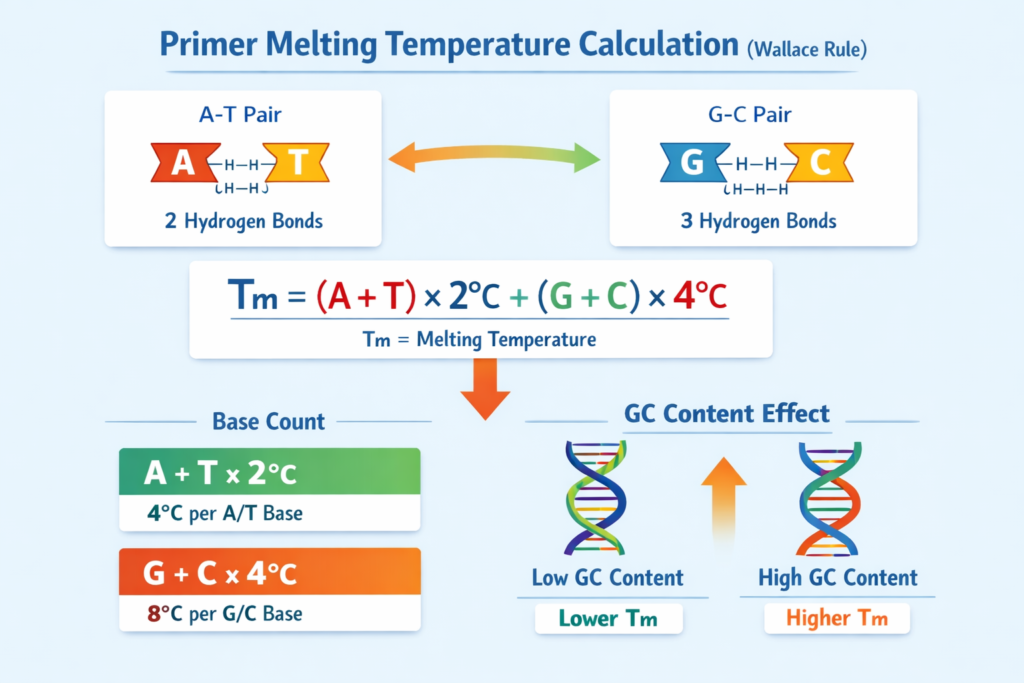
🧪 How is Primer Melting Temperature (Tm) Calculated?
The most widely used method is the Wallace Rule, especially for short primers:
👉 Tm = 2°C × (A + T) + 4°C × (G + C)
Where:
- A = Adenine
- T = Thymine
- G = Guanine
- C = Cytosine
This formula highlights the importance of GC content, since GC pairs form stronger hydrogen bonds, increasing stability. 🔗
⚙️ Why Use an Online Primer Annealing Temperature Calculator?
Manual calculations are prone to error, especially when dealing with multiple primers or complex sequences. Our tool provides:
✅ Instant & accurate results
✅ Error-free Tm and Ta calculation
✅ User-friendly interface
✅ Optimized for students & researchers
✅ Mobile & desktop compatible
This makes it ideal for lab planning, assignments, and real-world experiments.
📊 Importance of Accurate Annealing Temperature
Choosing the correct annealing temperature directly impacts PCR results:
✔️ Higher specificity – reduces non-specific amplification
✔️ Better yield – improves DNA amplification efficiency
✔️ Reproducibility – consistent lab results
✔️ Reduced primer-dimer formation
Incorrect temperature can lead to:
❌ No amplification
❌ Multiple unwanted bands
❌ Experimental failure
🧬 Role of GC Content in PCR Optimization
GC-rich primers have higher melting temperatures due to stronger bonding. This means:
- High GC → Higher Tm → Higher Ta
- Low GC → Lower Tm → Lower Ta
Maintaining a balanced GC content (40–60%) is ideal for primer design.
📈 Who Should Use This Tool?
This calculator is highly beneficial for:
👨🎓 Students studying molecular biology
👩🔬 Researchers performing PCR experiments
🧪 Lab technicians & scientists
📚 Educators teaching genetics concepts
🧬 Biotechnology professionals
🚀 How to Use This Calculator?
1️⃣ Enter the number of A, T, G, and C bases
2️⃣ Click “Calculate”
3️⃣ Get instant Tm and recommended Ta
That’s it—no complex formulas required! 🎯
💡 Pro Tips for PCR Success
✔️ Keep primer length between 18–25 bases
✔️ Avoid secondary structures
✔️ Maintain similar Tm for forward & reverse primers
✔️ Optimize Mg²⁺ concentration
By using this Primer Annealing Temperature Calculator, you ensure precision, efficiency, and reliability in your PCR workflows. Whether you’re solving an academic problem or conducting advanced genetic research, this tool simplifies complex calculations into a seamless experience. 🔥
🌍 Applications in Daily Life
The primer annealing temperature calculator plays a crucial role beyond laboratories and directly impacts modern life in multiple ways:
🧬 Medical Diagnostics – Used in PCR tests for detecting diseases like infections and genetic disorders
🦠 COVID-19 Testing – Accurate PCR temperature calculation ensures reliable virus detection
🌾 Agriculture & GM Crops – Helps in DNA analysis for crop improvement
🧪 Forensic Science – Used in DNA fingerprinting for crime investigation
👶 Genetic Testing – Supports ancestry and hereditary disease analysis
💊 Pharmaceutical Research – Essential in drug discovery and vaccine development
📚 Education & Research – Helps students understand PCR and DNA amplification
This makes the tool not just academic—but a real-world scientific necessity. 🌟
⚠️ Disclaimer
This Primer Annealing Temperature Calculator provides estimated results based on standard formulas such as the Wallace rule. While it offers high accuracy for educational and general research purposes, actual PCR conditions may vary depending on buffer composition, salt concentration, primer design, and lab conditions. 🧪
🔬 Users are advised to validate results experimentally before critical applications.
📊 This tool is intended for educational, informational, and preliminary research use only.
🚫 We do not guarantee 100% experimental accuracy in all laboratory conditions.
📌 Related Calculator
❓ FAQs
❓ What is primer annealing temperature in PCR? 🔬
Primer annealing temperature is the temperature at which primers bind to the DNA template during PCR. It is usually 3–5°C lower than the melting temperature (Tm).
❓ How do you calculate annealing temperature? 📊
Annealing temperature is calculated using the formula: Ta ≈ Tm – 3 to 5°C, where Tm is determined using formulas like the Wallace rule.
❓ What is the Wallace rule for Tm calculation? 🧬
The Wallace rule calculates melting temperature using: Tm = 2(A+T) + 4(G+C).
❓ Why is annealing temperature important in PCR? ⚡
It ensures specificity and efficiency. Incorrect temperature can lead to failed amplification or non-specific DNA products.
❓ What happens if annealing temperature is too high or too low? 🚫
Too high → primers won’t bind
Too low → non-specific binding occurs