
🌊 Bernoulli Equation Calculator
P + ½ρv2 + ρgh = Constant
Table of Contents
✍️ Author & Academic Authority: Dr. Nitish Kr. Bharadwaj
📘 Qualifications: B.Sc., B.Ed., M.Sc., Ph.D. (Biochemistry), MBA (Financial Management)
🌊 Bernoulli Equation Calculator – Introduction
Instantly Solve Fluid Dynamics Problems ⚙️
Fluid mechanics is one of the most fascinating areas of physics because it explains how liquids and gases behave when they move. From airplane wings ✈️ to water flowing through pipelines 🚰, fluid motion is everywhere in the world around us. One of the most powerful equations used to understand this motion is the Bernoulli Equation.
Our Bernoulli Equation Calculator helps students, engineers, and physics enthusiasts instantly compute relationships between pressure, velocity, height, and fluid density without manually solving complex equations. Instead of spending time rearranging formulas or performing lengthy calculations, you can simply enter the known values and get instant accurate results.
The Bernoulli principle was developed by the Swiss mathematician and physicist Daniel Bernoulli in the 18th century. The equation describes the conservation of mechanical energy in fluid flow. It states that as the velocity of a fluid increases, the pressure exerted by the fluid decreases. This principle is fundamental to fluid dynamics and explains many real-world phenomena.
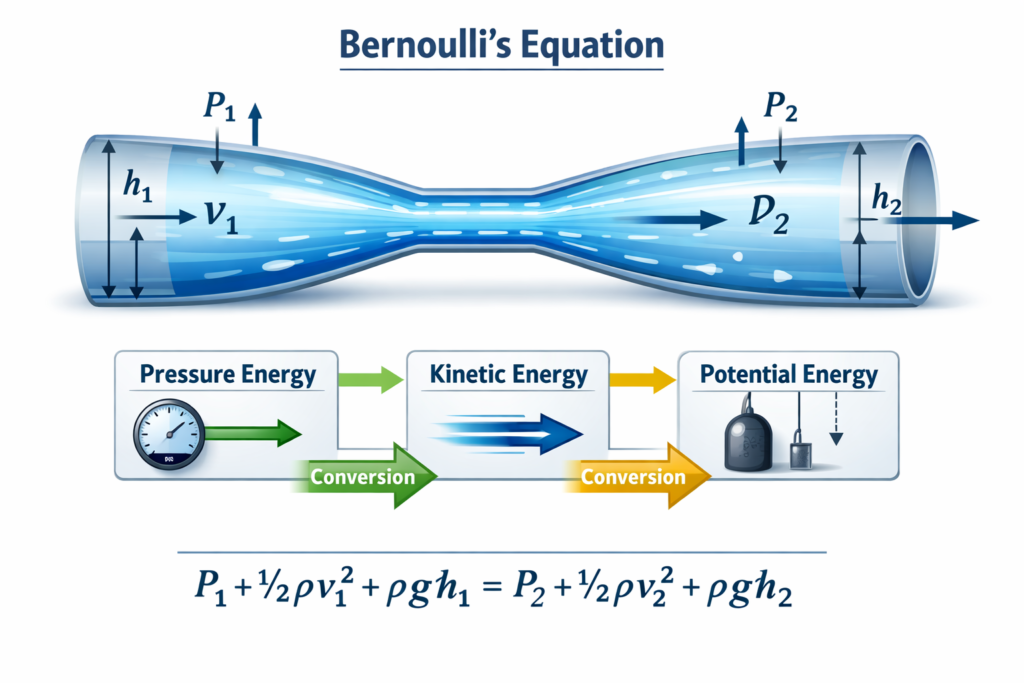
The Bernoulli equation formula is expressed as: P + ½ρv² + ρgh = constant
Where:
• P = Pressure of the fluid
• ρ (rho) = Density of the fluid
• v = Velocity of the fluid
• g = Acceleration due to gravity
• h = Height above reference level
Each term in the equation represents a form of energy in the fluid system:
🔹 Pressure Energy – Energy due to the fluid pressure
🔹 Kinetic Energy – Energy due to fluid velocity
🔹 Potential Energy – Energy due to fluid height
When fluid flows through a pipe or open channel, these energies transform from one form to another, but the total energy remains constant (assuming ideal flow conditions). This concept makes Bernoulli’s equation extremely useful in engineering, aerodynamics, hydraulics, and medical science.
⚡ Why Use an Online Bernoulli Equation Calculator?
Solving Bernoulli equation problems manually often requires rearranging the formula, inserting multiple variables, and performing several mathematical steps. This process can be time-consuming and prone to calculation errors.
Using a Bernoulli equation calculator online offers several advantages:
✔ Instant and accurate calculations
✔ Saves time during assignments or exams
✔ Eliminates manual formula rearrangement
✔ Helpful for students learning fluid mechanics
✔ Useful for engineers performing quick estimations
The calculator typically allows you to input values such as pressure, velocity, fluid density, and height, then automatically computes the unknown variable using the Bernoulli equation formula.
🧠 Understanding the Physics Behind Bernoulli’s Principle
To better understand the Bernoulli principle, imagine water flowing through a pipe that becomes narrower at one section.
When the pipe narrows:
• The fluid velocity increases 🚀
• The fluid pressure decreases 📉
This happens because energy must remain constant. If kinetic energy increases due to higher velocity, pressure energy must decrease.
This effect explains several important real-world systems:
✈️ Airplane wings generate lift due to pressure differences
🚿 Shower curtains move inward when water flows
⚙️ Venturi meters measure fluid flow rates
🩺 Medical devices measure blood flow
Because of its broad applications, the Bernoulli equation is considered one of the most important equations in fluid mechanics.
Who Should Use This Calculator? 👨🎓👩🔬
This fluid dynamics calculator is particularly helpful for:
🎓 Physics students studying fluid mechanics
👷 Mechanical and civil engineers
📚 Engineering exam preparation (JEE, GATE, etc.)
🔬 Researchers working with fluid systems
📊 Anyone solving Bernoulli equation problems
Whether you are solving homework questions or designing real-world systems, this calculator provides a fast and reliable solution.
🔢 Steps to Use the Bernoulli Equation Calculator
Using the calculator is simple:
1️⃣ Enter the fluid pressure value
2️⃣ Enter the fluid velocity
3️⃣ Enter the fluid density
4️⃣ Enter the height difference
5️⃣ Click Calculate
The calculator instantly applies the Bernoulli equation formula and returns the result.
🌍 Why Bernoulli Equation Matters in Physics
The Bernoulli equation connects energy conservation with fluid motion. Without it, many technologies we use today would not exist.
Examples include:
✈️ Aircraft wing design
🚰 Water supply systems
⚙️ Industrial pipelines
🩺 Medical diagnostic equipment
🚗 Carburetors and fuel systems
Because of these applications, Bernoulli’s principle is taught in almost every physics and engineering curriculum worldwide.
🌍 Applications in Daily Life
The Bernoulli principle plays a significant role in many real-world technologies and daily life systems.
✈️ Airplane Lift Generation: Aircraft wings are designed so that air moves faster above the wing than below it. According to the Bernoulli equation, faster air results in lower pressure, creating lift that allows airplanes to fly.
🚰 Water Supply Pipelines: Engineers use the Bernoulli equation calculator to determine pressure and velocity changes in pipes that transport water across cities.
🚗 Car Carburetors and Fuel Injection: Bernoulli’s principle helps regulate the flow of fuel and air in internal combustion engines.
🩺 Medical Venturi Masks: Hospitals use Venturi masks to control oxygen flow for patients using the Bernoulli effect.
🚿 Shower Curtains Moving Inward: When water flows quickly from the shower, air velocity changes cause a pressure drop, pulling the curtain inward.
⚙️ Industrial Fluid Systems: Chemical plants and hydraulic systems use Bernoulli equation calculations to design safe fluid transport systems.
🌬️ Wind and Weather Phenomena: Meteorologists apply fluid dynamics equations to study airflow patterns in the atmosphere.
⚠️ Disclaimer 📢
The Bernoulli Equation Calculator available on this website is designed for educational and informational purposes only. While we strive to provide accurate calculations using standard physics formulas, the results should be considered as approximate values based on the inputs provided.
🔬 Fluid dynamics problems in real engineering systems may require additional parameters such as viscosity, turbulence, friction losses, and boundary conditions that are not included in simple Bernoulli equation calculations.
📚 Students should always verify results with textbooks, teachers, or professional engineering references when using the calculator for academic work.
⚙️ Engineers and professionals should not rely solely on this calculator for critical engineering design or safety calculations. By using this tool, you acknowledge that allcalculators.co.in is not responsible for decisions made based on the calculator results.
📌 Related Calculator
❓FAQs
❓ What is the Bernoulli equation in fluid mechanics?
The Bernoulli equation is a fundamental formula in fluid dynamics that relates pressure, velocity, and height in a moving fluid. It states that the total mechanical energy of a fluid remains constant along a streamline.
❓ How does a Bernoulli Equation Calculator work?
A Bernoulli equation calculator automatically applies the formula P + ½ρv² + ρgh = constant to calculate unknown variables like pressure, velocity, or height based on the values entered by the user.
❓ Where is the Bernoulli principle used in real life?
The Bernoulli principle is widely used in airplane wing design, water pipelines, Venturi meters, carburetors, medical devices, and aerodynamic engineering.
❓ Why does pressure decrease when velocity increases?
According to Bernoulli’s theorem, when the velocity of a fluid increases, its kinetic energy increases. To maintain energy conservation, pressure energy decreases.
❓ Is Bernoulli equation valid for all fluids?
The Bernoulli equation works best for ideal fluids with steady, incompressible, and frictionless flow. Real fluids may require corrections for viscosity and turbulence.