
⚓ Archimedes’ Principle Calculator
Where:
ρ = Density of Fluid (kg/m3)
g = Acceleration due to Gravity (m/s2)
V = Volume of Displaced Fluid (m3)
Table of Contents
✍️ Author & Academic Authority: Dr. Nitish Kr. Bharadwaj
📘 Qualifications: B.Sc., B.Ed., M.Sc., Ph.D. (Biochemistry), MBA (Financial Management)
🌊 Archimedes' Principle Calculator – Introduction
Instantly Calculate Buoyant Force in Fluids ⚖️
The Archimedes' Principle Calculator is an advanced yet easy-to-use online physics calculator designed to help students, teachers, engineers, and science enthusiasts quickly calculate buoyant force, displaced fluid weight, and floating conditions of objects in liquids or gases. 🚀 This powerful calculator applies the famous Archimedes principle formula, allowing users to instantly determine the upward force exerted by a fluid on an immersed object.
Archimedes’ Principle is one of the most important laws in fluid mechanics and classical physics. It states that any object submerged partially or completely in a fluid experiences an upward force equal to the weight of the fluid displaced by the object. This upward force is called buoyant force. 🌊
Mathematically, the Archimedes principle formula is expressed as: Buoyant Force = Density of Fluid × Volume of Displaced Fluid × Gravitational Acceleration.
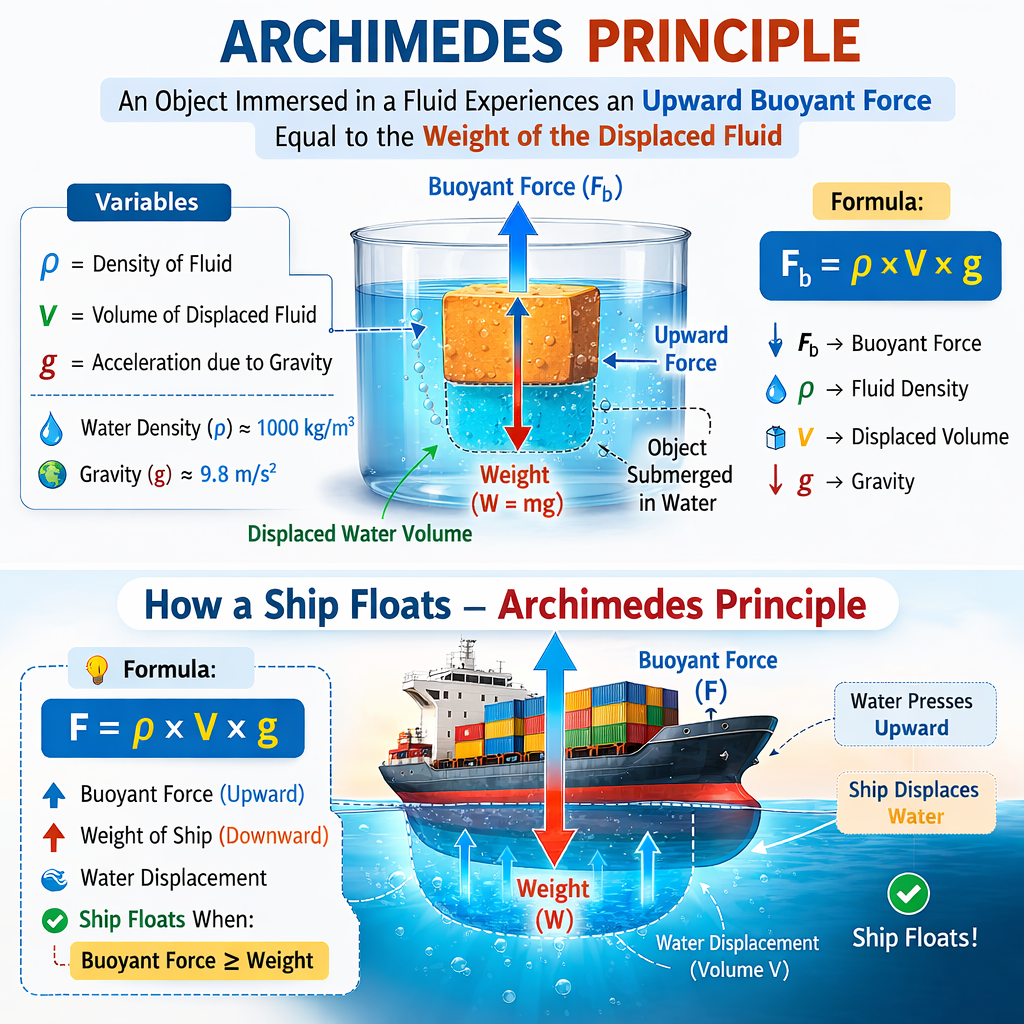
Or in standard physics notation: Fᵦ = ρ × V × g
Where:
- Fᵦ = Buoyant force
- ρ = Density of fluid
- V = Volume of displaced fluid
- g = Acceleration due to gravity
Using this formula manually can sometimes be time-consuming, especially for students solving physics problems or engineers performing fluid calculations. That is where the Archimedes' Principle Calculator becomes extremely useful. With just a few inputs, this buoyancy calculator online instantly computes the correct value.
This calculator is particularly helpful for physics students preparing for exams, engineering calculations, and scientific experiments involving fluid displacement. Many competitive exams such as JEE, NEET, GATE, and other engineering entrance tests frequently include questions related to buoyant force and Archimedes' principle, making this calculator a valuable study companion. 📚
The concept behind Archimedes’ principle was discovered by the Greek mathematician and scientist Archimedes of Syracuse over 2,000 years ago. According to historical accounts, he discovered this principle while taking a bath and noticing that the water level rose when he entered the tub. This observation led him to understand the relationship between displaced fluid volume and buoyant force. The famous moment was marked by his legendary exclamation: “Eureka!” 🎉
Today, Archimedes’ principle forms the foundation of many technologies used in everyday life. It explains why ships float on water, why submarines can dive and resurface, why hot air balloons rise in air, and how hydrometers measure liquid density.
A buoyant force calculator simplifies these calculations by automatically applying the formula when the user enters:
✔ Density of the fluid
✔ Volume of the displaced liquid
✔ Gravitational acceleration
Once the values are entered, the calculator instantly computes the floating force acting on the object.
This Archimedes principle calculator online is extremely useful in many fields including:
- Fluid mechanics
- Marine engineering
- Ship design
- Environmental science
- Hydrology
- Mechanical engineering
For example, engineers designing large ships must ensure that the buoyant force is greater than or equal to the weight of the ship so that it remains afloat. Similarly, submarine engineers adjust the density and displacement of water in ballast tanks to control whether the submarine floats, sinks, or stays neutrally buoyant.
Students studying density and buoyancy concepts often struggle to perform these calculations quickly. This is why the fluid buoyancy calculator provides an efficient way to check answers, verify homework problems, and practice solving physics equations.
Another interesting aspect of Archimedes' principle is that it applies not only to liquids but also to gases. For example, hot air balloons rise because the density of heated air inside the balloon becomes lower than the surrounding air, creating an upward buoyant force.
The Archimedes Principle Calculator on allcalculators.co.in allows users to perform these physics calculations instantly without needing complex formulas or manual computations. Whether you are a student solving physics problems, a teacher explaining buoyancy, or an engineer analyzing floating structures, this calculator provides fast and accurate results. ⚡
By using this tool, users can save time, avoid calculation mistakes, and understand the relationship between density, volume, and buoyant force more clearly.
If you're looking for a reliable buoyant force calculator, fluid displacement calculator, or Archimedes principle physics calculator, this tool provides the fastest and simplest solution.
🌍 Applications of Archimedes' Principle in Daily Life
Archimedes’ principle is not just a theoretical physics concept — it plays a vital role in many real-world technologies and daily activities.
🚢 Ship Floating on Water: Ships weigh thousands of tons, yet they float because the buoyant force produced by water equals the weight of the ship. Ship designers carefully calculate fluid displacement using the Archimedes principle formula.
🛥 Submarine Diving and Surfacing: Submarines control buoyancy using ballast tanks. By filling the tanks with water, they increase density and sink. By pumping air into the tanks, they decrease density and float upward.
🎈 Hot Air Balloons: Hot air balloons rise due to buoyant force in air. Heated air inside the balloon becomes less dense than the surrounding atmosphere, causing the balloon to float upward.
🧪 Hydrometers: Hydrometers measure liquid density based on how deeply they sink in the fluid. This device works entirely on the principle of fluid buoyancy and displaced volume.
🧊 Ice Floating in Water: Ice floats because its density is lower than water. According to Archimedes' principle, the buoyant force balances the weight of the ice before it completely submerges.
🏊 Human Swimming: When humans swim, the water exerts buoyant force on the body, reducing the effective weight and helping the body float.
⚠️ Disclaimer 📢
The Archimedes' Principle Calculator available on allcalculators.co.in is intended for educational, academic, and informational purposes only. While every effort has been made to ensure the accuracy of calculations related to buoyant force, fluid density, and displacement, the results generated by this tool should not be used as a substitute for professional engineering analysis, laboratory measurements, or scientific research calculations.
Users are advised to verify critical calculations independently before applying them in real-world engineering, industrial, or safety-related scenarios. By using this online buoyancy calculator, you acknowledge that the website owners are not responsible for decisions made based on the generated results.
📌 Related Calculator
❓FAQs
❓ What is Archimedes' Principle?
Archimedes' Principle states that a body partially or fully immersed in a fluid experiences an upward buoyant force equal to the weight of the fluid displaced. This principle explains why objects float or sink in liquids.
❓ What does the Archimedes Principle Calculator calculate?
The Archimedes Principle Calculator computes the buoyant force acting on an object immersed in a fluid using the formula: Buoyant Force = Density × Volume × Gravity.
❓ What is the formula of buoyant force?
The formula used in the buoyancy calculator is: F = ρ × V × g
Where
ρ = fluid density
V = displaced volume
g = gravitational acceleration
❓ Why do ships float according to Archimedes’ principle?
Ships float because the buoyant force produced by displaced water equals the weight of the ship, allowing it to stay afloat.
❓ Can Archimedes' principle apply to gases?
Yes. Archimedes’ principle applies to both liquids and gases. For example, hot air balloons float due to buoyant force in air.