
💧 Water Viscosity Calculator
Dynamic Viscosity (μ) of water approximation:
μ = A × 10(B / (T − C))
Kinematic Viscosity:
ν = μ / ρ
Where:
μ = Dynamic viscosity (Pa·s)
ν = Kinematic viscosity (m2/s)
ρ = Density of water (kg/m3)
T = Temperature (°C)
Table of Contents
✍️ Author & Academic Authority: Dr. Nitish Kr. Bharadwaj
📘 Qualifications: B.Sc., B.Ed., M.Sc., Ph.D. (Biochemistry), MBA (Financial Management)
💧 Water Viscosity Calculator – Introduction
Instantly Calculate Viscosity of Water at Different Temperatures
Water is one of the most widely studied fluids in physics, engineering, environmental science, and chemistry. One of its most important physical properties is viscosity, which describes how easily water flows. The Water Viscosity Calculator helps students, engineers, and researchers instantly determine the dynamic viscosity or kinematic viscosity of water at different temperatures using scientifically accepted formulas.
🔬 Viscosity is defined as the internal resistance of a fluid to flow. When water moves through pipes, rivers, pumps, or industrial systems, its viscosity determines how easily it flows. Higher viscosity means the fluid flows more slowly, while lower viscosity means the fluid flows more freely.
For water, viscosity strongly depends on temperature. As temperature increases, the molecules move faster and the fluid becomes less resistant to flow. Therefore, the viscosity of water decreases as temperature increases.
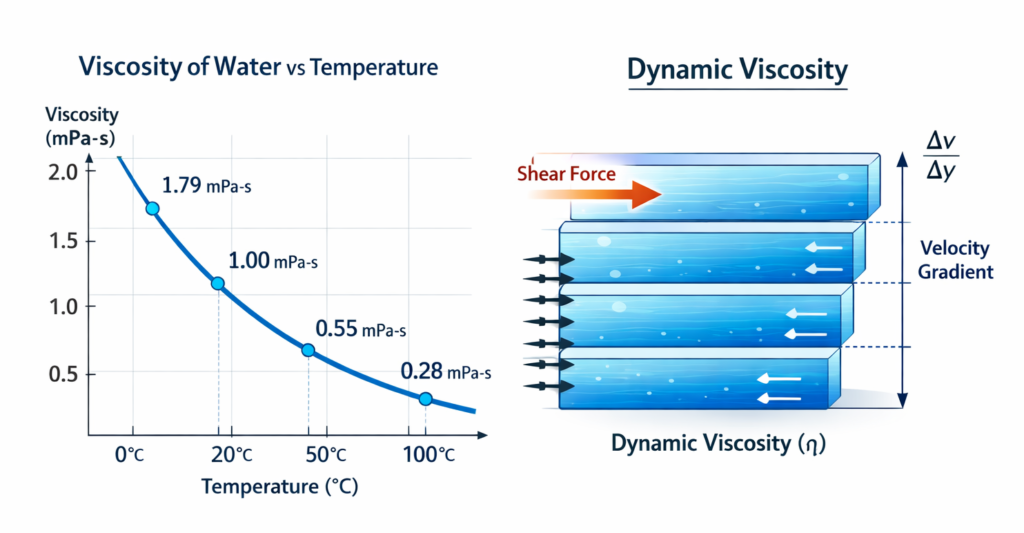
For example:
- At 0°C, water viscosity ≈ 1.79 mPa·s
- At 20°C, water viscosity ≈ 1.00 mPa·s
- At 100°C, water viscosity ≈ 0.28 mPa·s
Because viscosity changes significantly with temperature, scientists and engineers often rely on tools like a Water Viscosity Calculator to obtain precise values quickly.
📘 Understanding Water Viscosity in Physics
In physics and fluid mechanics, viscosity is measured using two main types:
1️⃣ Dynamic Viscosity (μ): Dynamic viscosity measures the internal resistance of a fluid when force is applied. It is defined using Newton’s law of viscosity: μ = Shear Stress / Velocity Gradient
Units of dynamic viscosity include:
- Pascal-seconds (Pa·s)
- milliPascal-seconds (mPa·s)
- centipoise (cP)
For water at room temperature: 1 mPa·s ≈ 1 cP
2️⃣ Kinematic Viscosity (ν): Kinematic viscosity describes how easily a fluid flows under gravity and is calculated using: ν = μ / ρ
Where:
ν = kinematic viscosity
μ = dynamic viscosity
ρ = density of water
Units include:
- m²/s
- centistokes (cSt)
At 20°C, water has a kinematic viscosity of approximately 1.004 × 10⁻⁶ m²/s.
🌡️ Temperature Dependence of Water Viscosity: Water viscosity changes dramatically with temperature due to molecular motion.
When temperature rises:
🔥 Molecular energy increases
💧 Hydrogen bonds weaken
⚡ Flow resistance decreases
As a result, viscosity drops rapidly.
Scientists often use empirical formulas to estimate viscosity across temperatures.
One common approximation used in calculators is: μ = A × 10(B/(T − C))
Where:
μ = viscosity
T = temperature
A, B, C = empirical constants
Using such equations allows the Water Viscosity Calculator to deliver accurate results for various scientific calculations.
🔬 Importance in Fluid Mechanics
Viscosity plays a major role in fluid dynamics and determines whether flow is laminar or turbulent. Engineers often use viscosity values when calculating:
- Reynolds number
- Pipe flow resistance
- Pump power requirements
- Heat transfer efficiency
Because water is used in nearly every industrial process, knowing its viscosity is essential for designing efficient systems.
🧮 How This Water Viscosity Calculator Works
This online tool calculates viscosity using temperature-dependent fluid property equations. Simply enter the required values such as:
🌡️ Temperature of water
⚙️ Density (if needed)
Then the calculator instantly outputs:
✔ Dynamic viscosity
✔ Kinematic viscosity
✔ Scientific units
The results help students and professionals solve problems related to fluid flow, hydrodynamics, and thermodynamics.
🌍 Applications in Daily Life
Although viscosity is often studied in physics laboratories, it affects many real-world systems we encounter daily.
🚰 Water Supply Systems: Municipal water pipelines rely on viscosity calculations to determine pressure loss and flow rate. Engineers use water viscosity values to design efficient plumbing networks.
🚗 Automotive Cooling Systems: Car engines use water-based coolants. The viscosity of water influences how efficiently coolant circulates through the engine radiator.
🌾 Agriculture & Irrigation: Farm irrigation systems rely on accurate water flow calculations. Viscosity determines how easily water travels through irrigation pipes and channels.
🏭 Industrial Processes: Factories use water for cooling, cleaning, and chemical reactions. Engineers calculate viscosity to optimize heat exchangers, pumps, and pipelines.
🌊 Environmental Studies: Scientists studying rivers, lakes, and oceans use viscosity data to understand water movement, sediment transport, and pollution dispersion.
🧪 Laboratory Experiments: Physics and chemistry students frequently calculate water viscosity vs temperature during experiments involving fluid dynamics and molecular motion.
⚠️ Disclaimer
The Water Viscosity Calculator on AllCalculators.co.in is designed for educational and informational purposes only.
📚 Results generated by this tool are based on standard physics equations and empirical data commonly used in fluid mechanics.
However: ❗ Minor variations may occur due to temperature measurement accuracy, environmental conditions, or rounding.
Therefore:
✔ Always verify results before using them in engineering design, scientific research, or industrial applications.
✔ This calculator should be used as a learning and estimation tool, not a substitute for professional engineering calculations.
Using this tool means you acknowledge that the website is not liable for any decisions made using the results.
📌 Related Calculator
❓FAQs
💧 What is the viscosity of water at room temperature?
At 20°C (room temperature), the dynamic viscosity of water is approximately 1.002 mPa·s (or 1 centipoise).
🌡️ Why does water viscosity decrease with temperature?
As temperature increases, water molecules move faster and intermolecular forces weaken, reducing resistance to flow. This causes the viscosity of water to decrease.
🧮 How does a Water Viscosity Calculator work?
A water viscosity calculator uses temperature-dependent formulas and empirical constants to compute dynamic viscosity or kinematic viscosity instantly.
🔬 What is the difference between dynamic viscosity and kinematic viscosity?
Dynamic viscosity measures fluid resistance to shear, while kinematic viscosity considers fluid density and describes how easily the fluid flows under gravity.
📚 Why is viscosity important in physics?
Viscosity is essential in fluid mechanics because it determines flow behavior, energy loss, turbulence, and heat transfer in liquids like water.