
🧪 Stokes’ Law Calculator
v = (2 r2 (ρs − ρf) g) / (9 η)
Where:
v = Terminal Velocity
r = Radius of Sphere
ρs = Density of Sphere
ρf = Density of Fluid
η = Viscosity of Fluid
g = Acceleration due to gravity
Table of Contents
✍️ Author & Academic Authority: Dr. Nitish Kr. Bharadwaj
📘 Qualifications: B.Sc., B.Ed., M.Sc., Ph.D. (Biochemistry), MBA (Financial Management)
🧪 Stokes’ Law Calculator – Introduction
Instantly Calculate Drag Force, Terminal Velocity & Fluid Viscosity ⚛️
Understanding how tiny particles move through liquids or gases is an essential concept in fluid mechanics and physics. The Stokes’ Law Calculator is a powerful physics tool designed to help students, engineers, and researchers easily compute drag force, terminal velocity, and viscosity relationships for small spherical particles moving through a viscous fluid.
Whether you’re solving sedimentation problems in physics, analyzing particle motion in fluids, or conducting laboratory experiments, this calculator makes complex calculations quick and accurate. 🚀
📘 What is Stokes’ Law?
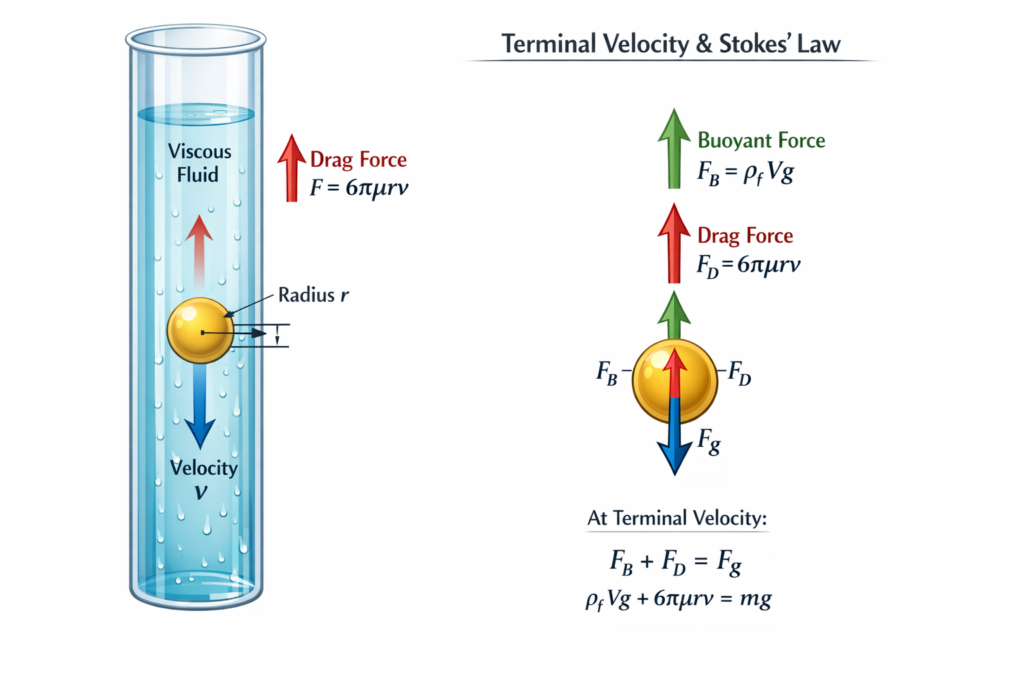
Stokes’ Law is a fundamental equation in fluid dynamics that describes the drag force experienced by a small spherical particle moving through a viscous fluid. It was derived by the famous Irish physicist George Gabriel Stokes in 1851.
The law applies when:
✔ The particle is spherical
✔ The flow is laminar
✔ Reynolds number is very small
✔ The particle moves slowly in a viscous fluid
The mathematical expression for Stokes’ Law is: F = 6πμrv
Where:
- F = Drag force acting on the particle
- μ (mu) = Dynamic viscosity of the fluid
- r = Radius of the particle
- v = Velocity of the particle
- π = Mathematical constant (~3.1416)
This equation helps determine how much resistance a fluid exerts on a moving particle.
Our Stokes’ Law Calculator instantly calculates the result once you input the required parameters.
⚙️ How the Stokes’ Law Calculator Works
The online Stokes Law calculator simplifies complex physics equations into an easy-to-use interface.
Users simply enter:
🔹 Fluid viscosity
🔹 Particle radius
🔹 Velocity of the particle
The calculator automatically computes the drag force acting on the particle.
This eliminates manual calculations and reduces the chances of mistakes in physics assignments or research work.
🔬 Understanding Terminal Velocity Using Stokes Law
One of the most important uses of Stokes’ Law is determining terminal velocity.
Terminal velocity occurs when the gravitational force pulling a particle downward equals the drag force pushing upward.
The formula for terminal velocity is: v = (2 r² (ρp − ρf) g) / (9 μ)
Where:
- v = Terminal velocity
- r = Particle radius
- ρp = Density of particle
- ρf = Density of fluid
- g = Acceleration due to gravity
- μ = Dynamic viscosity
This formula is widely used in:
✔ Sedimentation analysis
✔ Fluid dynamics experiments
✔ Environmental science studies
Using our Terminal Velocity Stokes Law Calculator, you can easily determine the speed at which particles settle in fluids.
🧠 When Does Stokes’ Law Apply?
The equation works only under specific fluid conditions.
Stokes’ Law assumptions include:
✔ Particle must be perfectly spherical
✔ Fluid flow must be laminar
✔ Reynolds number must be less than 1
✔ Particle must be small relative to the container
If these conditions are not satisfied, the drag force may deviate from the predicted value.
🎓 Who Should Use This Calculator?
This Stokes Law physics calculator is particularly helpful for:
📚 Physics students
🧑🔬 Laboratory researchers
👩🏫 Teachers explaining fluid mechanics
🧑🔧 Engineering students
🌍 Environmental scientists
Students preparing for exams in fluid mechanics, classical mechanics, and physics lab work can greatly benefit from this tool.
🌍Applications in Daily Life
Although Stokes’ Law is a physics concept, it has many practical real-world applications.
🧪 Laboratory Experiments: Physics laboratories frequently use Stokes’ Law experiments to measure the viscosity of liquids by observing how small spheres fall through fluids.
🌊 Sedimentation in Water Treatment: Water purification plants rely on particle settling velocity calculations to remove suspended particles from water using sedimentation tanks.
🧫 Blood Flow & Medical Science: Stokes’ Law helps researchers understand particle movement in blood plasma and other biological fluids.
🏭 Industrial Particle Separation: Industries use settling velocity calculations to separate particles in:
✔ Chemical processing
✔ Oil refineries
✔ Food production plants
🌎 Environmental Science: Scientists use Stokes Law sedimentation calculations to analyze how dust particles settle in the atmosphere or water bodies.
🧊 Rainfall Formation: Meteorologists apply Stokes’ Law terminal velocity principles to understand how water droplets fall through the atmosphere during rainfall.
⚠️ Disclaimer
The Stokes’ Law Calculator on AllCalculators.co.in is designed for educational and informational purposes only.
While the calculator provides highly accurate results based on standard physics formulas, the results may vary depending on real-world conditions such as turbulence, particle shape irregularities, and fluid flow variations.
Users should verify results before applying them in scientific research, engineering projects, or industrial processes.
AllCalculators.co.in is not responsible for decisions made based on calculator results. Always consult textbooks, instructors, or professional engineers for critical applications.
📌 Related Calculators
❓FAQs
❓ What is Stokes’ Law in physics?
Stokes’ Law is a formula that calculates the drag force acting on a spherical particle moving through a viscous fluid. It is widely used in fluid mechanics, sedimentation analysis, and viscosity experiments.
❓ What is terminal velocity in Stokes’ Law?
Terminal velocity is the maximum constant velocity a particle reaches while falling through a fluid when drag force balances gravitational force.
❓ What does the Stokes Law Calculator calculate?
The Stokes Law Calculator calculates the drag force on a particle in a viscous fluid using the equation: F = 6πμrv.
❓ When is Stokes’ Law valid?
Stokes’ Law works when:
✔ Flow is laminar
✔ Reynolds number is less than 1
✔ Particle is spherical
✔ Velocity is relatively low
❓ Why is Stokes’ Law important in fluid mechanics?
Stokes’ Law helps scientists understand particle motion, sedimentation, viscosity measurement, and fluid resistance in many engineering and scientific fields.