
🌬️ Air Density Calculator
ρ = P / (R × T)
Where:
ρ = Air Density (kg/m3)
P = Pressure (Pa)
R = Specific Gas Constant for Dry Air = 287.05 J/(kg·K)
T = Temperature (Kelvin)
Table of Contents
✍️ Author & Academic Authority: Dr. Nitish Kr. Bharadwaj
📘 Qualifications: B.Sc., B.Ed., M.Sc., Ph.D. (Biochemistry), MBA (Financial Management)
🌬️ Air Density Calculator – Introduction
Instantly Calculate Density of Air at Any Temperature, Pressure & Altitude
Air density plays a crucial role in physics, engineering, aviation, meteorology, and environmental science. The Air Density Calculator helps students, engineers, pilots, and researchers easily determine the density of air based on temperature, pressure, and humidity without complex manual calculations. 🚀
Air density refers to the mass of air molecules per unit volume, typically expressed in kg/m³ (kilograms per cubic meter). In simple terms, it tells us how heavy the air is in a given space. The value of air density changes depending on temperature, altitude, atmospheric pressure, and humidity.
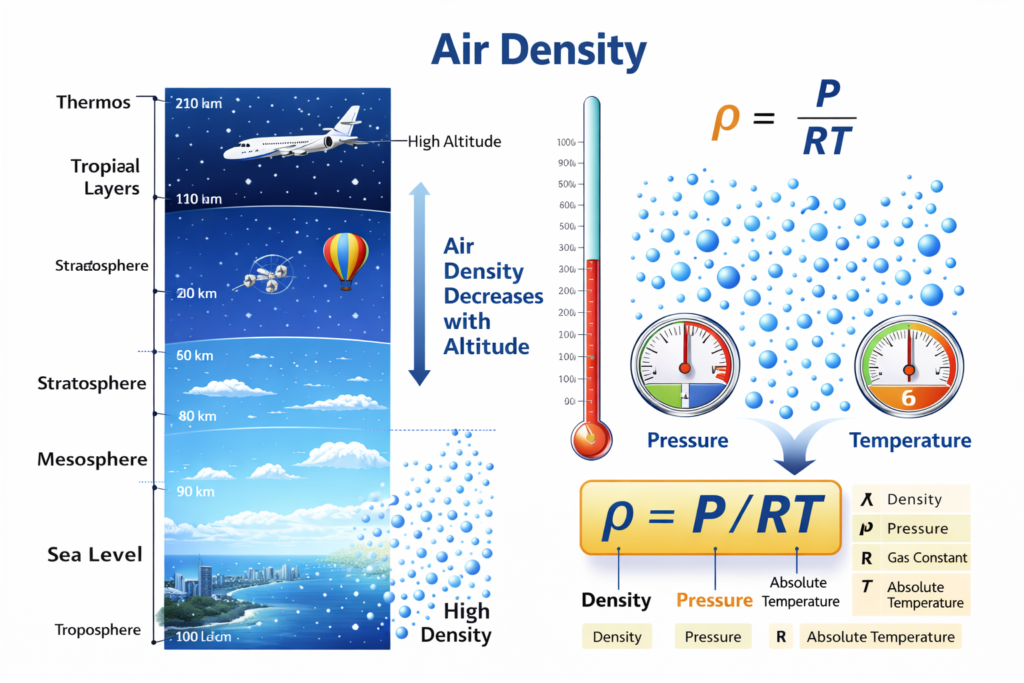
At standard atmospheric conditions (15°C temperature and 1 atm pressure), the standard air density value is approximately 1.225 kg/m³. However, as environmental conditions change, the density of air also changes.
For example:
🌡️ Higher Temperature → Lower Air Density
🏔️ Higher Altitude → Lower Air Density
📉 Lower Pressure → Lower Air Density
These relationships make air density calculations extremely important in many real-world applications.
📘 Air Density Formula
The density of air can be calculated using the ideal gas law: ρ = P / (R × T)
Where:
ρ = Air density (kg/m³)
P = Atmospheric pressure (Pa)
R = Specific gas constant for dry air (287.05 J/kg·K)
T = Absolute temperature (Kelvin)
This equation allows scientists and engineers to calculate the density of air accurately based on environmental conditions.
Our online Air Density Calculator automates this formula so you can instantly compute air density without manual calculations.
🌎 Why Air Density Matters
Air density influences many natural phenomena and technological systems.
For instance, aircraft performance depends heavily on air density. When air density decreases at high altitudes or high temperatures, aircraft wings generate less lift. This is why planes require longer runways in hot weather or high-altitude airports.
Similarly, air density affects weather patterns, wind movement, and climate modeling. Meteorologists use air density data to predict storm formation, pressure systems, and atmospheric circulation.
In engineering and physics, air density calculations are necessary when analyzing aerodynamics, fluid dynamics, drag forces, and airflow systems.
⚙️ How the Air Density Calculator Works
The calculator uses the standard air density equation derived from the ideal gas law.
You simply input:
✔️ Temperature
✔️ Atmospheric Pressure
✔️ Altitude (optional in advanced calculations)
The calculator then processes these values and provides the accurate air density value instantly.
This eliminates:
❌ Manual formula calculations
❌ Unit conversion errors
❌ Time-consuming physics equations
Instead, users receive instant, reliable results within seconds.
📊 Factors Affecting Air Density
🌡️ Temperature: Temperature has a major influence on air density. As temperature increases, air molecules move faster and spread apart, making air less dense.
📉 Pressure: Higher pressure compresses air molecules closer together, resulting in higher air density.
🏔️ Altitude: At higher altitudes, atmospheric pressure decreases, causing air density to drop significantly.
💧 Humidity: Moist air actually becomes less dense than dry air because water vapor molecules are lighter than nitrogen and oxygen molecules.
🚀 Advantages of Using This Online Calculator
Using this free Air Density Calculator offers several benefits:
⚡ Instant results
📱 Mobile-friendly calculations
📊 Accurate physics-based formulas
🎓 Perfect for students and engineers
🌍 Useful for aviation and weather analysis
Instead of solving complicated equations manually, users can calculate air density instantly using this tool.
🔬 Standard Air Density Value
Under standard atmospheric conditions:
Temperature = 15°C
Pressure = 101325 Pa
Humidity = 0%
The standard density of air is: 1.225 kg/m³
This value is widely used in aerodynamics calculations, aircraft design, and atmospheric physics.
🌍 Applications of Air Density in Daily Life
Air density is not just a theoretical physics concept. It affects many real-world systems and technologies.
✈️ Aviation: Pilots and aerospace engineers use air density calculations to determine aircraft lift, fuel efficiency, and runway length requirements.
🌦️ Weather Forecasting: Meteorologists use air density data to predict storms, wind patterns, and atmospheric pressure changes.
🚗 Vehicle Aerodynamics: Car designers calculate air density to understand drag forces and fuel efficiency.
⚡ Wind Energy: Wind turbines rely on accurate air density values to estimate potential power generation.
🏗️ Engineering & Construction: Air density affects ventilation systems, HVAC design, and airflow simulations.
🏃 Sports Performance; Athletes, especially cyclists and runners, experience different aerodynamic resistance depending on air density.
⚠️ Disclaimer
The Air Density Calculator available on this website is designed for educational, academic, and general informational purposes only.
While the calculator uses scientifically accurate formulas from physics and atmospheric science, results may vary depending on environmental assumptions such as humidity, altitude variations, and measurement accuracy. Users should not rely solely on this calculator for professional engineering design, aviation planning, or safety-critical calculations. For critical applications, always consult certified engineers, meteorological services, or scientific professionals. By using this tool, you agree that the website allcalculators.co.in is not responsible for any decisions made based on the calculator results.
📌 Related Calculator
❓FAQs
❓ What is air density?
Air density is the mass of air per unit volume, typically measured in kg/m³, and depends on temperature, pressure, and humidity.
❓ What is the standard air density value?
The standard density of air at sea level is approximately 1.225 kg/m³ at 15°C and 1 atm pressure.
❓ How do you calculate air density?
Air density can be calculated using the formula: ρ = P / (R × T)
Where P is pressure, R is the gas constant, and T is temperature in Kelvin.
❓ Why does air density decrease with altitude?
As altitude increases, atmospheric pressure decreases, causing air molecules to spread apart and reduce density.
❓ Why is air density important in aviation?
Air density affects aircraft lift, engine performance, and runway requirements, making it critical for flight safety.