
⚡ Photoelectric Effect Calculator
E = hν
KEmax = hν − φ
eV = KEmax
Where:
h = Planck’s Constant (6.626 × 10⁻³⁴ J·s)
ν = Frequency of Light
φ = Work Function
eV = Stopping Potential Energy
Table of Contents
✍️ Author & Academic Authority: Dr. Nitish Kr. Bharadwaj
📘 Qualifications: B.Sc., B.Ed., M.Sc., Ph.D. (Biochemistry), MBA (Financial Management)
⚡ Photoelectric Effect Calculator – Introduction
Instantly Calculate Photon Energy, Work Function & Electron Kinetic Energy
The Photoelectric Effect Calculator is a powerful physics tool designed to help students, researchers, and science enthusiasts quickly solve problems related to the photoelectric effect equation. This phenomenon is one of the most important concepts in quantum physics, explaining how light can eject electrons from the surface of metals. With the help of this calculator, users can easily determine values such as photon energy, work function, frequency, wavelength, stopping potential, and kinetic energy of emitted electrons without performing lengthy manual calculations.
The photoelectric effect was first explained by Albert Einstein in 1905, a discovery that later earned him the Nobel Prize in Physics in 1921. Einstein showed that light behaves not only as a wave but also as a stream of tiny energy packets called photons. When these photons hit a metal surface with sufficient energy, they transfer energy to electrons, allowing them to escape from the metal surface. This process is the foundation of many modern technologies, including solar panels, light sensors, night vision devices, and photo detectors.
The mathematical representation of the photoelectric effect is known as the Einstein photoelectric equation:
E = hf = Φ + KE
Where:
E = Energy of the photon
h = Planck’s constant
f = Frequency of the incident light
Φ = Work function of the metal
KE = Maximum kinetic energy of the emitted electron
⚛️ Diagram showing Photoelectric Effect
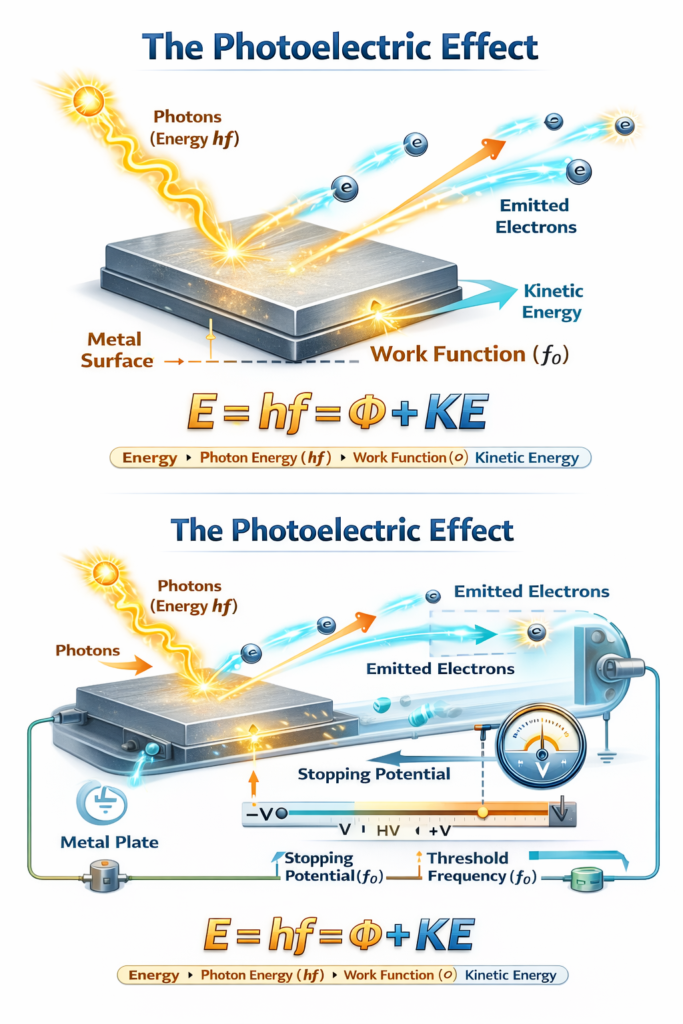
Using a photoelectric effect formula calculator, users can solve for any unknown parameter in the equation. For example, if the frequency of incident light and work function are known, the calculator can determine the maximum kinetic energy of the emitted electron. Similarly, it can also compute the threshold frequency, which is the minimum frequency required to eject electrons from a metal surface.
A major advantage of using an online photoelectric effect calculator is that it eliminates calculation errors while saving time during exams, homework, and laboratory work. Physics students often struggle with unit conversions between frequency, wavelength, energy, and electron volts, but this calculator automatically handles those conversions.
The concept of the photoelectric effect also proved a fundamental idea of quantum mechanics, demonstrating that energy exchange occurs in discrete packets instead of continuous waves. This revolutionary concept challenged classical physics and opened the door to the development of modern quantum theory.
A typical photoelectric equation calculator works by allowing users to input variables such as:
• Frequency of incident light
• Wavelength of light
• Work function of the material
• Stopping potential
• Planck’s constant value
Once these values are entered, the calculator computes the missing variable instantly using standard physics equations for photoelectric emission.
Another important concept related to the photoelectric effect is the threshold frequency. If the frequency of incoming light is below this value, no electrons will be emitted regardless of light intensity. This phenomenon confirms that light energy is quantized.
The stopping potential is also a critical parameter. It refers to the minimum electric potential required to stop emitted electrons from reaching the collector plate. Using a stopping potential calculator, students can determine the kinetic energy of electrons through the relation: KE = eV₀
Where:
e = electron charge
V₀ = stopping potential
The photoelectric effect calculator simplifies all these complex formulas into a single interactive tool. Instead of solving multiple steps manually, users can instantly compute answers for physics problems related to photon energy, electron emission, frequency, wavelength, and kinetic energy.
Such tools are especially useful for high school physics, IIT-JEE preparation, NEET aspirants, engineering students, and university physics courses. Teachers also use these calculators to demonstrate real-time results during lectures.
Moreover, understanding the photoelectric effect is essential for learning about semiconductors, solar cells, CCD cameras, and photomultiplier tubes. It is one of the core principles behind converting light energy into electrical energy.
By using a reliable photoelectric effect online calculator, users can better visualize how energy from photons interacts with electrons at the atomic level. This not only enhances conceptual understanding but also improves problem-solving speed.
Whether you are preparing for physics exams, conducting research, or simply curious about quantum mechanics, the Photoelectric Effect Calculator is an essential educational tool that makes complex quantum physics calculations fast, accurate, and easy to understand.
🌍 Applications in Daily Life
The photoelectric effect principle is widely used in modern technology and plays an important role in everyday life. Some major applications include:
🔆 Solar Panels (Photovoltaic Cells): Solar cells convert sunlight into electricity using the photoelectric effect principle. Photons strike semiconductor materials and release electrons, generating electrical current.
📷 Digital Cameras & Image Sensors: Modern cameras use photoelectric sensors (CCD and CMOS) to convert incoming light into electrical signals that form digital images.
🚪 Automatic Doors & Motion Sensors: Many security systems and automatic doors rely on photoelectric sensors to detect interruptions in light beams.
🌙 Night Vision Devices: Night vision equipment amplifies small amounts of light using photoelectric emission to help users see in darkness.
🔬 Scientific Instruments: Devices such as photomultiplier tubes, spectrometers, and light detectors depend on the photoelectric effect to measure light intensity accurately.
💡 Street Light Automation: Light sensors in street lights use the photoelectric effect to automatically switch lights on at night and off during the day.
⚠️ Disclaimer
The Photoelectric Effect Calculator provided on this website is designed for educational and informational purposes only. While every effort has been made to ensure the accuracy of formulas and calculations, the results generated by this tool should be used as reference values only. Users are advised to verify results when performing scientific research, academic assignments, or laboratory experiments.
This calculator simplifies complex quantum physics equations, but it may not account for all real-world variables or experimental conditions. The website and its creators are not responsible for any decisions or actions taken based on the results obtained from this tool. By using this calculator, you agree that the tool is intended to assist with learning, conceptual understanding, and quick calculations in physics.
📌 Related Calculator
❓FAQs
❓ What is the photoelectric effect in physics?
The photoelectric effect is a phenomenon where electrons are emitted from a metal surface when light with sufficient frequency strikes it. The energy of the photons must exceed the work function of the material.
❓ What does the Photoelectric Effect Calculator calculate?
A photoelectric effect calculator can compute photon energy, electron kinetic energy, work function, stopping potential, threshold frequency, and wavelength using the Einstein photoelectric equation.
❓ What is the formula for the photoelectric effect?
The standard photoelectric equation is: E = hf = Φ + KE; Where hf is photon energy, Φ is work function, and KE is the maximum kinetic energy of emitted electrons.
❓ What is threshold frequency?
The threshold frequency is the minimum frequency of light required to eject electrons from a metal surface. Below this frequency, the photoelectric effect does not occur.
❓ Why did Einstein win the Nobel Prize for the photoelectric effect?
Einstein received the 1921 Nobel Prize in Physics for explaining the photoelectric effect, proving that light behaves as discrete packets of energy called photons.